
SARS-CoV-2 谱系 B.1.1.7 出现的时空入侵动态。
Spatiotemporal invasion dynamics of SARS-CoV-2 lineage B.1.1.7 emergence.
机构信息
Instituto de Medicina Tropical, Faculdade de Medicina da Universidade de Sao Paulo, Sao Paulo, Brazil.
Department of Zoology, University of Oxford, Oxford, UK.
出版信息
Science. 2021 Aug 20;373(6557):889-895. doi: 10.1126/science.abj0113. Epub 2021 Jul 22.
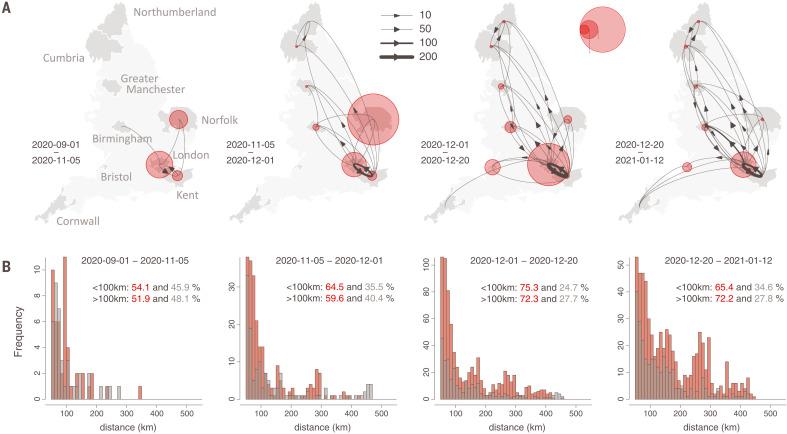
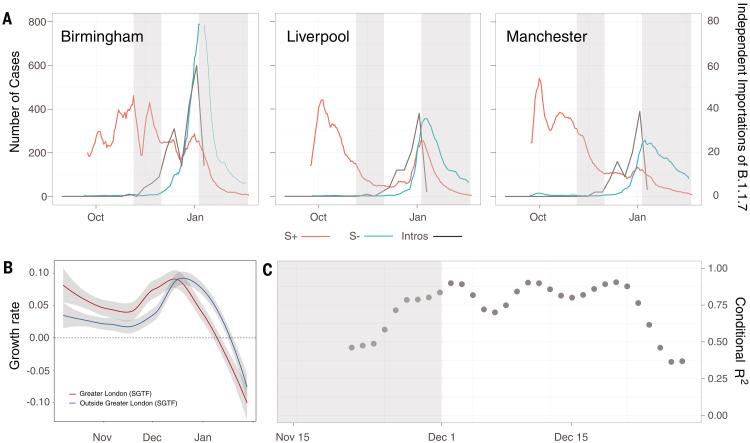
Understanding the causes and consequences of the emergence of severe acute respiratory syndrome coronavirus 2 (SARS-CoV-2) variants of concern is crucial to pandemic control yet difficult to achieve because they arise in the context of variable human behavior and immunity. We investigated the spatial invasion dynamics of lineage B.1.1.7 by jointly analyzing UK human mobility, virus genomes, and community-based polymerase chain reaction data. We identified a multistage spatial invasion process in which early B.1.1.7 growth rates were associated with mobility and asymmetric lineage export from a dominant source location, enhancing the effects of B.1.1.7's increased intrinsic transmissibility. We further explored how B.1.1.7 spread was shaped by nonpharmaceutical interventions and spatial variation in previous attack rates. Our findings show that careful accounting of the behavioral and epidemiological context within which variants of concern emerge is necessary to interpret correctly their observed relative growth rates.
了解严重急性呼吸综合征冠状病毒 2(SARS-CoV-2)引起关注的变异株出现的原因和后果对于大流行控制至关重要,但由于它们是在人类行为和免疫的变化背景下出现的,因此难以实现。我们通过联合分析英国的人类流动性、病毒基因组和基于社区的聚合酶链反应数据,研究了谱系 B.1.1.7 的空间入侵动态。我们确定了一个多阶段的空间入侵过程,其中早期 B.1.1.7 的增长率与流动性和来自主要来源地的不对称谱系输出有关,从而增强了 B.1.1.7 固有传染性增加的影响。我们进一步探讨了非药物干预措施以及先前攻击率的空间变化如何塑造 B.1.1.7 的传播。我们的研究结果表明,有必要仔细考虑引起关注的变异株出现的行为和流行病学背景,以便正确解释它们观察到的相对增长率。


 Zotero 插件