
CR-I-TASSER:使用深度卷积神经网络从冷冻电镜密度图中组装蛋白质结构。
CR-I-TASSER: assemble protein structures from cryo-EM density maps using deep convolutional neural networks.
机构信息
Department of Computational Medicine and Bioinformatics, University of Michigan Medical School, Ann Arbor, MI, USA.
Department of Biological Chemistry, University of Michigan Medical School, Ann Arbor, MI, USA.
出版信息
Nat Methods. 2022 Feb;19(2):195-204. doi: 10.1038/s41592-021-01389-9. Epub 2022 Feb 7.
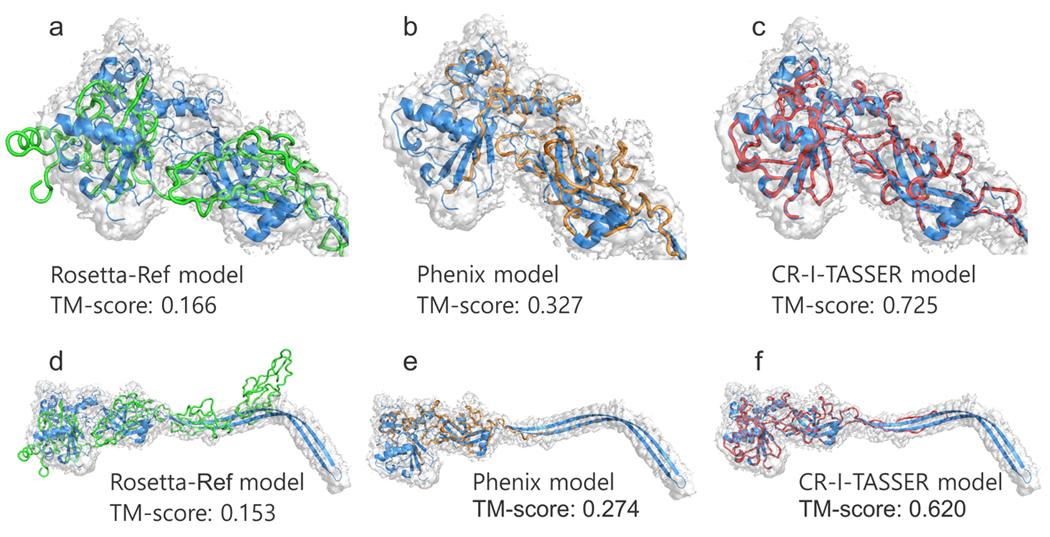
Cryo-electron microscopy (cryo-EM) has become a leading approach for protein structure determination, but it remains challenging to accurately model atomic structures with cryo-EM density maps. We propose a hybrid method, CR-I-TASSER (cryo-EM iterative threading assembly refinement), which integrates deep neural-network learning with I-TASSER assembly simulations for automated cryo-EM structure determination. The method is benchmarked on 778 proteins with simulated and experimental density maps, where CR-I-TASSER constructs models with a correct fold (template modeling (TM) score >0.5) for 643 targets that is 64% higher than the best of some other de novo and refinement-based approaches on high-resolution data samples. Detailed data analyses showed that the main advantage of CR-I-TASSER lies in the deep learning-based Cα position prediction, which significantly improves the threading template quality and therefore boosts the accuracy of final models through optimized fragment assembly simulations. These results demonstrate a new avenue to determine cryo-EM protein structures with high accuracy and robustness covering various target types and density map resolutions.
冷冻电镜(cryo-EM)已成为蛋白质结构测定的主要方法,但仍难以准确地用 cryo-EM 密度图来模拟原子结构。我们提出了一种混合方法,CR-I-TASSER(cryo-EM 迭代穿线组装精修),它将深度神经网络学习与 I-TASSER 组装模拟相结合,用于自动化 cryo-EM 结构测定。该方法在 778 个具有模拟和实验密度图的蛋白质上进行了基准测试,其中 CR-I-TASSER 为 643 个目标构建了具有正确折叠的模型(模板建模(TM)得分>0.5),比其他一些从头开始和基于精修的方法在高分辨率数据样本上的最佳结果高 64%。详细的数据分析表明,CR-I-TASSER 的主要优势在于基于深度学习的 Cα 位置预测,这显著提高了穿线模板的质量,从而通过优化的片段组装模拟提高最终模型的准确性。这些结果表明了一种新的途径,可以用高准确性和鲁棒性来确定 cryo-EM 蛋白质结构,涵盖各种目标类型和密度图分辨率。


 Zotero 插件