
基于代理的方法模拟 SARS-CoV-2 在澳大利亚和新西兰的疾病进展:支持公共卫生决策的报告。
Modelling SARS-CoV-2 disease progression in Australia and New Zealand: an account of an agent-based approach to support public health decision-making.
机构信息
Transport, Health and Urban Design (THUD) Research Lab, The University of Melbourne, Victoria.
Faculty of Medicine and Health, The University of New England, New South Wales.
出版信息
Aust N Z J Public Health. 2022 Jun;46(3):292-303. doi: 10.1111/1753-6405.13221. Epub 2022 Mar 3.
OBJECTIVE
In 2020, we developed a public health decision-support model for mitigating the spread of SARS-CoV-2 infections in Australia and New Zealand. Having demonstrated its capacity to describe disease progression patterns during both countries' first waves of infections, we describe its utilisation in Victoria in underpinning the State Government's then 'RoadMap to Reopening'.
METHODS
Key aspects of population demographics, disease, spatial and behavioural dynamics, as well as the mechanism, timing, and effect of non-pharmaceutical public health policies responses on the transmission of SARS-CoV-2 in both countries were represented in an agent-based model. We considered scenarios related to the imposition and removal of non-pharmaceutical interventions on the estimated progression of SARS-CoV-2 infections.
RESULTS
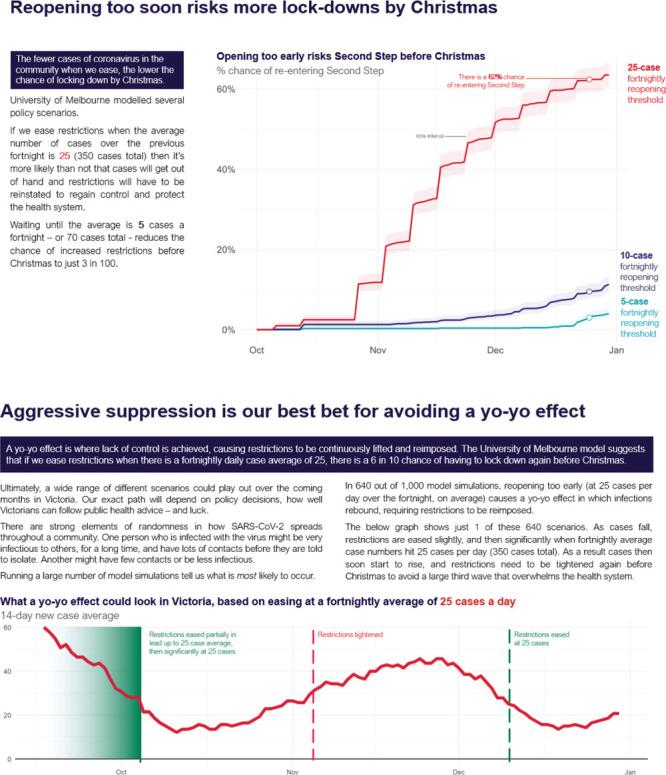
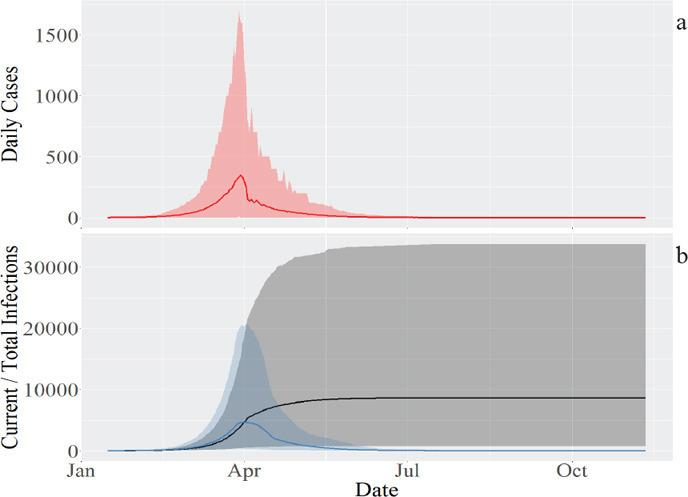
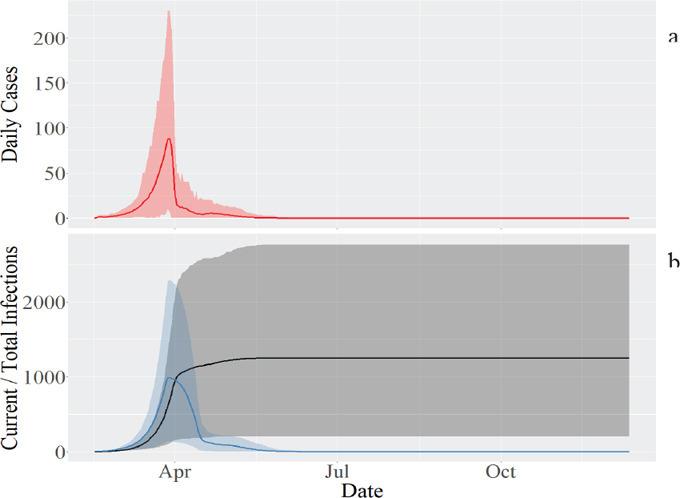
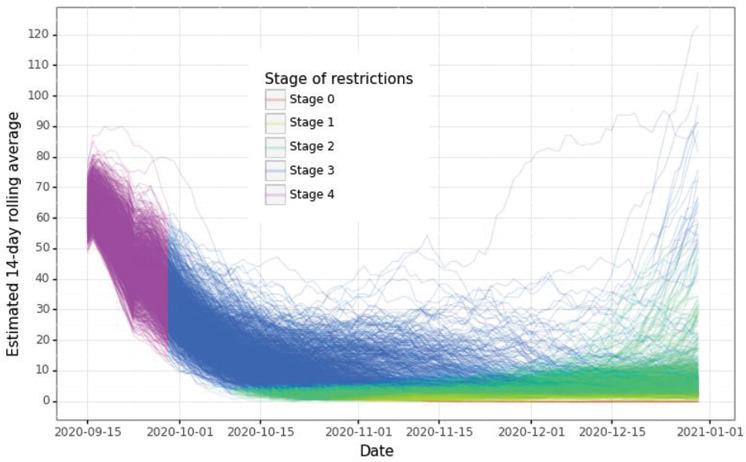
Wave 1 results suggested elimination of community transmission of SARS-CoV-2 was possible in both countries given sustained public adherence to social restrictions beyond 60 days' duration. However, under scenarios of decaying adherence to restrictions, a second wave of infections (Wave 2) was predicted in Australia. In Victoria's second wave, we estimated in early September 2020 that a rolling 14-day average of <5 new cases per day was achievable on or around 26 October. Victoria recorded a 14-day rolling average of 4.6 cases per day on 25 October.
CONCLUSIONS
Elimination of SARS-CoV-2 transmission represented in faithfully constructed agent-based models can be replicated in the real world.
IMPLICATIONS FOR PUBLIC HEALTH
Agent-based public health policy models can be helpful to support decision-making in novel and complex unfolding public health crises.
目的
2020 年,我们开发了一种公共卫生决策支持模型,以减轻 SARS-CoV-2 在澳大利亚和新西兰的传播。该模型在两国首次感染期间展示了描述疾病进展模式的能力,在此基础上,我们描述了它在维多利亚州支持州政府“重新开放路线图”时的应用。
方法
基于代理的模型中体现了人口统计学、疾病、空间和行为动态的关键方面,以及非药物公共卫生政策对两国 SARS-CoV-2 传播的影响机制、时间和效果。我们考虑了与非药物干预的实施和取消相关的情景,以估计 SARS-CoV-2 感染的进展情况。
结果
第一波结果表明,如果公众持续遵守社会限制措施超过 60 天,两国都有可能消除 SARS-CoV-2 的社区传播。然而,在限制措施遵守度下降的情况下,预计澳大利亚将出现第二波感染(第二波)。在维多利亚州的第二波疫情中,我们估计在 2020 年 9 月初,每天新发病例数<5 例的滚动 14 天平均值可在 10 月 26 日或前后达到。维多利亚州在 10 月 25 日记录的 14 天滚动平均每天有 4.6 例病例。
结论
忠实构建的基于代理的模型中可以复制 SARS-CoV-2 传播的消除。
对公共卫生的影响
基于代理的公共卫生政策模型有助于支持在新出现的复杂公共卫生危机中做出决策。




 Zotero 插件