
斑马鱼中α-半乳糖苷酶A活性降低(反映了法布里肾病表型的独特特征)。 (注:括号内为补充完整语义后的内容,原文括号缺失)
Reduced α-galactosidase A activity in zebrafish ( mirrors distinct features of Fabry nephropathy phenotype.
作者信息
Elsaid Hassan O A, Furriol Jessica, Blomqvist Maria, Diswall Mette, Leh Sabine, Gharbi Naouel, Anonsen Jan Haug, Babickova Janka, Tøndel Camilla, Svarstad Einar, Marti Hans-Peter, Krause Maximilian
机构信息
Department of Clinical Medicine, University of Bergen, Bergen, Norway.
Department of Medicine, Haukeland University Hospital, Bergen, Norway.
出版信息
Mol Genet Metab Rep. 2022 Feb 17;31:100851. doi: 10.1016/j.ymgmr.2022.100851. eCollection 2022 Jun.
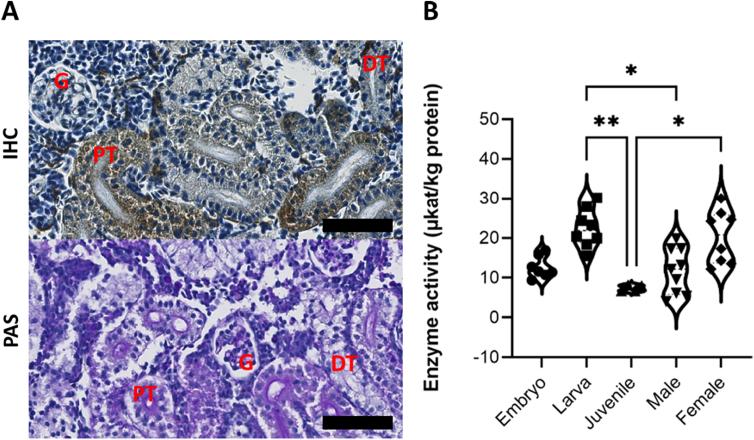
Fabry disease (FD) is a rare genetic lysosomal storage disorder, resulting from partial or complete lack of alpha-galactosidase A (α-GAL) enzyme, leading to systemic accumulation of substrate glycosphingolipids with a broad range of tissue damage. Current models are laborious, expensive, and fail to adequately mirror the complex FD physiopathology. To address these issues, we developed an innovative FD model in zebrafish. Zebrafish gene encoding α-GAL enzyme presents a high (>70%) homology with its human counterpart, and the corresponding protein has a similar tissue distribution, as evaluated by immunohistochemistry. Moreover, a similar enzymatic activity in different life stages could be demonstrated. By using CRISPR/Cas9 technology, we generated a mutant zebrafish with decreased gene expression, and decreased expression of the specific gene product in the kidney. Mutant animals showed higher plasma creatinine levels and proteinuria. Transmission electron microscopy (TEM) studies documented an increased podocyte foot process width (FPW) in mutant, as compared to wild type zebrafish. This zebrafish model reliably mirrors distinct features of human FD and could be advantageously used for the identification of novel biomarkers and for an effective screening of innovative therapeutic approaches.
法布里病(FD)是一种罕见的遗传性溶酶体贮积症,由于部分或完全缺乏α-半乳糖苷酶A(α-GAL)酶,导致底物糖鞘脂在全身蓄积,并造成广泛的组织损伤。目前的模型操作繁琐、成本高昂,且无法充分反映FD复杂的病理生理学特征。为了解决这些问题,我们在斑马鱼中开发了一种创新的FD模型。斑马鱼编码α-GAL酶的基因与其人类对应基因具有高度(>70%)同源性,通过免疫组织化学评估,相应蛋白质具有相似的组织分布。此外,在不同生命阶段可证明具有相似的酶活性。通过使用CRISPR/Cas9技术,我们生成了一个基因表达降低且肾脏中特定基因产物表达降低的突变斑马鱼。突变动物表现出血浆肌酐水平升高和蛋白尿。透射电子显微镜(TEM)研究表明,与野生型斑马鱼相比,突变体的足细胞足突宽度(FPW)增加。这种斑马鱼模型可靠地反映了人类FD的不同特征,可有利地用于鉴定新型生物标志物和有效筛选创新治疗方法。




 Zotero 插件