
利用人类灰质和白质代谢组学区分阿尔茨海默病中载脂蛋白E和阶段依赖性变化。
Human Gray and White Matter Metabolomics to Differentiate APOE and Stage Dependent Changes in Alzheimer's Disease.
作者信息
Hammond Tyler C, Xing Xin, Yanckello Lucy M, Stromberg Arnold, Chang Ya-Hsuan, Nelson Peter T, Lin Ai-Ling
机构信息
Sanders-Brown Center on Aging, University of Kentucky, Lexington, KY, USA.
Department of Neuroscience, University of Kentucky, Lexington, KY, USA.
出版信息
J Cell Immunol. 2021;3(6):397-412. doi: 10.33696/immunology.3.123.
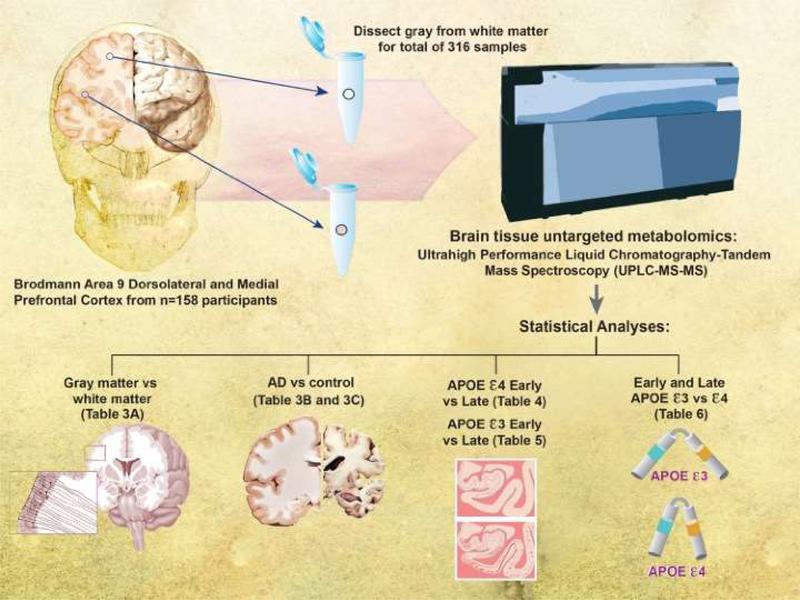
Alzheimer's disease (AD) is the most common form of dementia with hallmarks of β-amyloid (Aβ) plaques, tau tangles, and neurodegeneration. Studies have shown that neurodegeneration components, especially brain metabolic deficits, are more predictable for AD severity than Aβ and tau. However, detailed knowledge of the biochemical composition of AD brain tissue vs. normal brain tissue remains unclear. In this study, we performed a metabolomics analysis on the brain tissue of 158 community-based older adults in the University of Kentucky AD Research Center brain bank to characterize the biochemical profiles of brains with and without AD based on white/gray matter type, apolipoprotein E genotype (ε3 vs ε4 variants), and disease stage (early vs late) as all these factors influence metabolic processes. We also used machine learning to rank the top metabolites separating controls and AD in gray and white matter. Compared with control samples, we found that glutamate and creatine metabolism were more critical for predicting AD in the gray matter, while glycine, fatty acid, pyrimidine, tricarboxylic acid (TCA) cycle, and phosphatidylcholine metabolism were more critical in the white matter. In ε4 carriers, metabolites associated with the TCA cycle and oxidative phosphorylation were prominent in advanced stages compared to the early stages. In ε3 carriers, metabolites related to oxidative DNA damage, changes in inhibitory neurotransmitters, and disruptions of neuronal membranes were prominent in advanced stages compared to the early stages. In early disease, ε4 carriers had metabolites related to poor kidney function and altered neuronal sterol metabolism compared to ε3 carriers, but there were few differences between genotypes in late disease. Our results indicate that metabolism plays a pivotal role in differentiating - and stage-dependent changes in AD and may facilitate precision lifestyle and dietary interventions to mitigate AD risk in the early stages, especially for ε4 carriers.
阿尔茨海默病(AD)是最常见的痴呆形式,具有β-淀粉样蛋白(Aβ)斑块、tau缠结和神经退行性变等特征。研究表明,神经退行性变成分,尤其是脑代谢缺陷,比Aβ和tau更能预测AD的严重程度。然而,AD脑组织与正常脑组织的生化组成的详细知识仍不清楚。在本研究中,我们对肯塔基大学AD研究中心脑库中158名社区老年人的脑组织进行了代谢组学分析,以根据白质/灰质类型、载脂蛋白E基因型(ε3与ε4变体)和疾病阶段(早期与晚期)来表征有无AD的脑的生化特征,因为所有这些因素都会影响代谢过程。我们还使用机器学习对灰质和白质中区分对照和AD的顶级代谢物进行排名。与对照样本相比,我们发现谷氨酸和肌酸代谢对于预测灰质中的AD更为关键,而甘氨酸、脂肪酸、嘧啶、三羧酸(TCA)循环和磷脂酰胆碱代谢在白质中更为关键。在ε4携带者中,与TCA循环和氧化磷酸化相关的代谢物在晚期比早期更为突出。在ε3携带者中,与氧化性DNA损伤、抑制性神经递质变化和神经元膜破坏相关的代谢物在晚期比早期更为突出。在疾病早期,与ε3携带者相比,ε4携带者具有与肾功能不良和神经元甾醇代谢改变相关的代谢物,但在疾病晚期基因型之间几乎没有差异。我们的结果表明,代谢在区分AD以及AD的阶段依赖性变化中起关键作用,并且可能有助于在早期阶段实施精准的生活方式和饮食干预以降低AD风险,尤其是对于ε4携带者。

 Zotero 插件