
在高密度城市中,社会经济地位、密度、功能与 COVID-19 传播之间的精细关联。
The fine-scale associations between socioeconomic status, density, functionality, and spread of COVID-19 within a high-density city.
机构信息
Otto Poon Charitable Foundation Smart Cities Research Institute, The Hong Kong Polytechnic University, Hung Hom, Hong Kong.
Department of Land Surveying and Geo-Informatics, The Hong Kong Polytechnic University, Hung Hom, Hong Kong.
出版信息
BMC Infect Dis. 2022 Mar 21;22(1):274. doi: 10.1186/s12879-022-07274-w.
BACKGROUND
Motivated by the need for precise epidemic control and epidemic-resilient urban design, this study aims to reveal the joint and interactive associations between urban socioeconomic, density, connectivity, and functionality characteristics and the COVID-19 spread within a high-density city. Many studies have been made on the associations between urban characteristics and the COVID-19 spread, but there is a scarcity of such studies in the intra-city scale and as regards complex joint and interactive associations by using advanced machine learning approaches.
METHODS
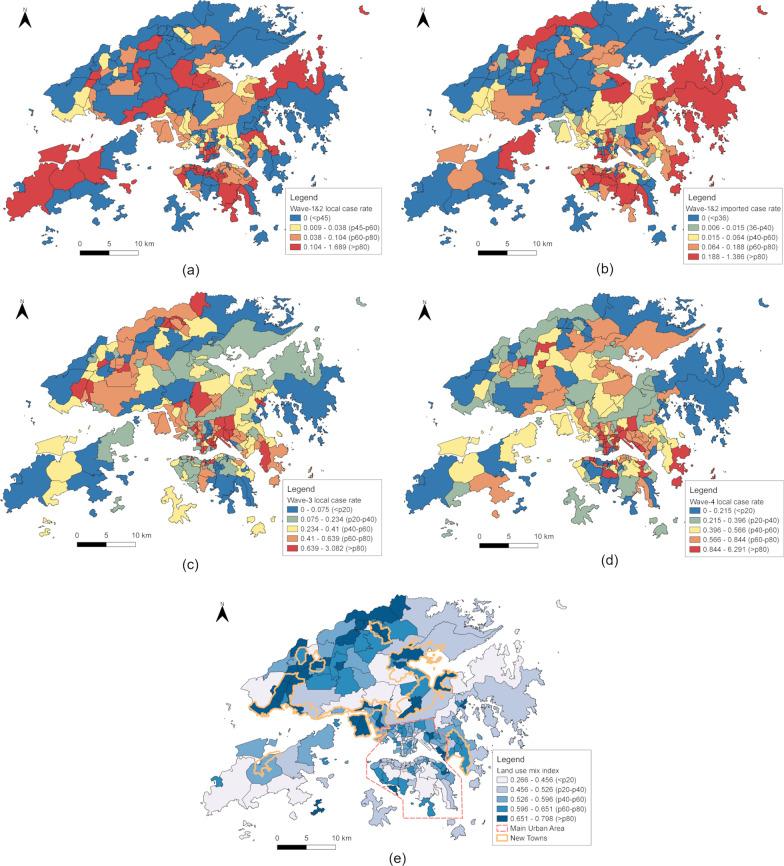
Differential-evolution-based association rule mining was used to investigate the joint and interactive associations between the urban characteristics and the spatiotemporal distribution of COVID-19 confirmed cases, at the neighborhood scale in Hong Kong. The associations were comparatively studied for the distribution of the cases in four waves of COVID-19 transmission: before Jun 2020 (wave 1 and 2), Jul-Oct 2020 (wave 3), and Nov 2020-Feb 2021 (wave 4), and for local and imported confirmed cases.
RESULTS
The first two waves of COVID-19 were found mainly characterized by higher-socioeconomic-status (SES) imported cases. The third-wave outbreak concentrated in densely populated and usually lower-SES neighborhoods, showing a high risk of within-neighborhood virus transmissions jointly contributed by high density and unfavorable SES. Starting with a super-spread which considerably involved high-SES population, the fourth-wave outbreak showed a stronger link to cross-neighborhood transmissions driven by urban functionality. Then the outbreak diffused to lower-SES neighborhoods and interactively aggravated the within-neighborhood pandemic transmissions. Association was also found between a higher SES and a slightly longer waiting period (i.e., the period from symptom onset to diagnosis of symptomatic cases), which further indicated the potential contribution of higher-SES population to the pandemic transmission.
CONCLUSIONS
The results of this study may provide references to developing precise anti-pandemic measures for specific neighborhoods and virus transmission routes. The study also highlights the essentiality of reliving co-locating overcrowdedness and unfavorable SES for developing epidemic-resilient compact cities, and the higher obligation of higher-SES population to conform anti-pandemic policies.
背景
为了实现精准的疫情防控和具备弹性的城市设计,本研究旨在揭示城市社会经济、密度、连通性和功能特征与高密度城市内 COVID-19 传播之间的联合和交互关联。已有许多研究探讨了城市特征与 COVID-19 传播之间的关联,但在城市内部尺度上以及使用先进的机器学习方法研究复杂的联合和交互关联方面,此类研究还很匮乏。
方法
使用基于差分进化的关联规则挖掘方法,在香港的邻里尺度上,研究了城市特征与 COVID-19 确诊病例时空分布之间的联合和交互关联。在四个 COVID-19 传播波次(2020 年 6 月前(波 1 和 2)、2020 年 7 月至 10 月(波 3)和 2020 年 11 月至 2021 年 2 月(波 4))以及本地和输入确诊病例中,对关联进行了比较研究。
结果
前两波 COVID-19 主要以高社会经济地位(SES)输入病例为特征。第三波疫情集中在人口稠密且通常 SES 较低的社区,高密度和不利的 SES 共同导致了社区内病毒传播的高风险。第四波疫情始于一个超级传播事件,涉及大量高 SES 人群,由城市功能驱动的跨社区传播对疫情的扩散起到了更强的作用。随后疫情扩散到 SES 较低的社区,并与社区内疫情传播相互加剧。研究还发现 SES 较高与等待时间略长(即症状出现到确诊症状病例的时间)之间存在关联,这进一步表明高 SES 人群可能对疫情传播有一定贡献。
结论
本研究结果可为特定邻里和病毒传播途径制定精准的抗疫措施提供参考。研究还强调了缓解人口过度集中和 SES 不利状况对于建设具有弹性的紧凑型城市的重要性,以及高 SES 人群遵守抗疫政策的更高义务。

 Zotero 插件