
使用FAPi PET对癌症相关成纤维细胞(CAF)进行成像。
Imaging Cancer-Associated Fibroblasts (CAFs) with FAPi PET.
作者信息
Gilardi Laura, Airò Farulla Lighea Simona, Demirci Emre, Clerici Ilaria, Omodeo Salè Emanuela, Ceci Francesco
机构信息
Division of Nuclear Medicine, IEO European Institute of Oncology IRCCS, 20141 Milan, Italy.
Department of Oncology and Hemato-Oncology, University of Milan, 20122 Milan, Italy.
出版信息
Biomedicines. 2022 Feb 23;10(3):523. doi: 10.3390/biomedicines10030523.
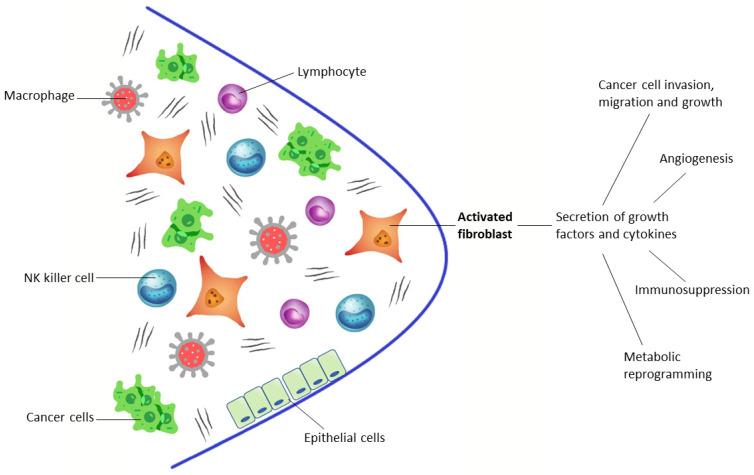
The tumor microenvironment (TME) surrounding tumor cells is a complex and highly dynamic system that promotes tumorigenesis. Cancer-associated fibroblasts (CAFs) are key elements in TME playing a pivotal role in cancer cells' proliferation and metastatic spreading. Considering the high expression of the fibroblast activation protein (FAP) on the cell membrane, CAFs emerged as appealing TME targets, namely for molecular imaging, leading to a pan-tumoral approach. Therefore, FAP inhibitors (FAPis) have recently been developed for PET imaging and radioligand therapy, exploring the clinical application in different tumor sub-types. The present review aimed to describe recent developments regarding radiolabeled FAP inhibitors and evaluate the possible translation of this pan-tumoral approach in clinical practice. At present, the application of FAPi-PET has been explored mainly in single-center studies, generally performed in small and heterogeneous cohorts of oncological patients. However, preliminary results were promising, in particular in low FDG-avid tumors, such as primary liver and gastro-entero-pancreatic cancer, or in regions with an unfavorable tumor-to-background ratio at FDG-PET/CT (i.e., brain), and in radiotherapy planning of head and neck tumors. Further promising results have been obtained in the detection of peritoneal carcinomatosis, especially in ovarian and gastric cancer. Data regarding the theranostics approach are still limited at present, and definitive conclusions about its efficacy cannot be drawn at present. Nevertheless, the use of FAPi-based radio-ligand to treat the TME has been evaluated in first-in-human studies and appears feasible. Although the pan-tumoral approach in molecular imaging showed promising results, its real impact in day-to-day clinical practice has yet to be confirmed, and multi-center prospective studies powered for efficacy are needed.
肿瘤细胞周围的肿瘤微环境(TME)是一个促进肿瘤发生的复杂且高度动态的系统。癌症相关成纤维细胞(CAFs)是TME中的关键要素,在癌细胞增殖和转移扩散中起关键作用。鉴于成纤维细胞活化蛋白(FAP)在细胞膜上的高表达,CAFs成为有吸引力的TME靶点,即用于分子成像,从而形成一种泛肿瘤方法。因此,FAP抑制剂(FAPis)最近已被开发用于PET成像和放射性配体治疗,探索在不同肿瘤亚型中的临床应用。本综述旨在描述放射性标记FAP抑制剂的最新进展,并评估这种泛肿瘤方法在临床实践中可能的转化应用。目前,FAPi-PET的应用主要在单中心研究中进行探索,这些研究通常在肿瘤患者的小型异质性队列中开展。然而,初步结果很有前景,特别是在低FDG摄取的肿瘤中,如原发性肝癌和胃肠胰癌,或在FDG-PET/CT中肿瘤与背景比值不利的区域(即脑部),以及头颈部肿瘤的放射治疗计划中。在检测腹膜癌转移方面也取得了进一步的有前景的结果,特别是在卵巢癌和胃癌中。目前关于治疗诊断方法的数据仍然有限,目前尚不能就其疗效得出明确结论。尽管如此,基于FAPi的放射性配体治疗TME已在首次人体研究中进行了评估,且似乎可行。虽然分子成像中的泛肿瘤方法显示出有前景的结果,但其在日常临床实践中的实际影响尚未得到证实,需要开展多中心前瞻性疗效研究。
 Zotero 插件