
炎症状态对伴有代谢心血管疾病风险表型的老年人群餐后结局的影响。
Influence of a proinflammatory state on postprandial outcomes in elderly subjects with a risk phenotype for cardiometabolic diseases.
机构信息
Department of Nutrition and Food Science, Nutritional Physiology, University of Bonn, Nussallee 9, 53115, Bonn, Germany.
Institute of Clinical Chemistry and Clinical Pharmacology, University Hospital Bonn, Bonn, Germany.
出版信息
Eur J Nutr. 2022 Sep;61(6):3077-3083. doi: 10.1007/s00394-022-02870-7. Epub 2022 Mar 30.
PURPOSE
Low-grade inflammation in obesity is associated with insulin resistance and other metabolic disturbances. In response to high-energy meal intake, blood concentrations of inflammatory markers, glucose and insulin rise. The aim of this study was to examine whether a basal inflammatory state influences postprandial responses.
METHODS
A randomized crossover trial was performed in 60 participants with a cardiometabolic risk phenotype (age 70 ± 5 years; BMI 30.9 ± 3.1 kg/m). Each participant consumed three different iso-energetic meals (4300 kJ): a Western diet-like high-fat meal (WDHF), a Western diet-like high-carbohydrate meal (WDHC) and a Mediterranean diet-like meal (MED). Blood samples were collected when fasted and hourly for 5 h postprandially and analyzed for glucose, insulin, interleukin-1β (IL-1β), interleukin-6 (IL-6) and endothelial adhesion molecules. Based on fasting serum C-reactive protein (CRP) concentrations, participants were assigned to a high inflammation (CRP ≥ 2.0 mg/L; n = 30) or low inflammation (CRP < 2.0 mg/L; n = 30) group, and postprandial outcomes were compared.
RESULTS
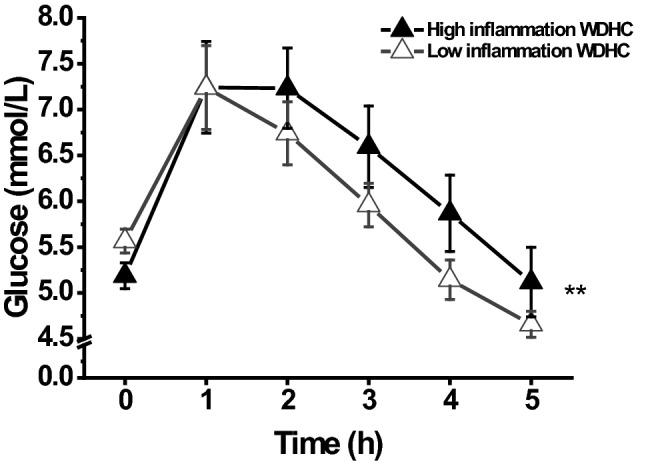
Plasma IL-6, glucose and serum insulin increased after all meals, while IL-1β and endothelial adhesion molecules were unchanged. The high inflammation group had higher fasting and postprandial IL-6 concentrations than the low inflammation group, although the IL-6 response slope was similar between groups. In response to the WDHC meal, participants in the high inflammation group experienced a higher glycaemic response than those in the low inflammation group.
CONCLUSION
A basal proinflammatory state results in higher absolute fasting and postprandial IL-6 concentrations, but the increase in IL-6 relative to basal levels is not different between high and low inflammation groups. Elevated glycaemic response in the high inflammation group may be due to inflammation-induced short-term insulin resistance. The trial was registered at http://www.germanctr.de and http://www.drks.de under identifier DRKS00009861 (registration date, January 22, 2016).
目的
肥胖症中的低度炎症与胰岛素抵抗和其他代谢紊乱有关。在摄入高热量膳食后,血液中炎症标志物、葡萄糖和胰岛素的浓度升高。本研究旨在探讨基础炎症状态是否会影响餐后反应。
方法
在具有代谢风险表型的 60 名参与者(年龄 70 ± 5 岁;BMI 30.9 ± 3.1 kg/m²)中进行了一项随机交叉试验。每位参与者摄入三种不同能量的餐食(4300 kJ):一种类似于西方饮食的高脂肪餐(WDHF)、一种类似于西方饮食的高碳水化合物餐(WDHC)和一种类似于地中海饮食的餐食(MED)。空腹和餐后 5 小时内每小时采集血液样本,分析血糖、胰岛素、白细胞介素-1β(IL-1β)、白细胞介素-6(IL-6)和内皮细胞黏附分子。根据空腹血清 C 反应蛋白(CRP)浓度,将参与者分为高炎症(CRP≥2.0 mg/L;n=30)或低炎症(CRP<2.0 mg/L;n=30)组,并比较餐后结果。
结果
所有餐食后,血浆 IL-6、葡萄糖和血清胰岛素均升高,而 IL-1β和内皮细胞黏附分子无变化。高炎症组的空腹和餐后 IL-6 浓度高于低炎症组,尽管两组的 IL-6 反应斜率相似。在 WDHC 餐食中,高炎症组的血糖反应高于低炎症组。
结论
基础促炎状态导致空腹和餐后 IL-6 浓度升高,但高炎症组和低炎症组的 IL-6 相对于基础水平的增加没有差异。高炎症组血糖反应升高可能是由于炎症引起的短期胰岛素抵抗。该试验在德国临床试验注册中心(http://www.germanctr.de)和德国临床试验注册中心(http://www.drks.de)进行,注册编号为 DRKS00009861(注册日期为 2016 年 1 月 22 日)。

 Zotero 插件