
2019年冠状病毒病疫情后儿童脑膜炎的流行病学和致病病原体变化:一项多中心数据库研究
Changes in the Epidemiology and Causative Pathogens of Meningitis in Children After the Outbreak of the Coronavirus Disease 2019: A Multicenter Database Study.
作者信息
Lee Jooyoung, Choi Arum, Kim Kyunghoon, Bin Joong Hyun, Eom Tae Hoon, Yoo Il Han, Yoon Da Hye, Kim Sukil, Kim Young Hoon
机构信息
Department of Pediatrics, College of Medicine, The Catholic University of Korea, Seoul, South Korea.
Department of Preventive Medicine and Public Health, College of Medicine, The Catholic University of Korea, Seoul, South Korea.
出版信息
Front Pediatr. 2022 Apr 14;10:810616. doi: 10.3389/fped.2022.810616. eCollection 2022.
BACKGROUND
With the outbreak of the COVID-19 pandemic, non-pharmaceutical interventions such as social distancing have been implemented worldwide, and a decrease in other infectious diseases has been reported as an unexpected benefit. However, to date, studies are lacking regarding the effects of the COVID-19 pandemic on neuroinfectious diseases; therefore, we aimed to determine the effects of the COVID-19 pandemic on the incidence of meningitis, which is the most common infectious disease in children.
METHODS
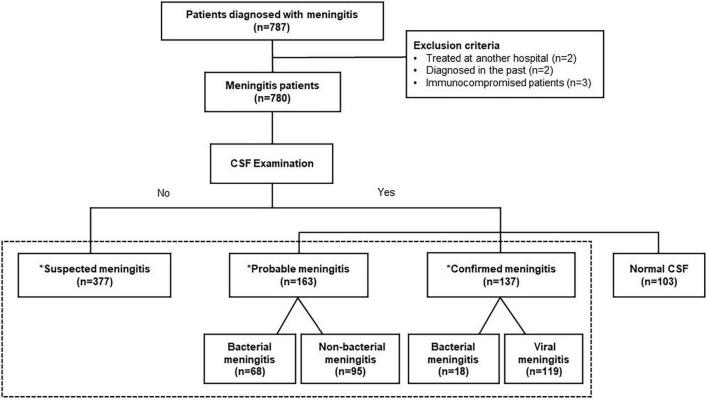
This retrospective study used electronic medical record data from five university hospitals located in the metropolitan cities in Korea. This study included patients aged <18 years who were diagnosed with meningitis between January 2017 and December 2020. We analyzed the clinical characteristics of patients with meningitis and changes in the incidence and causative pathogens of meningitis before and after the COVID-19 outbreak.
RESULTS
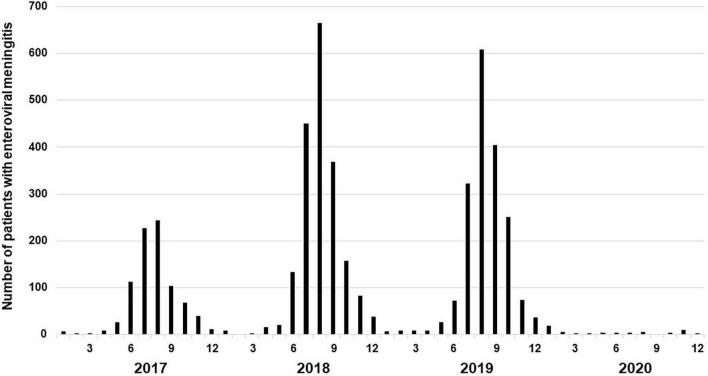
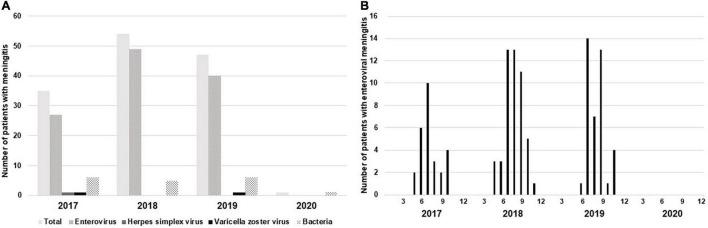
The study included 677 patients with meningitis. Following the outbreak of COVID-19 in Korea in January 2020, the incidence of childhood meningitis significantly decreased and seasonal changes noted yearly disappeared. There was a difference in the age distribution of patients with meningitis. The incidence of meningitis decreased significantly in children aged >5 years, and the incidence in children <5 years of age relatively increased ( < 0.001). In addition, there was a notable decrease in the cases of suspected meningitis ( < 0.001). The incidence of enteroviral meningitis, the most common cause of meningitis, significantly decreased.
CONCLUSION
After the COVID-19 outbreak, the incidence of childhood meningitis significantly decreased with the implementation of non-pharmaceutical interventions. Absence of enteroviral meningitis and decrease in the proportion of patients aged ≥5 years with meningitis having mild symptoms were noted. Consequently, it can be concluded that the non-pharmaceutical interventions (NPIs) instituted to prevent the spread of COVID-19 had some effect on reducing the incidence of meningitis.
背景
随着新冠疫情的爆发,社交距离等非药物干预措施已在全球范围内实施,据报道,其他传染病的减少是一项意外的益处。然而,迄今为止,关于新冠疫情对神经感染性疾病影响的研究尚缺;因此,我们旨在确定新冠疫情对儿童最常见的感染性疾病——脑膜炎发病率的影响。
方法
这项回顾性研究使用了来自韩国大城市五家大学医院的电子病历数据。本研究纳入了2017年1月至2020年12月期间诊断为脑膜炎的18岁以下患者。我们分析了脑膜炎患者的临床特征以及新冠疫情爆发前后脑膜炎发病率和致病病原体的变化。
结果
该研究纳入了677例脑膜炎患者。2020年1月韩国爆发新冠疫情后,儿童脑膜炎发病率显著下降,每年出现的季节性变化消失。脑膜炎患者的年龄分布存在差异。5岁以上儿童脑膜炎发病率显著下降,5岁以下儿童发病率相对上升(<0.001)。此外,疑似脑膜炎病例显著减少(<0.001)。脑膜炎最常见病因肠道病毒性脑膜炎的发病率显著下降。
结论
新冠疫情爆发后,随着非药物干预措施的实施,儿童脑膜炎发病率显著下降。注意到肠道病毒性脑膜炎的缺失以及≥5岁脑膜炎轻症患者比例的下降。因此,可以得出结论,为防止新冠病毒传播而采取的非药物干预措施(NPIs)对降低脑膜炎发病率有一定作用。

 Zotero 插件