
基于快速床边抗原检测的 SARS-CoV-2 准确性:一项更新的系统评价和荟萃分析,以及荟萃回归分析影响因素。
Accuracy of rapid point-of-care antigen-based diagnostics for SARS-CoV-2: An updated systematic review and meta-analysis with meta-regression analyzing influencing factors.
机构信息
Division of Infectious Disease and Tropical Medicine, Center for Infectious Diseases, Heidelberg University Hospital, Heidelberg, Germany.
Department of Anesthesiology, Heidelberg University Hospital, Heidelberg, Germany.
出版信息
PLoS Med. 2022 May 26;19(5):e1004011. doi: 10.1371/journal.pmed.1004011. eCollection 2022 May.
BACKGROUND
Comprehensive information about the accuracy of antigen rapid diagnostic tests (Ag-RDTs) for Severe Acute Respiratory Syndrome Coronavirus 2 (SARS-CoV-2) is essential to guide public health decision makers in choosing the best tests and testing policies. In August 2021, we published a systematic review and meta-analysis about the accuracy of Ag-RDTs. We now update this work and analyze the factors influencing test sensitivity in further detail.
METHODS AND FINDINGS
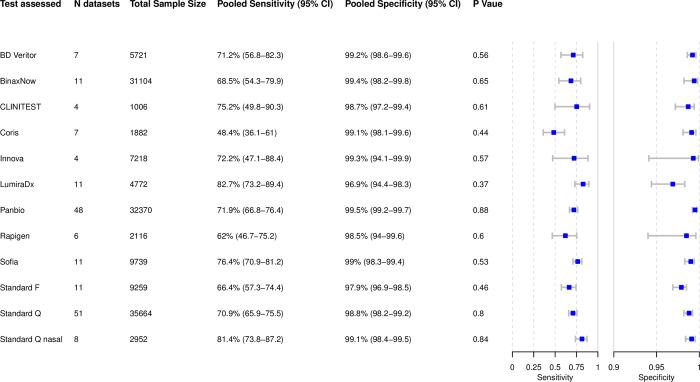
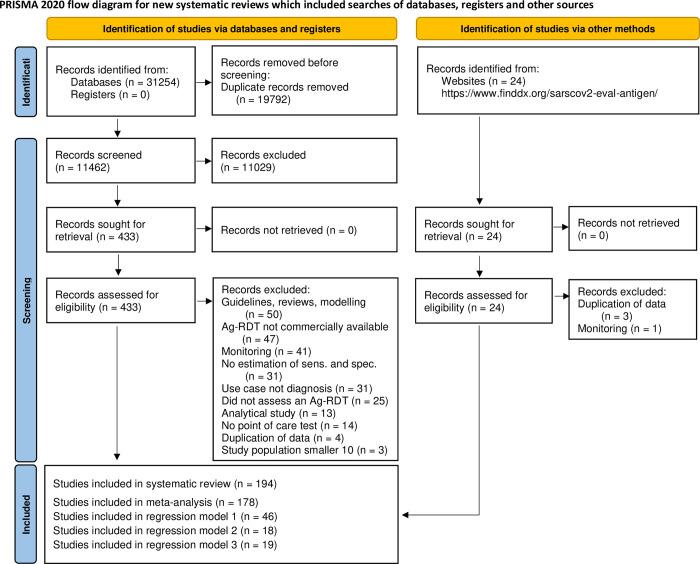
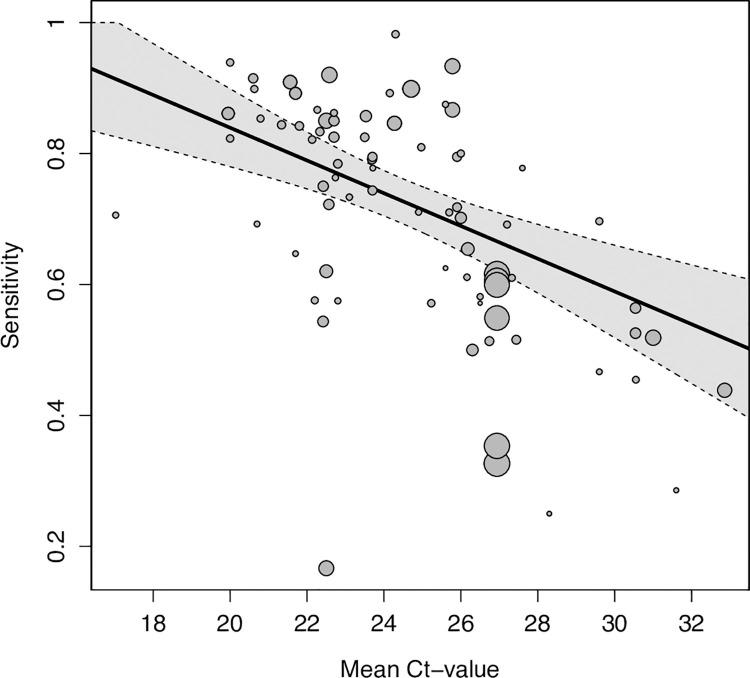
We registered the review on PROSPERO (registration number: CRD42020225140). We systematically searched preprint and peer-reviewed databases for publications evaluating the accuracy of Ag-RDTs for SARS-CoV-2 until August 31, 2021. Descriptive analyses of all studies were performed, and when more than 4 studies were available, a random-effects meta-analysis was used to estimate pooled sensitivity and specificity with reverse transcription polymerase chain reaction (RT-PCR) testing as a reference. To evaluate factors influencing test sensitivity, we performed 3 different analyses using multivariable mixed-effects meta-regression models. We included 194 studies with 221,878 Ag-RDTs performed. Overall, the pooled estimates of Ag-RDT sensitivity and specificity were 72.0% (95% confidence interval [CI] 69.8 to 74.2) and 98.9% (95% CI 98.6 to 99.1). When manufacturer instructions were followed, sensitivity increased to 76.3% (95% CI 73.7 to 78.7). Sensitivity was markedly better on samples with lower RT-PCR cycle threshold (Ct) values (97.9% [95% CI 96.9 to 98.9] and 90.6% [95% CI 88.3 to 93.0] for Ct-values <20 and <25, compared to 54.4% [95% CI 47.3 to 61.5] and 18.7% [95% CI 13.9 to 23.4] for Ct-values ≥25 and ≥30) and was estimated to increase by 2.9 percentage points (95% CI 1.7 to 4.0) for every unit decrease in mean Ct-value when adjusting for testing procedure and patients' symptom status. Concordantly, we found the mean Ct-value to be lower for true positive (22.2 [95% CI 21.5 to 22.8]) compared to false negative (30.4 [95% CI 29.7 to 31.1]) results. Testing in the first week from symptom onset resulted in substantially higher sensitivity (81.9% [95% CI 77.7 to 85.5]) compared to testing after 1 week (51.8%, 95% CI 41.5 to 61.9). Similarly, sensitivity was higher in symptomatic (76.2% [95% CI 73.3 to 78.9]) compared to asymptomatic (56.8% [95% CI 50.9 to 62.4]) persons. However, both effects were mainly driven by the Ct-value of the sample. With regards to sample type, highest sensitivity was found for nasopharyngeal (NP) and combined NP/oropharyngeal samples (70.8% [95% CI 68.3 to 73.2]), as well as in anterior nasal/mid-turbinate samples (77.3% [95% CI 73.0 to 81.0]). Our analysis was limited by the included studies' heterogeneity in viral load assessment and sample origination.
CONCLUSIONS
Ag-RDTs detect most of the individuals infected with SARS-CoV-2, and almost all (>90%) when high viral loads are present. With viral load, as estimated by Ct-value, being the most influential factor on their sensitivity, they are especially useful to detect persons with high viral load who are most likely to transmit the virus. To further quantify the effects of other factors influencing test sensitivity, standardization of clinical accuracy studies and access to patient level Ct-values and duration of symptoms are needed.
背景
全面了解抗原快速诊断检测(Ag-RDT)对严重急性呼吸综合征冠状病毒 2 (SARS-CoV-2)的准确性对于指导公共卫生决策者选择最佳的检测和检测政策至关重要。2021 年 8 月,我们发表了一项关于 Ag-RDT 准确性的系统评价和荟萃分析。现在,我们更新了这项工作,并进一步详细分析了影响检测灵敏度的因素。
方法和发现
我们在 PROSPERO(注册号:CRD42020225140)上注册了该综述。我们系统地检索了预印本和同行评议数据库,以获取评估 SARS-CoV-2 时 Ag-RDT 准确性的出版物,检索截至 2021 年 8 月 31 日。对所有研究进行描述性分析,当有超过 4 项研究时,使用随机效应荟萃分析估计以逆转录聚合酶链反应(RT-PCR)检测为参考的合并敏感性和特异性。为了评估影响检测灵敏度的因素,我们使用多变量混合效应荟萃回归模型进行了 3 项不同的分析。我们纳入了 194 项研究,共涉及 221878 项 Ag-RDT 检测。总体而言,Ag-RDT 敏感性和特异性的合并估计值分别为 72.0%(95%置信区间 [CI] 69.8 至 74.2)和 98.9%(95% CI 98.6 至 99.1)。当遵循制造商的说明时,敏感性增加到 76.3%(95% CI 73.7 至 78.7)。在 RT-PCR 循环阈值(Ct)值较低的样本中,敏感性明显更好(Ct 值<20 和<25 的 97.9% [95% CI 96.9 至 98.9] 和 90.6% [95% CI 88.3 至 93.0],而 Ct 值≥25 和≥30 的 54.4% [95% CI 47.3 至 61.5] 和 18.7% [95% CI 13.9 至 23.4]),并且当调整检测程序和患者症状状态时,平均 Ct 值每降低 1 个单位,敏感性估计会增加 2.9 个百分点(95% CI 1.7 至 4.0)。同样,我们发现真阳性(22.2 [95% CI 21.5 至 22.8])的平均 Ct 值低于假阴性(30.4 [95% CI 29.7 至 31.1])结果。与 1 周后(51.8%,95% CI 41.5 至 61.9)相比,症状出现后第一周进行检测会导致更高的敏感性(81.9% [95% CI 77.7 至 85.5])。同样,在有症状的个体(76.2% [95% CI 73.3 至 78.9])中,敏感性高于无症状个体(56.8% [95% CI 50.9 至 62.4])。然而,这两个效应主要是由样本的 Ct 值驱动的。就样本类型而言,鼻咽(NP)和联合 NP/咽拭子样本(70.8% [95% CI 68.3 至 73.2])以及前鼻/中鼻甲样本(77.3% [95% CI 73.0 至 81.0])的敏感性最高。我们的分析受到包括研究中病毒载量评估和样本起源异质性的限制。
结论
Ag-RDT 检测到大多数感染 SARS-CoV-2 的个体,当病毒载量较高时,几乎所有(>90%)个体都会被检测到。由于 Ct 值估计的病毒载量是影响其敏感性的最具影响力的因素,因此它们特别有助于检测病毒载量较高的个体,这些个体最有可能传播病毒。为了进一步量化影响检测灵敏度的其他因素,需要对临床准确性研究进行标准化,并获得患者的 Ct 值和症状持续时间。


 Zotero 插件