
自组装纳米颗粒中的透明质酸:靶向癌症治疗的无限可能
Hyaluronic Acid within Self-Assembling Nanoparticles: Endless Possibilities for Targeted Cancer Therapy.
作者信息
Curcio Manuela, Vittorio Orazio, Bell Jessica Lilian, Iemma Francesca, Nicoletta Fiore Pasquale, Cirillo Giuseppe
机构信息
Department of Pharmacy Health and Nutritional Science, University of Calabria, 87036 Rende, Italy.
Children's Cancer Institute, Lowy Cancer Research Centre, University of New South Wales, Sidney, NSW 2052, Australia.
出版信息
Nanomaterials (Basel). 2022 Aug 18;12(16):2851. doi: 10.3390/nano12162851.
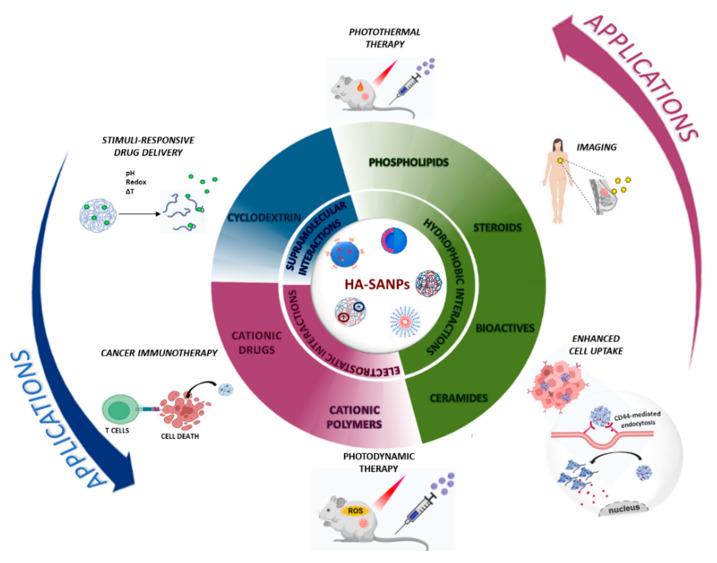
Self-assembling nanoparticles (SANPs) based on hyaluronic acid (HA) represent unique tools in cancer therapy because they combine the HA targeting activity towards cancer cells with the advantageous features of the self-assembling nanosystems, i.e., chemical versatility and ease of preparation and scalability. This review describes the key outcomes arising from the combination of HA and SANPs, focusing on nanomaterials where HA and/or HA-derivatives are inserted within the self-assembling nanostructure. We elucidate the different HA derivatization strategies proposed for this scope, as well as the preparation methods used for the fabrication of the delivery device. After showing the biological results in the employed in vivo and in vitro models, we discussed the pros and cons of each nanosystem, opening a discussion on which approach represents the most promising strategy for further investigation and effective therapeutic protocol development.
基于透明质酸(HA)的自组装纳米颗粒(SANPs)是癌症治疗中的独特工具,因为它们将HA对癌细胞的靶向活性与自组装纳米系统的优势特性相结合,即化学多功能性、易于制备和可扩展性。本综述描述了HA和SANPs结合产生的关键成果,重点关注HA和/或HA衍生物插入自组装纳米结构中的纳米材料。我们阐明了为此目的提出的不同HA衍生化策略,以及用于制造递送装置的制备方法。在展示了在体内和体外模型中获得的生物学结果后,我们讨论了每个纳米系统的优缺点,开启了关于哪种方法代表最有前景的策略以进行进一步研究和有效治疗方案开发的讨论。



 Zotero 插件