
丹参酮 IIA 通过调控 p38/p53 通路实现对放射性心肌细胞损伤的保护作用。
Tanshinone IIA Accomplished Protection against Radiation-Induced Cardiomyocyte Injury by Regulating the p38/p53 Pathway.
机构信息
The First Clinical Medical College, Gansu University of Chinese Medicine, Lanzhou 730000, China.
Gansu Provincial Maternity and Child-Care Hospital, Lanzhou 730000, China.
出版信息
Mediators Inflamm. 2022 Aug 22;2022:1478181. doi: 10.1155/2022/1478181. eCollection 2022.
BACKGROUND
Radiotherapy is one of the major strategies for treating tumors, and it inevitably causes damage to relevant tissues and organs during treatment. Radiation-induced heart disease (RIHD) refers to radiation-induced cardiovascular adverse effects caused by thoracic radiotherapy. Currently, there is no uniform standard in the treatment of RIHD.
METHODS
In our group study, by administering a dose of 4 Gy radiation, we established a radiation injured cardiomyocyte model and explored the regulatory relationship between tanshinone IIA and p38 MAPK in cardiomyocyte injury. We assessed cell damage and proliferation using clonogenic assay and lactate dehydrogenase (LDH) release assay. The measures of antioxidant activity and oxidative stress were conducted using superoxide dismutase (SOD) and reactive oxygen species (ROS). The apoptosis rate and the relative expression of apoptotic proteins were conducted using flow cytometry and western blot. To assess p38 and p53 expressions and phosphorylation levels, western blot was performed.
RESULTS
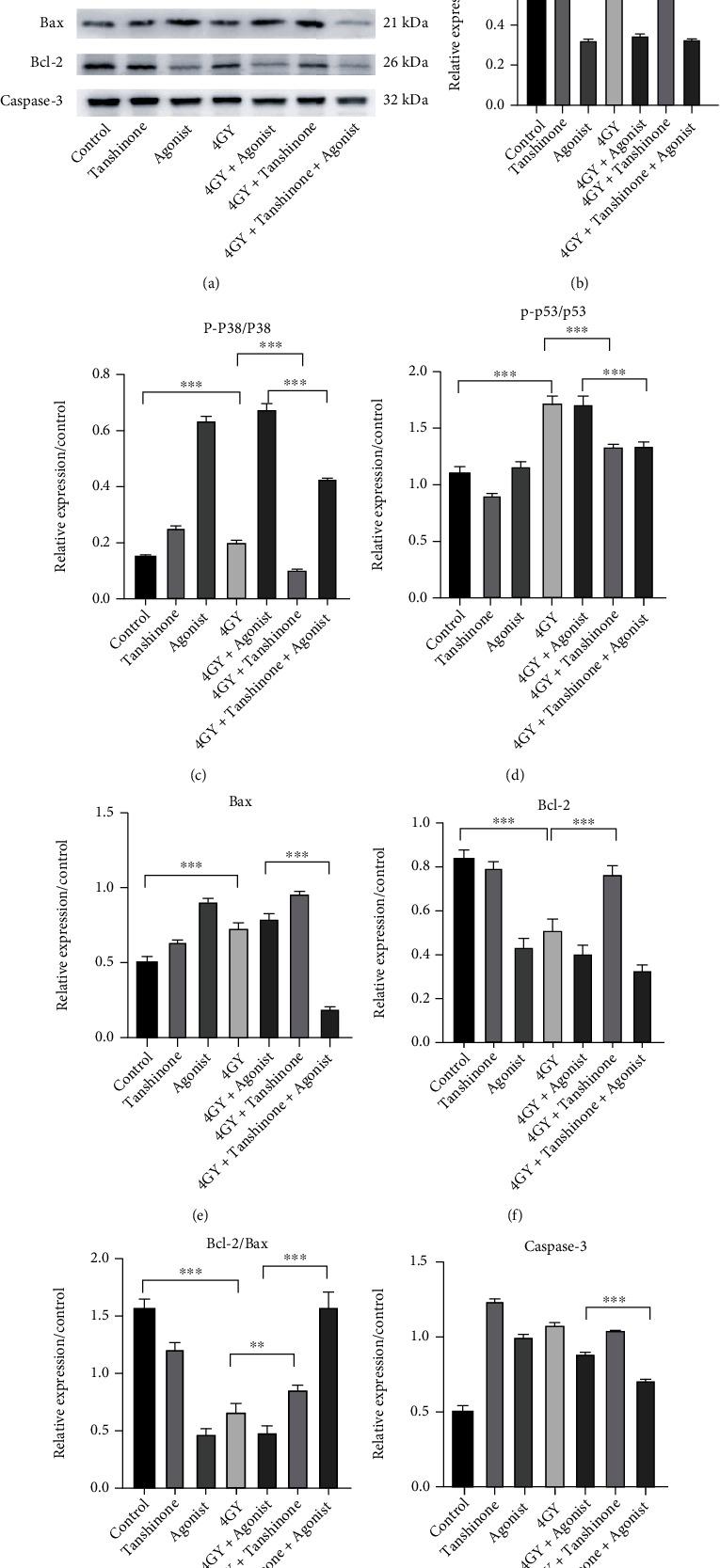
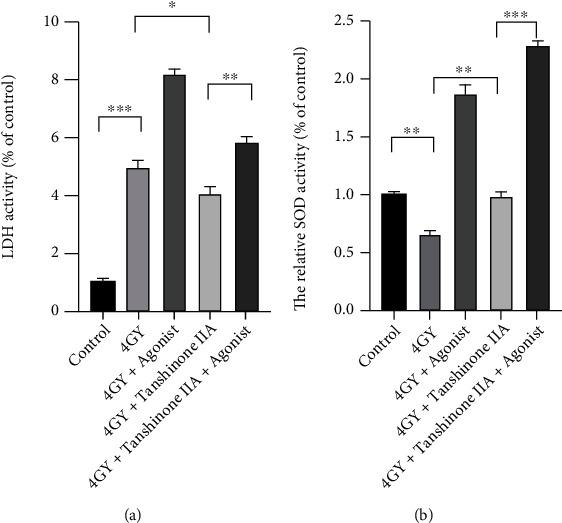
Experimental results suggested that tanshinone IIA restored cell proliferation in radiation-induced cardiomyocyte injury (∗∗ < 0.01), and the level of LDH release decreased (∗ < 0.05). Meanwhile, tanshinone IIA could decrease the ROS generation induced by radiation (∗∗ < 0.01) and upregulate the SOD level (∗∗ < 0.01). Again, tanshinone IIA reduced radiation-induced cardiomyocyte apoptosis (∗∗ < 0.01). Finally, tanshinone IIA downregulated radiation-induced p38/p53 overexpression (∗∗∗ < 0.001).
CONCLUSIONS
The treatment effects of tanshinone IIA against radiation-induced myocardial injury may be through the regulation of the p38/p53 pathway.
背景
放射治疗是肿瘤治疗的主要策略之一,在治疗过程中不可避免地会对相关组织和器官造成损伤。放射性心脏病(RIHD)是指胸部放射治疗引起的放射性心血管不良效应。目前,RIHD 的治疗尚无统一标准。
方法
在我们的小组研究中,通过给予 4Gy 剂量的辐射,建立了辐射损伤心肌细胞模型,并探讨了丹参酮 IIA 与心肌细胞损伤中 p38MAPK 的调节关系。我们使用集落形成实验和乳酸脱氢酶(LDH)释放实验评估细胞损伤和增殖。使用超氧化物歧化酶(SOD)和活性氧(ROS)评估抗氧化活性和氧化应激的措施。使用流式细胞术和 Western blot 评估细胞凋亡率和凋亡蛋白的相对表达。通过 Western blot 评估 p38 和 p53 的表达和磷酸化水平。
结果
实验结果表明,丹参酮 IIA 恢复了辐射诱导的心肌细胞损伤中的细胞增殖(∗∗ < 0.01),并且 LDH 释放水平降低(∗ < 0.05)。同时,丹参酮 IIA 可以减少辐射引起的 ROS 生成(∗∗ < 0.01)并上调 SOD 水平(∗∗ < 0.01)。此外,丹参酮 IIA 减少了辐射诱导的心肌细胞凋亡(∗∗ < 0.01)。最后,丹参酮 IIA 下调了辐射诱导的 p38/p53 过表达(∗∗∗ < 0.001)。
结论
丹参酮 IIA 治疗辐射诱导的心肌损伤的作用可能是通过调节 p38/p53 通路。



 Zotero 插件