
饮食多样性与肠道微生物组、粪便代谢物和宿主代谢的关联:来自 2 个前瞻性中国队列的研究结果。
Associations of dietary diversity with the gut microbiome, fecal metabolites, and host metabolism: results from 2 prospective Chinese cohorts.
机构信息
College of Life Sciences, Zhejiang University, Hangzhou, China.
Key Laboratory of Growth Regulation and Translational Research of Zhejiang Province, School of Life Sciences, Westlake University, Hangzhou, China.
出版信息
Am J Clin Nutr. 2022 Oct 6;116(4):1049-1058. doi: 10.1093/ajcn/nqac178.
BACKGROUND
Dietary diversity is essential for human health. The gut ecosystem provides a potential link between dietary diversity, host metabolism, and health, yet this mechanism is poorly understood.
OBJECTIVES
Here, we aimed to investigate the relation between dietary diversity and the gut environment as well as host metabolism from a multiomics perspective.
METHODS
Two independent longitudinal Chinese cohorts (a discovery and a validation cohort) were included in the present study. Dietary diversity was evaluated with FFQs. In the discovery cohort (n = 1916), we performed shotgun metagenomic and 16S ribosomal ribonucleic acid (rRNA) sequencing to profile the gut microbiome. We used targeted metabolomics to quantify fecal and serum metabolites. The associations between dietary diversity and the microbial composition were replicated in the validation cohort (n = 1320).
RESULTS
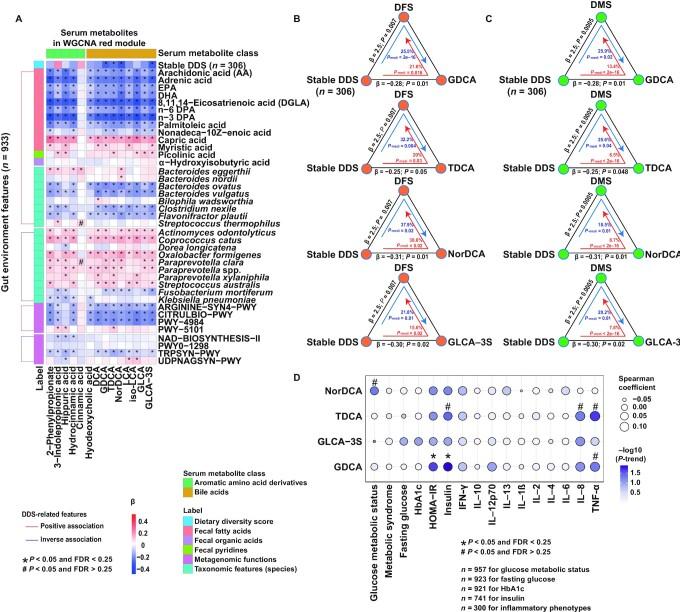
Dietary diversity was positively associated with α diversity of the gut microbiota. We identified dietary diversity-related gut environment features, including the microbial structure (β diversity), 68 microbial genera, 18 microbial species, 8 functional pathways, and 13 fecal metabolites. We further found 332 associations of dietary diversity and related gut environment features with circulating metabolites. Both the dietary diversity and diversity-related features were inversely correlated with 4 circulating secondary bile acids. Moreover, 16 mediation associations were observed among dietary diversity, diversity-related features, and the 4 secondary bile acids.
CONCLUSIONS
These results suggest that high dietary diversity is associated with the gut microbial environment. The identified key microbes and metabolites may serve as hypotheses to test for preventing metabolic diseases.
背景
饮食多样性对人类健康至关重要。肠道生态系统为饮食多样性、宿主代谢和健康之间的潜在联系提供了可能,但这一机制尚未得到充分理解。
目的
本研究旨在从多组学角度研究饮食多样性与肠道环境和宿主代谢之间的关系。
方法
本研究纳入了两个独立的纵向中国队列(发现队列和验证队列)。采用 FFQ 评估饮食多样性。在发现队列(n=1916)中,我们进行了 shotgun 宏基因组和 16S 核糖体核糖核酸(rRNA)测序,以分析肠道微生物组。我们使用靶向代谢组学来定量粪便和血清代谢物。在验证队列(n=1320)中,我们复制了饮食多样性与微生物组成之间的关联。
结果
饮食多样性与肠道微生物群落的 α 多样性呈正相关。我们确定了与饮食多样性相关的肠道环境特征,包括微生物结构(β 多样性)、68 个微生物属、18 个微生物种、8 个功能途径和 13 种粪便代谢物。我们还发现了 332 种与饮食多样性和相关肠道环境特征与循环代谢物的关联。饮食多样性和多样性相关特征与 4 种循环次级胆汁酸呈负相关。此外,在饮食多样性、多样性相关特征和 4 种次级胆汁酸之间观察到 16 种中介关联。
结论
这些结果表明,高饮食多样性与肠道微生物环境有关。鉴定出的关键微生物和代谢物可作为预防代谢性疾病的假说进行检验。


 Zotero 插件