
呼吸道合胞病毒或流感病毒合并感染在 COVID-19 患者临床严重程度中的作用:系统评价和荟萃分析。
The role of respiratory co-infection with influenza or respiratory syncytial virus in the clinical severity of COVID-19 patients: A systematic review and meta-analysis.
机构信息
Department of Epidemiology, School of Public Health, Nanjing Medical University, Nanjing, 211166, China.
Department of Biostatistics, School of Public Health, Nanjing Medical University, Nanjing, China.
出版信息
J Glob Health. 2022 Sep 17;12:05040. doi: 10.7189/jogh.12.05040.
BACKGROUND
With the easing of COVID-19 non-pharmaceutical interventions, the resurgence of both influenza and respiratory syncytial virus (RSV) was observed in several countries globally after remaining low in activity for over a year. However, whether co-infection with influenza or RSV influences disease severity in COVID-19 patients has not yet been determined clearly. We aimed to understand the impact of influenza/RSV co-infection on clinical disease severity among COVID-19 patients.
METHODS
We conducted a systematic literature review of publications comparing the clinical severity between the co-infection group (ie, influenza/RSV with SARS-CoV-2) and mono-infection group (ie, SARS-CoV-2), using the following four outcomes: need or use of supplemental oxygen, intensive care unit (ICU) admission, mechanical ventilation, and deaths. We summarized the results by clinical outcome and conducted random-effect meta-analyses where applicable.
RESULTS
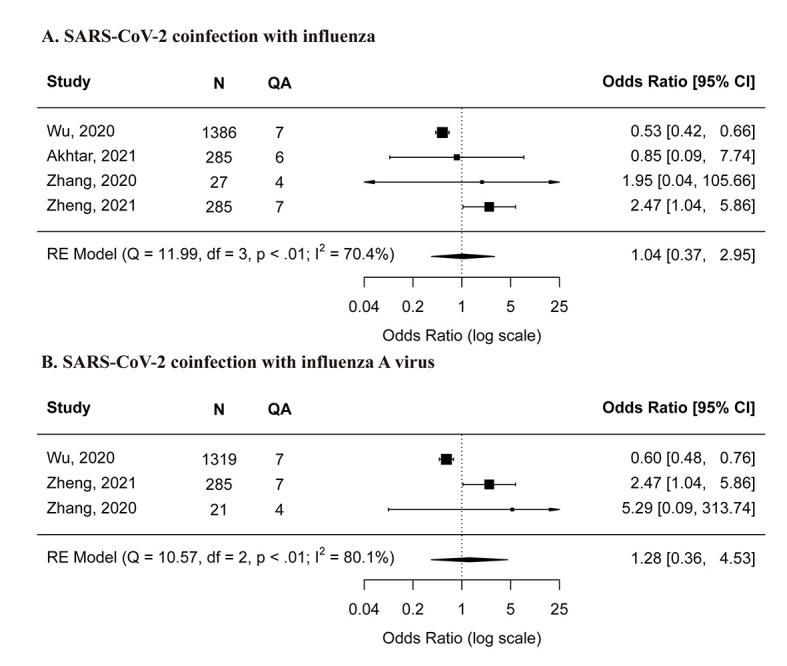
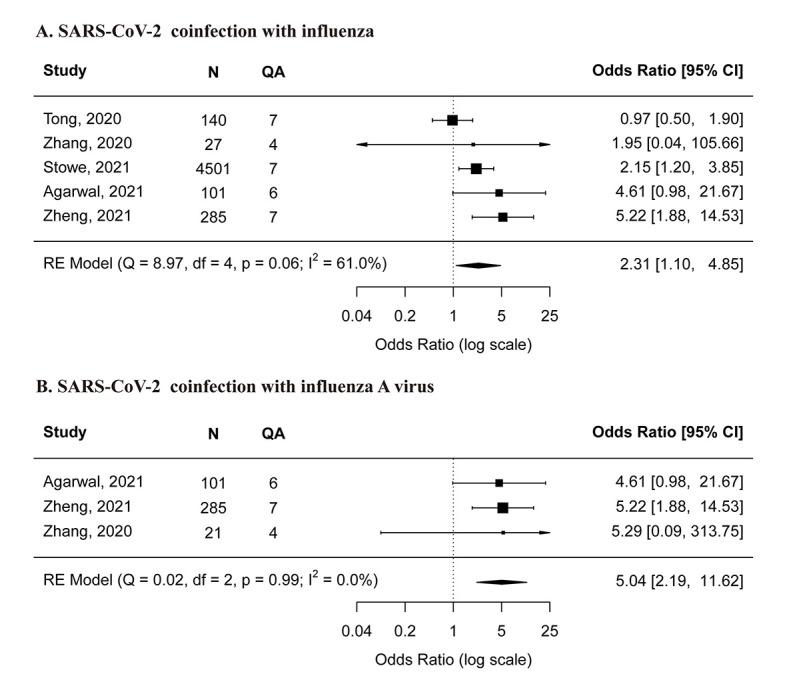
Twelve studies reporting a total of 7862 COVID-19 patients were included in the review. Influenza and SARS-CoV-2 co-infection were found to be associated with a higher risk of ICU admission (five studies, odds ratio (OR) = 2.09, 95% confidence interval (CI) = 1.64-2.68) and mechanical ventilation (five studies, OR = 2.31, 95% CI = 1.10-4.85). No significant association was found between influenza co-infection and need/use of supplemental oxygen or deaths among COVID-19 patients (four studies, OR = 1.04, 95% CI = 0.37-2.95; 11 studies, OR = 1.41, 95% CI = 0.65-3.08, respectively). For RSV co-infection, data were only sufficient to allow for analyses for the outcome of deaths, and no significant association was found between RSV co-infection and deaths among COVID-19 patients (three studies, OR = 5.27, 95% CI = 0.58-47.87).
CONCLUSIONS
Existing evidence suggests that co-infection with influenza might be associated with a 2-fold increase in the risk for ICU admission and for mechanical ventilation among COVID-19 patients whereas evidence is limited on the role of RSV co-infection. Co-infection with influenza does not increase the risk of death in COVID-19 patients.
REGISTRATION
PROSEPRO CRD42021283045.
背景
随着 COVID-19 非药物干预措施的放宽,在经历了一年多的低活性后,流感和呼吸道合胞病毒 (RSV) 在多个国家再次出现。然而,流感或 RSV 合并感染是否会影响 COVID-19 患者的疾病严重程度尚不清楚。我们旨在了解流感/RSV 合并感染对 COVID-19 患者临床疾病严重程度的影响。
方法
我们对比较合并感染组(即流感/RSV 与 SARS-CoV-2)和单感染组(即 SARS-CoV-2)之间临床严重程度的出版物进行了系统的文献回顾,使用以下四个结局:需要或使用补充氧气、重症监护病房(ICU)入院、机械通气和死亡。我们根据临床结局总结了结果,并在适用的情况下进行了随机效应荟萃分析。
结果
综述共纳入了 12 项研究,总计 7862 例 COVID-19 患者。流感和 SARS-CoV-2 合并感染与 ICU 入院风险增加相关(五项研究,优势比 (OR) = 2.09,95%置信区间 (CI) = 1.64-2.68)和机械通气(五项研究,OR = 2.31,95%CI = 1.10-4.85)。流感合并感染与 COVID-19 患者需要/使用补充氧气或死亡之间无显著相关性(四项研究,OR = 1.04,95%CI = 0.37-2.95;11 项研究,OR = 1.41,95%CI = 0.65-3.08)。对于 RSV 合并感染,仅获得足够的数据进行死亡率结局分析,未发现 RSV 合并感染与 COVID-19 患者死亡之间存在显著相关性(三项研究,OR = 5.27,95%CI = 0.58-47.87)。
结论
现有证据表明,流感合并感染可能使 COVID-19 患者 ICU 入院和机械通气的风险增加 2 倍,而 RSV 合并感染的作用证据有限。流感合并感染不会增加 COVID-19 患者的死亡风险。
登记号
PROSEPRO CRD42021283045。



 Zotero 插件