
游离DNA生物学重要性的新视角
New Perspectives on the Importance of Cell-Free DNA Biology.
作者信息
Bronkhorst Abel J, Ungerer Vida, Oberhofer Angela, Gabriel Sophie, Polatoglou Eleni, Randeu Hannah, Uhlig Carsten, Pfister Heiko, Mayer Zsuzsanna, Holdenrieder Stefan
机构信息
Munich Biomarker Research Center, Institute for Laboratory Medicine, German Heart Centre, Technical University Munich, Lazarettstraße 36, D-80636 Munich, Germany.
出版信息
Diagnostics (Basel). 2022 Sep 3;12(9):2147. doi: 10.3390/diagnostics12092147.
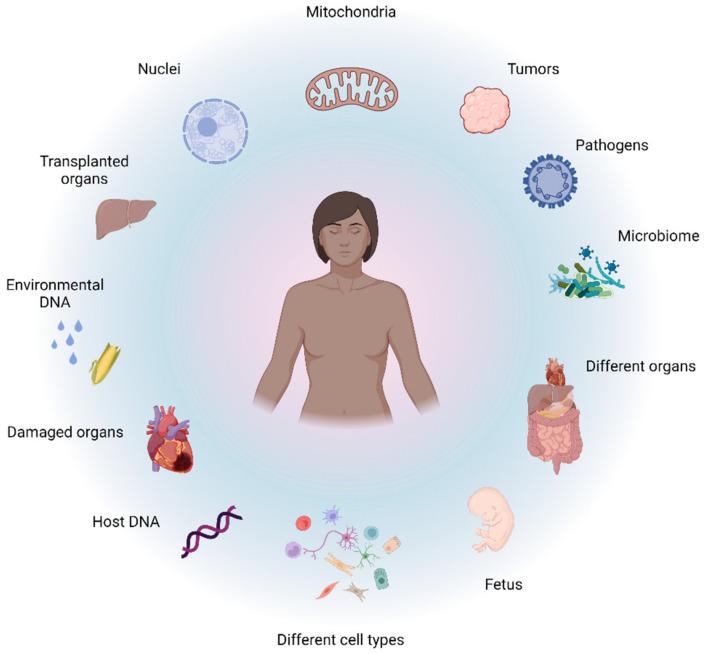
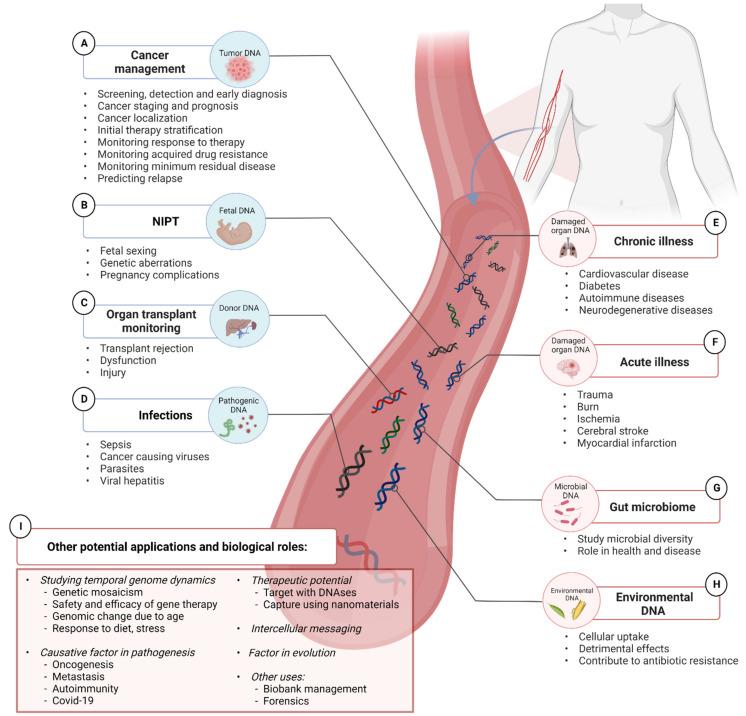
Body fluids are constantly replenished with a population of genetically diverse cell-free DNA (cfDNA) fragments, representing a vast reservoir of information reflecting real-time changes in the host and metagenome. As many body fluids can be collected non-invasively in a one-off and serial fashion, this reservoir can be tapped to develop assays for the diagnosis, prognosis, and monitoring of wide-ranging pathologies, such as solid tumors, fetal genetic abnormalities, rejected organ transplants, infections, and potentially many others. The translation of cfDNA research into useful clinical tests is gaining momentum, with recent progress being driven by rapidly evolving preanalytical and analytical procedures, integrated bioinformatics, and machine learning algorithms. Yet, despite these spectacular advances, cfDNA remains a very challenging analyte due to its immense heterogeneity and fluctuation in vivo. It is increasingly recognized that high-fidelity reconstruction of the information stored in cfDNA, and in turn the development of tests that are fit for clinical roll-out, requires a much deeper understanding of both the physico-chemical features of cfDNA and the biological, physiological, lifestyle, and environmental factors that modulate it. This is a daunting task, but with significant upsides. In this review we showed how expanded knowledge on cfDNA biology and faithful reverse-engineering of cfDNA samples promises to (i) augment the sensitivity and specificity of existing cfDNA assays; (ii) expand the repertoire of disease-specific cfDNA markers, thereby leading to the development of increasingly powerful assays; (iii) reshape personal molecular medicine; and (iv) have an unprecedented impact on genetics research.
体液中不断补充着一群基因多样的游离DNA(cfDNA)片段,它们构成了一个庞大的信息库,反映了宿主和宏基因组的实时变化。由于许多体液可以通过一次性和连续性的方式进行非侵入性采集,因此可以利用这个信息库开发检测方法,用于诊断、预后评估以及监测多种疾病,如实体瘤、胎儿基因异常、器官移植排斥、感染等,可能还有许多其他疾病。cfDNA研究向实用临床检测的转化正在加速,近期的进展得益于快速发展的分析前和分析程序、综合生物信息学以及机器学习算法。然而,尽管取得了这些显著进展,但由于cfDNA在体内具有极大的异质性和波动性,它仍然是一种极具挑战性的分析物。人们越来越认识到,要高保真地重建cfDNA中存储的信息,进而开发适合临床应用的检测方法,需要更深入地了解cfDNA的物理化学特征以及调节它的生物学、生理学、生活方式和环境因素。这是一项艰巨的任务,但也有显著的好处。在这篇综述中,我们展示了对cfDNA生物学的深入了解以及对cfDNA样本进行可靠的逆向工程如何有望:(i)提高现有cfDNA检测方法的灵敏度和特异性;(ii)扩大疾病特异性cfDNA标志物的范围,从而开发出越来越强大的检测方法;(iii)重塑个人分子医学;(iv)对遗传学研究产生前所未有的影响。





 Zotero 插件