
深度学习和基于图谱的自动分割在放射治疗中危及器官的临床评估。
Clinical evaluation of deep learning and atlas-based auto-segmentation for critical organs at risk in radiation therapy.
机构信息
Department of Radiation Oncology, Mid North Coast Cancer Institute, Port Macquarie, New South Wales, Australia.
Department of Radiation Oncology, Mid North Coast Cancer Institute, Coffs Harbour, New South Wales, Australia.
出版信息
J Med Radiat Sci. 2023 Apr;70 Suppl 2(Suppl 2):15-25. doi: 10.1002/jmrs.618. Epub 2022 Sep 23.
INTRODUCTION
Contouring organs at risk (OARs) is a time-intensive task that is a critical part of radiation therapy. Atlas-based automatic segmentation has shown some success at reducing this time burden on practitioners; however, this method often requires significant manual editing to reach a clinically accurate standard. Deep learning (DL) auto-segmentation has recently emerged as a promising solution. This study compares the accuracy of DL and atlas-based auto-segmentation in relation to clinical 'gold standard' reference contours.
METHODS
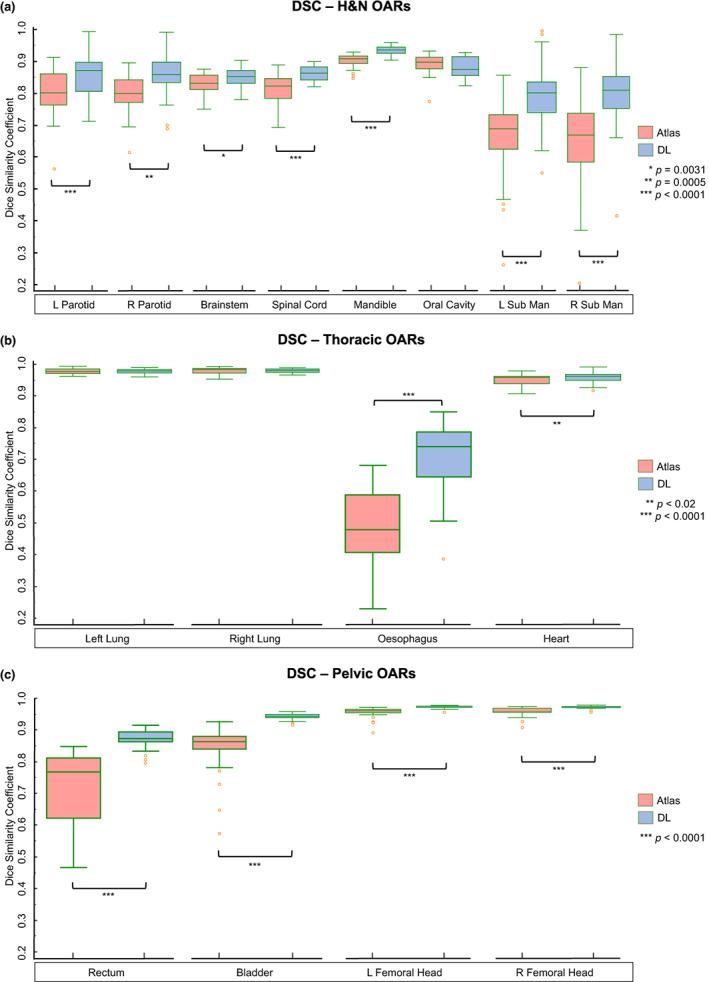
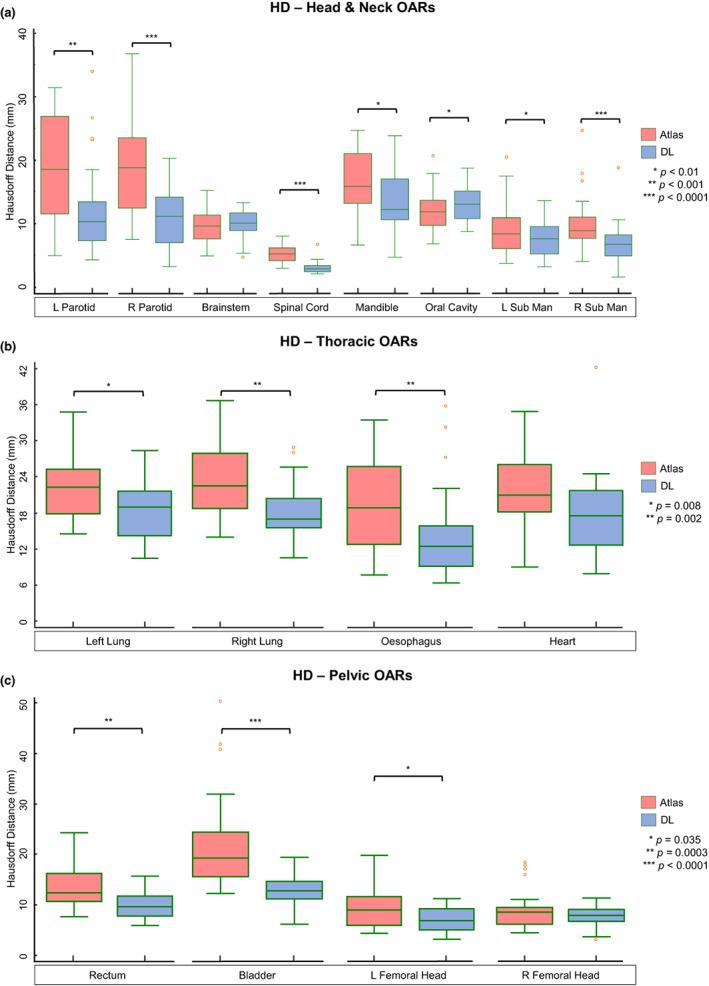
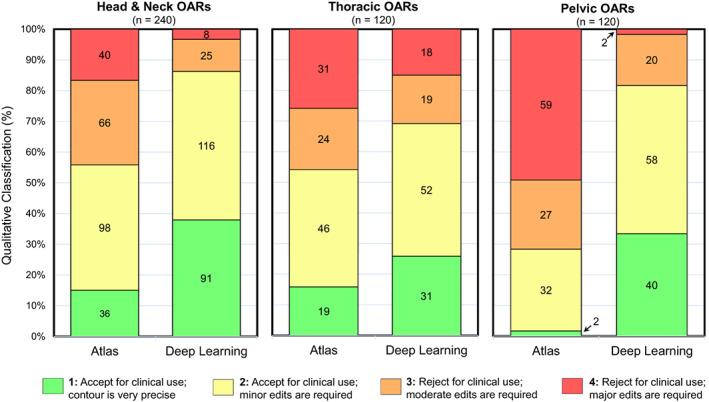
Ninety CT datasets (30 head and neck, 30 thoracic, 30 pelvic) were automatically contoured using both atlas and DL segmentation techniques. Sixteen critical OARs were then quantitatively measured for accuracy using the Dice similarity coefficient (DSC) and Hausdorff distance (HD). Qualitative analysis was performed to visually classify the accuracy of each structure into one of four explicitly defined categories. Additionally, the time to edit atlas and DL contours to a clinically acceptable level was recorded for a subset of 9 OARs.
RESULTS
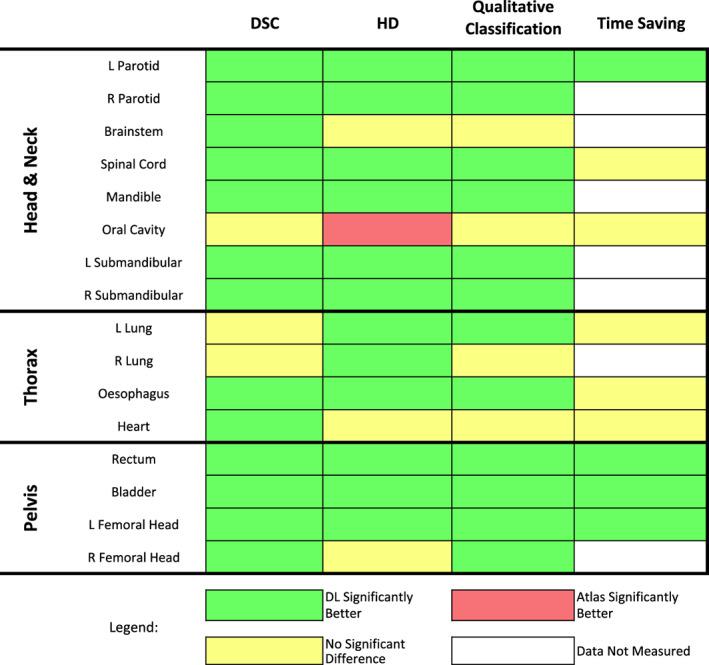
Of the 16 OARs analysed, DL delivered statistically significant improvements over atlas segmentation in 13 OARs measured with DSC, 12 OARs measured with HD, and 12 OARs measured qualitatively. The mean editing time for the subset of DL contours was 50%, 23% and 61% faster (all P < 0.05) than that of atlas segmentation for the head and neck, thorax, and pelvis respectively.
CONCLUSIONS
Deep learning segmentation comprehensively outperformed atlas-based contouring for the majority of evaluated OARs. Improvements were observed in geometric accuracy and visual acceptability, while editing time was reduced leading to increased workflow efficiency.
简介
勾画危及器官(OARs)是放射治疗中一项耗时的任务,也是关键部分。基于图谱的自动分割在一定程度上减少了医生的工作负担,但这种方法通常需要大量的手动编辑才能达到临床准确的标准。深度学习(DL)自动分割最近成为一种很有前途的解决方案。本研究比较了 DL 和基于图谱的自动分割在与临床“金标准”参考轮廓相关方面的准确性。
方法
使用基于图谱和 DL 分割技术对 90 个 CT 数据集(30 个头颈部、30 个胸部、30 个盆腔)进行自动勾画。然后使用 Dice 相似系数(DSC)和 Hausdorff 距离(HD)对 16 个关键 OAR 进行定量测量,以评估准确性。进行了定性分析,将每个结构的准确性分为四个明确定义的类别之一。此外,还记录了将图谱和 DL 轮廓编辑到临床可接受水平的时间,这是 9 个 OAR 的子集。
结果
在所分析的 16 个 OAR 中,在 13 个用 DSC 测量的 OAR、12 个用 HD 测量的 OAR 和 12 个用定性方法测量的 OAR 中,DL 比基于图谱的分割有统计学上的显著改善。对于头颈部、胸部和骨盆,DL 轮廓子集的平均编辑时间比基于图谱的分割分别快 50%、23%和 61%(均 P<0.05)。
结论
对于大多数评估的 OAR,深度学习分割全面优于基于图谱的轮廓勾画。在几何准确性和视觉可接受性方面都有改进,同时编辑时间减少,提高了工作流程效率。

 Zotero 插件