
基于应用程序的家庭锻炼计划对非特异性和退行性腰痛患者自我报告疼痛强度的影响:实用型开放性随机对照试验。
The Effect of an App-Based Home Exercise Program on Self-reported Pain Intensity in Unspecific and Degenerative Back Pain: Pragmatic Open-label Randomized Controlled Trial.
机构信息
Institute for Occupational Medicine, Social Medicine and Health Services Research, University Hospital Tübingen, Eberhard-Karls-University Tübingen, Tübingen, Germany.
Medical Assessment Institute Tübingen, Tübingen, Germany.
出版信息
J Med Internet Res. 2022 Oct 28;24(10):e41899. doi: 10.2196/41899.
BACKGROUND
The recommended first-line treatment for unspecific and degenerative back pain consists of movement exercises and patient education.
OBJECTIVE
Using a pragmatic, randomized controlled trial, we evaluated the effectiveness of a digital home exercise program on self-reported pain intensity compared with the standard of care for physiotherapy.
METHODS
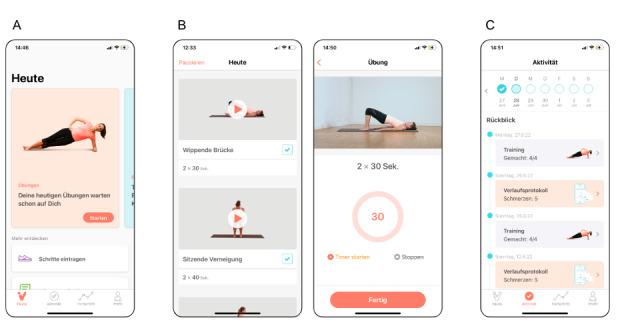
Participant recruitment was based on newspaper advertisements and a consecutive on-site assessment for eligibility and enrollment. Participants with unspecific and degenerative back pain aged ≥18 years were randomly assigned in a 1:1 ratio to receive a 12-week stand-alone digital home exercise program or physiotherapy. The digital home exercise program included 4 exercises daily, while physiotherapy included 6 to 12 sessions, depending on the severity of symptoms. The primary outcome was pain, which was assessed using a verbal numerical rating scale. The clinical relevance of pain reduction was assessed using the following thresholds: improvement of at least 1.4 points on the verbal numerical rating scale and a pain reduction of at least 30%.
RESULTS
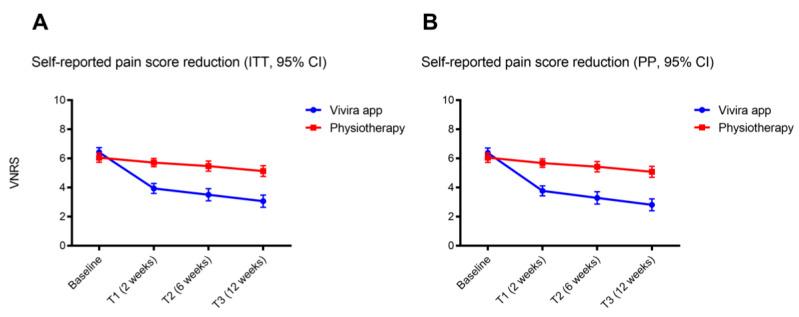
During the study period, 108 participants were assigned to the intervention group and 105 participants to the control group. The mean difference in pain scores between the 2 groups at 12 weeks was -2.44 (95% CI -2.92 to -1.95; P<.01) in favor of the intervention group. The group receiving the digital therapeutic achieved a clinically relevant reduction in pain over the course of the study (baseline vs 12 weeks), with a mean change of -3.35 (SD 2.05) score points or -53.1% (SD 29.5). By contrast, this change did not reach clinical relevance in the control group (mean -0.91, SD 1.5; -14.6%, SD 25.3). Retention rates of 89.9% in the intervention group and 97.3% in the control group were maintained throughout the study.
CONCLUSIONS
The use of the app-based home exercise program led to a significant and clinically relevant reduction in pain intensity throughout the 12-week duration of the program. The intervention studied showed superior improvement in self-reported pain intensity when compared with the standard of care. Given the great demand for standard physiotherapy for unspecific and degenerative back pain, digital therapeutics are evolving into a suitable therapeutic option that can overcome the limitations of access and availability of conventional modes of health care delivery into this spectrum of indications. However, further independent evaluations are required to support the growing body of evidence on the effectiveness of digital therapeutics in real-world care settings.
TRIAL REGISTRATION
German Clinical Trials Register DRKS00022781; https://tinyurl.com/hpdraa89.
背景
针对非特异性和退行性腰痛,推荐的一线治疗方法包括运动锻炼和患者教育。
目的
采用实用、随机对照试验,我们评估了数字家庭运动方案与物理治疗标准护理相比,在自我报告的疼痛强度方面的有效性。
方法
参与者的招募基于报纸广告和现场连续评估的资格和纳入标准。年龄≥18 岁的非特异性和退行性腰痛患者,按 1:1 的比例随机分配接受为期 12 周的独立数字家庭运动方案或物理治疗。数字家庭运动方案包括每天 4 次锻炼,而物理治疗根据症状严重程度,包括 6 至 12 次治疗。主要结局是疼痛,采用口述数字评分量表进行评估。使用以下阈值评估疼痛减轻的临床相关性:口述数字评分量表至少改善 1.4 分,疼痛减轻至少 30%。
结果
在研究期间,108 名参与者被分配到干预组,105 名参与者被分配到对照组。两组在 12 周时的疼痛评分平均差值为-2.44(95%CI-2.92 至-1.95;P<.01),有利于干预组。接受数字治疗的组在研究过程中实现了疼痛的临床相关减轻,平均变化为-3.35(SD 2.05)分或-53.1%(SD 29.5)。相比之下,对照组的这种变化没有达到临床相关性(平均-0.91,SD 1.5;-14.6%,SD 25.3)。干预组的保留率为 89.9%,对照组为 97.3%,整个研究过程中均保持不变。
结论
使用基于应用程序的家庭运动方案在整个 12 周的治疗期间显著降低了疼痛强度,且具有临床相关性。与标准护理相比,该干预措施在自我报告的疼痛强度方面显示出更好的改善。鉴于对非特异性和退行性腰痛的标准物理治疗的巨大需求,数字疗法正在演变为一种合适的治疗选择,可以克服常规医疗保健模式在这些适应症范围内的可及性和可用性限制。然而,需要进一步的独立评估来支持数字疗法在真实护理环境中有效性的不断增加的证据。
试验注册
德国临床试验注册中心 DRKS00022781;https://tinyurl.com/hpdraa89。

 Zotero 插件