
25份脓液样本的宏基因组二代测序结果分析
Analysis of Metagenomic Next-Generation Sequencing Results of 25 Pus Samples.
作者信息
Shi Yuru, Wu Jing, Liu Ting, Yue Li, Liu Yang, Gu Yan, Qi Yingjie
机构信息
Department of Clinical Laboratory, Infection Hospital Area of the First Affiliated Hospital of University of Science and Technology of China (Hefei Infectious Disease Hospital), Hefei, 230022, People's Republic of China.
出版信息
Infect Drug Resist. 2022 Nov 8;15:6515-6524. doi: 10.2147/IDR.S385925. eCollection 2022.
PURPOSE
To explore the clinical value of detecting pathogens in pus samples by metagenomic next-generation sequencing (mNGS).
METHODS
The 25 pus samples from infected patients were collected in this research. The positive rate and consistency of pathogenic bacteria detected by mNGS and conventional methods were compared. The pathogen types detected by the two methods were analyzed. Furthermore, the modifications of antibiotic treatment therapy were also evaluated based on mNGS results.
RESULTS
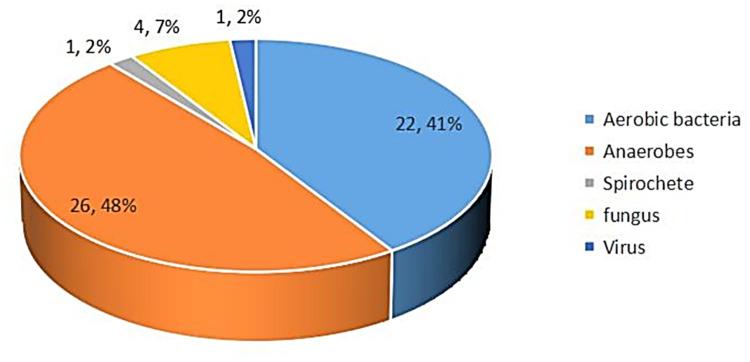
The sensitivity of mNGS method in detecting pathogenic bacteria in pus samples was better than that of conventional method (96% vs 40%; P < 0.01). Only 10 samples were detected pathogens by conventional methods, but 24 samples were detected by mNGS method. In specific, the results of conventional methods showed 10 samples had 11 kinds of pathogenic bacteria, of which 9 samples were single pathogen and 1 sample had two kinds of pathogenic bacteria. The results of mNGS method showed 24 samples were detected with 54 kinds of pathogenic bacteria, of which 15 samples were detected with single pathogen, and 9 samples were detected with two or more kinds of pathogenic bacteria. The two methods had 9(36%) consistent results, 14 (56%) completely different results, and 2 (8%) partially consistent results, and the kappa value was 0.19. Notably, mNGS could detect viruses, anaerobic bacteria, and other uncommon pathogens simultaneously.
CONCLUSION
The application of mNGS in the detection of pus specimens from different parts not only have high accuracy rate and also reduce the turnaround time of diagnosis. In addition, the performance of mNGS detection of anaerobic bacteria and caustic bacteria is better than conventional methods. The mNGS diagnosis in pus sample may play an important role in clinical diagnosis and treatment strategy decisions.
目的
探讨宏基因组下一代测序(mNGS)技术在检测脓液样本中病原体的临床价值。
方法
本研究收集了25例感染患者的脓液样本。比较mNGS技术与传统方法检测病原菌的阳性率及一致性,并分析两种方法检测出的病原体类型。此外,还根据mNGS结果评估抗生素治疗方案的调整情况。
结果
mNGS技术检测脓液样本中病原菌的灵敏度高于传统方法(96%比40%;P<0.01)。传统方法仅检测出10例样本有病原菌,而mNGS技术检测出24例样本有病原菌。具体而言,传统方法检测结果显示10例样本有11种病原菌,其中9例样本为单一病原体,1例样本有两种病原菌。mNGS技术检测结果显示24例样本检测出54种病原菌,其中15例样本为单一病原体,9例样本检测出两种或以上病原菌。两种方法结果一致的有9例(36%),完全不同的有14例(56%),部分一致的有2例(8%),kappa值为0.19。值得注意的是,mNGS技术可同时检测病毒、厌氧菌及其他罕见病原体。
结论
mNGS技术应用于不同部位脓液标本的检测,不仅准确率高,还可缩短诊断周转时间。此外,mNGS技术检测厌氧菌和苛养菌的性能优于传统方法。mNGS技术在脓液样本诊断中可能对临床诊断及治疗策略决策发挥重要作用。



 Zotero 插件