
粪便多组学研究炎症性肠病中的宿主-微生物相互作用。
Stool multi-omics for the study of host-microbe interactions in inflammatory bowel disease.
机构信息
Department of Pharmacology, University of California San Diego, La Jolla, CA, USA.
Skaggs School of Pharmacy, University of California San Diego, La Jolla, CA, USA.
出版信息
Gut Microbes. 2022 Jan-Dec;14(1):2154092. doi: 10.1080/19490976.2022.2154092.
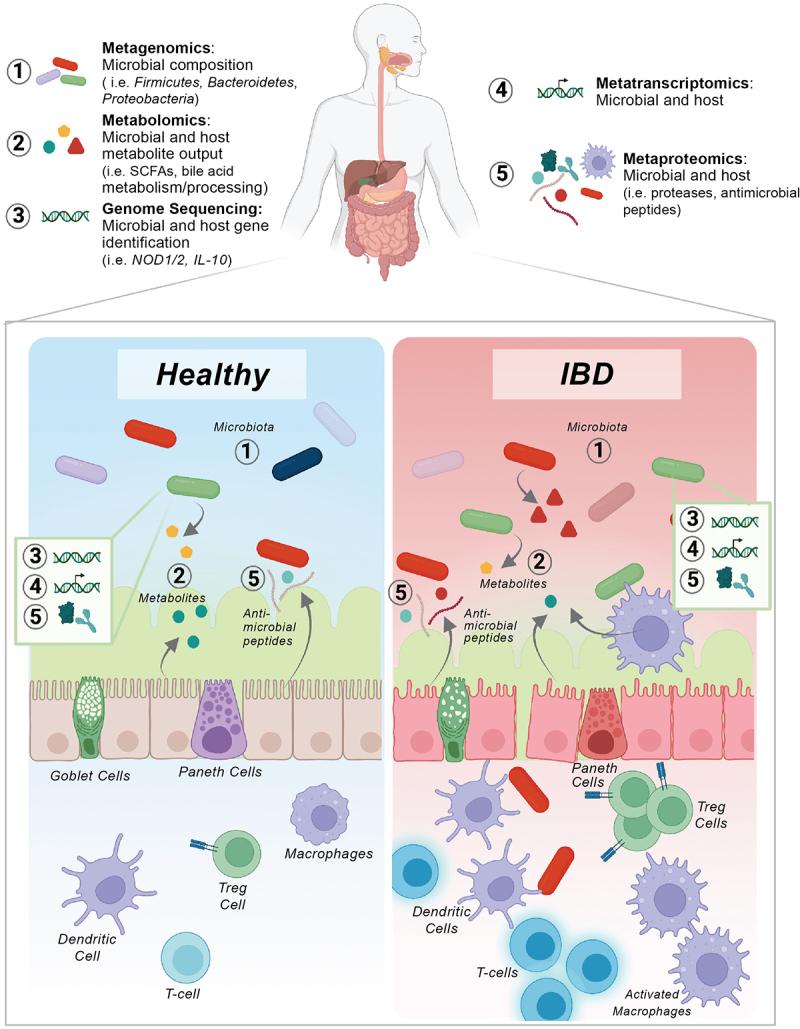
Inflammatory Bowel Disease (IBD) is a chronic immune-mediated inflammatory disease of the gastrointestinal tract that is a growing public burden. Gut microbes and their interactions with hosts play a crucial role in disease pathogenesis and progression. These interactions are complex, spanning multiple physiological systems and data types, making comprehensive disease assessment difficult, and often overwhelming single-omic capabilities. Stool-based multi-omics is a promising approach for characterizing host-gut microbiome interactions using deep integration of technologies such as 16S rRNA sequencing, shotgun metagenomics, meta-transcriptomics, metabolomics, and metaproteomics. The wealth of information generated through multi-omic studies is poised to usher in advancements in IBD research and precision medicine. This review highlights historical and recent findings from stool-based muti-omic studies that have contributed to unraveling IBD's complexity. Finally, we discuss common pitfalls, issues, and limitations, and how future pipelines should address them to standardize multi-omics in IBD research and beyond.
炎症性肠病(IBD)是一种慢性免疫介导的胃肠道炎症性疾病,是一个日益增长的公众负担。肠道微生物及其与宿主的相互作用在疾病的发病机制和进展中起着至关重要的作用。这些相互作用非常复杂,涉及多个生理系统和数据类型,使得全面的疾病评估变得困难,并且常常超出单一组学的能力。基于粪便的多组学是一种很有前途的方法,可通过深度整合 16S rRNA 测序、宏基因组学、元转录组学、代谢组学和宏蛋白质组学等技术来描述宿主-肠道微生物组的相互作用。通过多组学研究产生的大量信息有望推动 IBD 研究和精准医学的进步。本综述重点介绍了基于粪便的多组学研究中的历史和近期发现,这些发现有助于揭示 IBD 的复杂性。最后,我们讨论了常见的陷阱、问题和局限性,以及未来的研究应如何解决这些问题,以标准化 IBD 研究及其他领域的多组学。
 Zotero 插件