
纳米粒子在糖尿病创面愈合中的应用综述:治疗潜力及未来展望。
A Comprehensive Review of the Application of Nanoparticles in Diabetic Wound Healing: Therapeutic Potential and Future Perspectives.
机构信息
College of Life Science, Mudanjiang Medical University, Mudanjiang, People's Republic of China.
Changhai Clinical Research Unit, Shanghai Changhai Hospital, Naval Medical University, Shanghai, People's Republic of China.
出版信息
Int J Nanomedicine. 2022 Dec 5;17:6007-6029. doi: 10.2147/IJN.S386585. eCollection 2022.
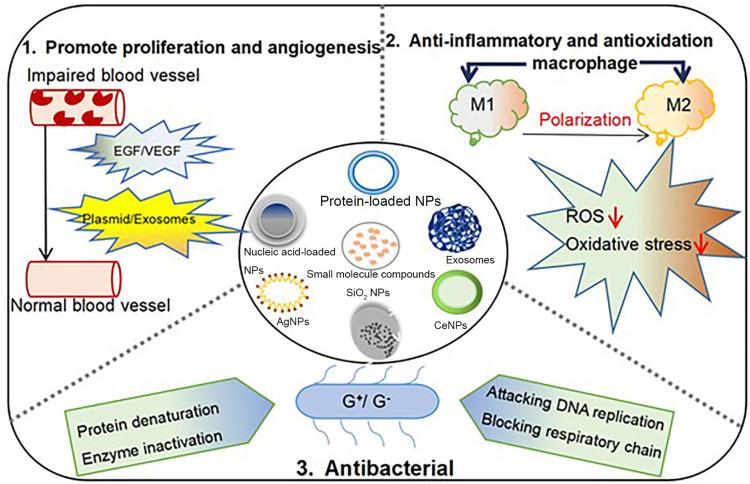
Diabetic wounds are one of the most challenging public health issues of the 21st century due to their inadequate vascular supply, bacterial infections, high levels of oxidative stress, and abnormalities in antioxidant defenses, whereas there is no effective treatment for diabetic wounds. Due to the distinct properties of nanoparticles, such as their small particle size, elevated cellular uptake, low cytotoxicity, antibacterial activity, good biocompatibility, and biodegradability. The application of nanoparticles has been widely used in the treatment of diabetic wound healing due to their superior anti-inflammatory, antibacterial, and antioxidant activities. These nanoparticles can also be loaded with various agents, such as organic molecules (eg, exosomes, small molecule compounds, etc.), inorganic molecules (metals, nonmetals, etc.), or complexed with various biomaterials, such as smart hydrogels (HG), chitosan (CS), and hyaluronic acid (HA), to augment their therapeutic potential in diabetic wounds. This paper reviews the therapeutic potential and future perspective of nanoparticles in the treatment of diabetic wounds. Together, nanoparticles represent a promising strategy in the treatment of diabetic wound healing. The future direction may be to develop novel nanoparticles with multiple effects that not only act in wound healing at all stages of diabetes but also provide a stable physiological environment throughout the wound-healing process.
糖尿病性创面是 21 世纪最具挑战性的公共健康问题之一,其原因在于血管供应不足、细菌感染、氧化应激水平高以及抗氧化防御异常,而目前对糖尿病性创面尚无有效的治疗方法。由于纳米粒子具有独特的性质,如粒径小、细胞摄取率高、细胞毒性低、抗菌活性、良好的生物相容性和可生物降解性,因此在治疗糖尿病创面愈合方面得到了广泛的应用。这些纳米粒子还可以负载各种药物,如有机分子(例如外泌体、小分子化合物等)、无机分子(金属、非金属等),或与各种生物材料结合,如智能水凝胶(HG)、壳聚糖(CS)和透明质酸(HA),以增强其在糖尿病创面中的治疗潜力。本文综述了纳米粒子在治疗糖尿病创面中的治疗潜力和未来前景。总之,纳米粒子代表了治疗糖尿病创面愈合的一种有前途的策略。未来的方向可能是开发具有多种作用的新型纳米粒子,这些纳米粒子不仅能在糖尿病的各个阶段促进创面愈合,而且能在整个创面愈合过程中提供稳定的生理环境。




 Zotero 插件