
一种与年龄相关的心血管疾病的统一模型。
A Unified Model of Age-Related Cardiovascular Disease.
作者信息
Fossel Michael, Bean Joe, Khera Nina, Kolonin Mikhail G
机构信息
Telocyte, Grand Rapids, MI 49503, USA.
University of Missouri School of Medicine, Kansas City, MO 65211, USA.
出版信息
Biology (Basel). 2022 Dec 6;11(12):1768. doi: 10.3390/biology11121768.
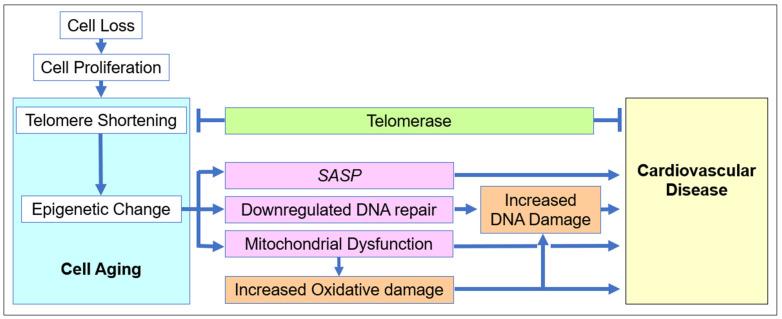
Despite progress in biomedical technologies, cardiovascular disease remains the main cause of mortality. This is at least in part because current clinical interventions do not adequately take into account aging as a driver and are hence aimed at suboptimal targets. To achieve progress, consideration needs to be given to the role of cell aging in disease pathogenesis. We propose a model unifying the fundamental processes underlying most age-associated cardiovascular pathologies. According to this model, cell aging, leading to cell senescence, is responsible for tissue changes leading to age-related cardiovascular disease. This process, occurring due to telomerase inactivation and telomere attrition, affects all components of the cardiovascular system, including cardiomyocytes, vascular endothelial cells, smooth muscle cells, cardiac fibroblasts, and immune cells. The unified model offers insights into the relationship between upstream risk factors and downstream clinical outcomes and explains why interventions aimed at either of these components have limited success. Potential therapeutic approaches are considered based on this model. Because telomerase activity can prevent and reverse cell senescence, telomerase gene therapy is discussed as a promising intervention. Telomerase gene therapy and similar systems interventions based on the unified model are expected to be transformational in cardiovascular medicine.
尽管生物医学技术取得了进展,但心血管疾病仍然是主要的死亡原因。这至少部分是因为当前的临床干预措施没有充分考虑衰老作为一个驱动因素,因此针对的是次优靶点。为了取得进展,需要考虑细胞衰老在疾病发病机制中的作用。我们提出了一个统一大多数与年龄相关的心血管疾病潜在基本过程的模型。根据这个模型,导致细胞衰老的细胞老化是导致与年龄相关的心血管疾病的组织变化的原因。这个过程由于端粒酶失活和端粒磨损而发生,影响心血管系统的所有组成部分,包括心肌细胞、血管内皮细胞、平滑肌细胞、心脏成纤维细胞和免疫细胞。这个统一模型揭示了上游危险因素和下游临床结果之间的关系,并解释了为什么针对这些组成部分中的任何一个的干预措施取得的成功有限。基于这个模型考虑了潜在的治疗方法。因为端粒酶活性可以预防和逆转细胞衰老,端粒酶基因治疗被作为一种有前景的干预措施进行了讨论。基于统一模型的端粒酶基因治疗和类似的系统干预措施有望在心血管医学中带来变革。

 Zotero 插件