
针对严重急性呼吸综合征冠状病毒2(SARS-CoV-2)的天然免疫识别
Innate immune recognition against SARS-CoV-2.
作者信息
Yamada Taisho, Takaoka Akinori
机构信息
Division of Signaling in Cancer and Immunology, Institute for Genetic Medicine, Hokkaido University, Sapporo, Hokkaido, Japan.
Molecular Medical Biochemistry Unit, Graduate School of Chemical Sciences and Engineering Hokkaido University, Sapporo, Hokkaido, Japan.
出版信息
Inflamm Regen. 2023 Jan 26;43(1):7. doi: 10.1186/s41232-023-00259-5.
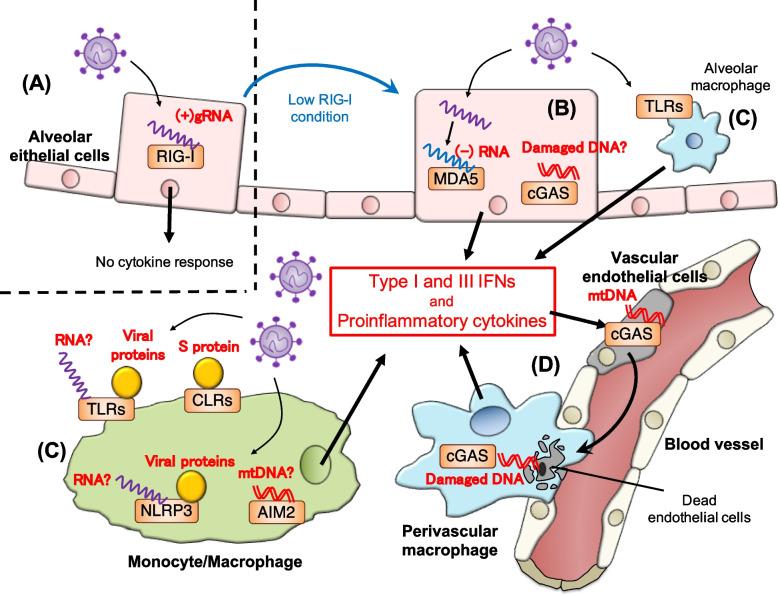
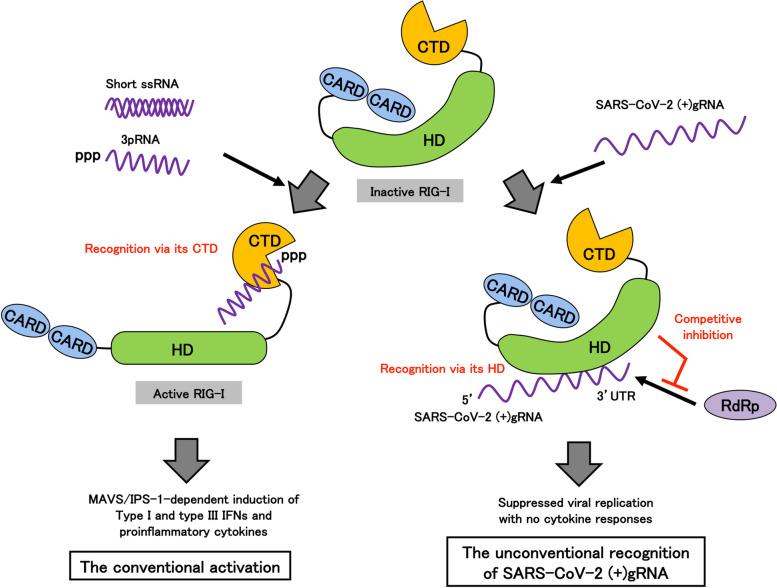
Severe acute respiratory syndrome coronavirus-2 (SARS-CoV-2) is the causative virus of pandemic acute respiratory disease called coronavirus disease 2019 (COVID-19). Most of the infected individuals have asymptomatic or mild symptoms, but some patients show severe and critical systemic inflammation including tissue damage and multi-organ failures. Immune responses to the pathogen determine clinical course. In general, the activation of innate immune responses is mediated by host pattern-recognition receptors (PRRs) that recognize pathogen-associated molecular patterns (PAMPs) as well as host damage-associated molecular patterns (DAMPs), which results in the activation of the downstream gene induction programs of types I and III interferons (IFNs) and proinflammatory cytokines for inducing antiviral activity. However, the excessive activation of these responses may lead to deleterious inflammation. Here, we review the recent advances in our understanding of innate immune responses to SARS-CoV-2 infection, particularly in terms of innate recognition and the subsequent inflammation underlying COVID-19 immunopathology.
严重急性呼吸综合征冠状病毒2(SARS-CoV-2)是引发大流行性急性呼吸道疾病冠状病毒病2019(COVID-19)的病毒。大多数感染者无症状或症状轻微,但一些患者会出现严重且危急的全身炎症,包括组织损伤和多器官功能衰竭。对病原体的免疫反应决定临床病程。一般来说,固有免疫反应的激活由宿主模式识别受体(PRR)介导,这些受体识别病原体相关分子模式(PAMP)以及宿主损伤相关分子模式(DAMP),从而导致I型和III型干扰素(IFN)以及促炎细胞因子的下游基因诱导程序激活,以诱导抗病毒活性。然而,这些反应的过度激活可能导致有害炎症。在此,我们综述了我们对SARS-CoV-2感染固有免疫反应理解的最新进展,特别是在固有识别以及COVID-19免疫病理学潜在的后续炎症方面。
 Zotero 插件