
靶向 Cbl-b 进行癌症免疫治疗。
Targeting Cbl-b in cancer immunotherapy.
机构信息
UPMC Hillman Cancer Center, Pittsburgh, Pennsylvania, USA.
Department of Medicine, University of Pittsburgh, Pittsburgh, Pennsylvania, USA.
出版信息
J Immunother Cancer. 2023 Feb;11(2). doi: 10.1136/jitc-2022-006007.
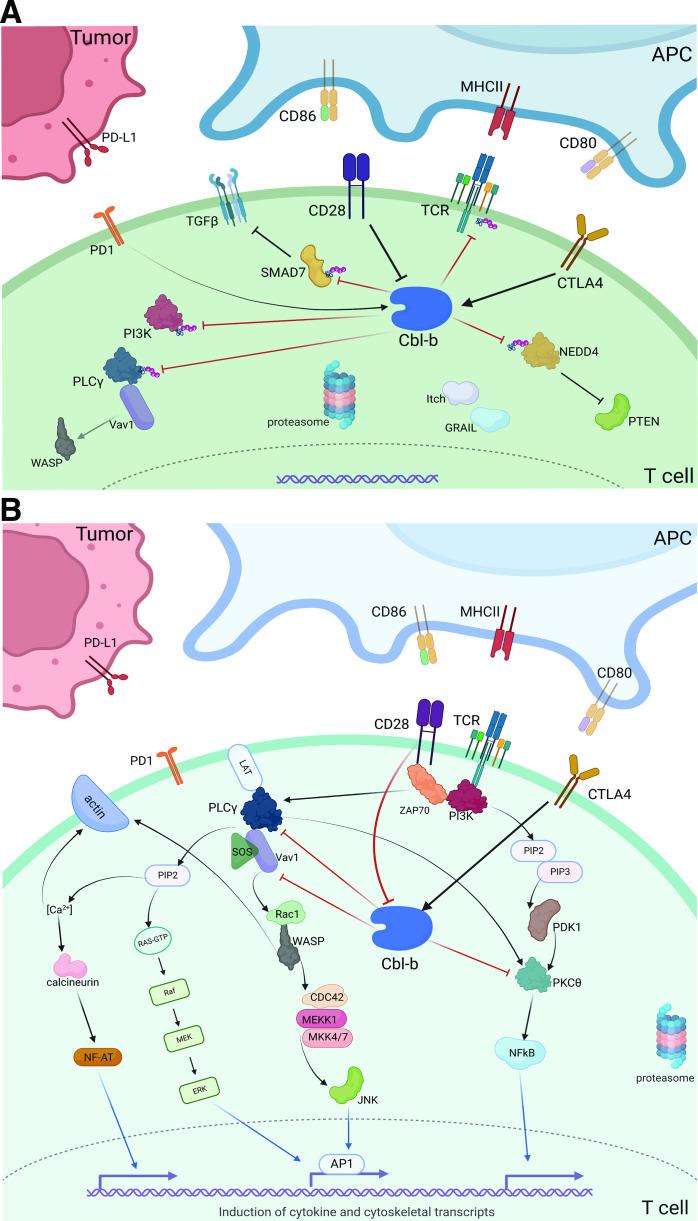
Cancer immunotherapy with immune-checkpoint blockade has improved the outcomes of patients with various malignancies, yet a majority do not benefit or develop resistance. To address this unmet need, efforts across the field are targeting additional coinhibitory receptors, costimulatory proteins, and intracellular mediators that could prevent or bypass anti-PD1 resistance mechanisms. The CD28 costimulatory pathway is necessary for antigen-specific T cell activation, though prior CD28 agonists did not translate successfully to clinic due to toxicity. Casitas B lymphoma-b (Cbl-b) is a downstream, master regulator of both CD28 and CTLA-4 signaling. This E3 ubiquitin ligase regulates both innate and adaptive immune cells, ultimately promoting an immunosuppressive tumor microenvironment (TME) in the absence of CD28 costimulation. Recent advances in pharmaceutical screening and computational biology have enabled the development of novel platforms to target this once 'undruggable' protein. These platforms include DNA encoded library screening, allosteric drug targeting, small-interfering RNA inhibition, CRISPR genome editing, and adoptive cell therapy. Both genetic knock-out models and Cbl-b inhibitors have been shown to reverse immunosuppression in the TME, stimulate cytotoxic T cell activity, and promote tumor regression, findings augmented with PD1 blockade in experimental models. In translating Cbl-b inhibitors to clinic, we propose specific gene expression profiles that may identify patient populations most likely to benefit. Overall, novel Cbl-b inhibitors provide antigen-specific immune stimulation and are a promising therapeutic tool in the field of immuno-oncology.
癌症免疫疗法中的免疫检查点阻断已经改善了各种恶性肿瘤患者的预后,但大多数患者并未从中受益或产生耐药性。为了满足这一未满足的需求,该领域的各项研究都在针对其他共抑制受体、共刺激蛋白和细胞内介质进行研究,这些靶点可能预防或绕过抗 PD-1 耐药机制。CD28 共刺激途径对于抗原特异性 T 细胞的激活是必要的,尽管先前的 CD28 激动剂由于毒性而未能成功转化为临床应用。 Casitas B 淋巴瘤-b(Cbl-b)是 CD28 和 CTLA-4 信号的下游主要调节因子。这种 E3 泛素连接酶调节先天和适应性免疫细胞,最终在缺乏 CD28 共刺激的情况下促进免疫抑制性肿瘤微环境(TME)。药物筛选和计算生物学的最新进展使靶向这种曾经“不可成药”的蛋白的新型平台得以开发。这些平台包括 DNA 编码文库筛选、变构药物靶向、小干扰 RNA 抑制、CRISPR 基因组编辑和过继细胞疗法。基因敲除模型和 Cbl-b 抑制剂都已被证明可以逆转 TME 中的免疫抑制,刺激细胞毒性 T 细胞的活性,并促进肿瘤消退,在实验模型中与 PD1 阻断联合使用时效果增强。在将 Cbl-b 抑制剂转化为临床应用时,我们提出了特定的基因表达谱,这些表达谱可能确定最有可能受益的患者群体。总的来说,新型 Cbl-b 抑制剂提供了抗原特异性免疫刺激,是免疫肿瘤学领域有前途的治疗工具。

 Zotero 插件