
一种用于从睑板腺造影评估睑板腺形态的深度学习模型。
A Deep Learning Model for Evaluating Meibomian Glands Morphology from Meibography.
作者信息
Wang Yuexin, Shi Faqiang, Wei Shanshan, Li Xuemin
机构信息
Beijing Key Laboratory of Restoration of Damaged Ocular Nerve, Department of Ophthalmology, Peking University Third Hospital, Beijing 100191, China.
State Key Laboratory of Virtual Reality Technology and Systems, School of Computer Science and Engineering, Beihang University, Beijing 100191, China.
出版信息
J Clin Med. 2023 Jan 29;12(3):1053. doi: 10.3390/jcm12031053.
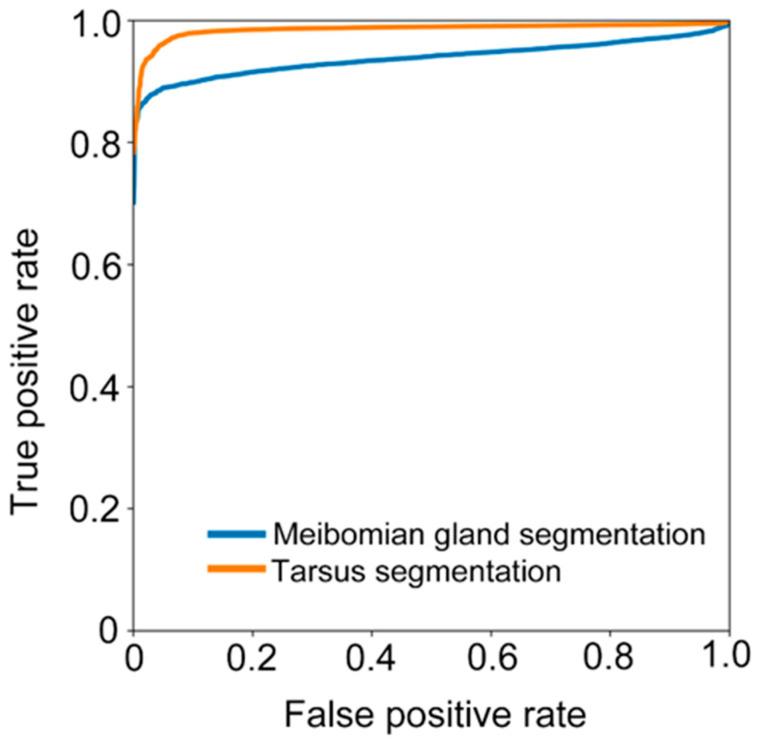
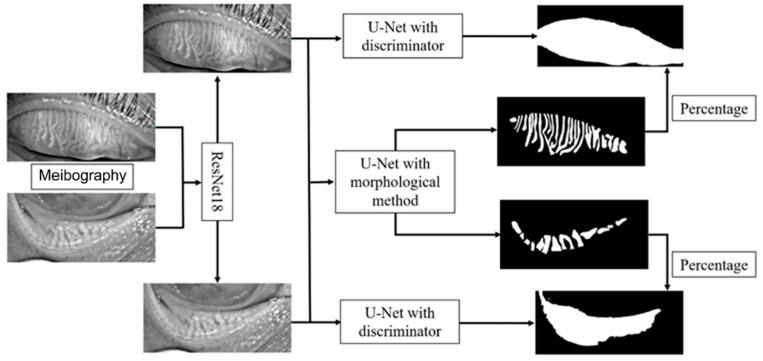
To develop a deep learning model for automatically segmenting tarsus and meibomian gland areas on meibography, we included 1087 meibography images from dry eye patients. The contour of the tarsus and each meibomian gland was labeled manually by human experts. The dataset was divided into training, validation, and test sets. We built a convolutional neural network-based U-net and trained the model to segment the tarsus and meibomian gland area. Accuracy, sensitivity, specificity, and receiver operating characteristic curve (ROC) were calculated to evaluate the model. The area under the curve (AUC) values for models segmenting the tarsus and meibomian gland area were 0.985 and 0.938, respectively. The deep learning model achieved a sensitivity and specificity of 0.975 and 0.99, respectively, with an accuracy of 0.985 for segmenting the tarsus area. For meibomian gland area segmentation, the model obtained a high specificity of 0.96, with high accuracy of 0.937 and a moderate sensitivity of 0.751. The present research trained a deep learning model to automatically segment tarsus and the meibomian gland area from infrared meibography, and the model demonstrated outstanding accuracy in segmentation. With further improvement, the model could potentially be applied to assess the meibomian gland that facilitates dry eye evaluation in various clinical and research scenarios.
为了开发一种用于在睑板腺图像上自动分割睑板和睑板腺区域的深度学习模型,我们纳入了1087张来自干眼患者的睑板腺图像。睑板和每个睑板腺的轮廓由专业人员手动标注。数据集被分为训练集、验证集和测试集。我们构建了一个基于卷积神经网络的U-net,并训练该模型来分割睑板和睑板腺区域。计算准确率、敏感性、特异性和受试者工作特征曲线(ROC)以评估该模型。分割睑板和睑板腺区域的模型的曲线下面积(AUC)值分别为0.985和0.938。该深度学习模型在分割睑板区域时的敏感性和特异性分别为0.975和0.99,准确率为0.985。对于睑板腺区域分割,该模型的特异性高达0.96,准确率为0.937,敏感性为0.751。本研究训练了一种深度学习模型,用于从红外睑板腺图像中自动分割睑板和睑板腺区域,该模型在分割方面表现出出色的准确性。经过进一步改进,该模型可能会被应用于评估睑板腺,以促进在各种临床和研究场景中的干眼评估。



 Zotero 插件