
泰国南部乌塔堡河热带河流淡水腹足纲动物中微塑料的出现。
Occurrence of microplastics in freshwater gastropods from a tropical river U-Taphao, southern Thailand.
机构信息
Coastal Oceanography and Climate Change Research Center, Faculty of Environmental Management, Prince of Songkla University, Hat Yai, Songkhla, Thailand.
International College, Prince of Songkla University, Hat Yai, Songkhla, Thailand.
出版信息
PeerJ. 2023 Feb 8;11:e14861. doi: 10.7717/peerj.14861. eCollection 2023.
BACKGROUND
Microplastics (MPs) are pollutants in rivers and marine environments. Rivers can be sources and sinks of MPs that enter the biota. Previous studies focusing on freshwater species are quite limited, especially for gastropods. Freshwater gastropods are essential to aquatic ecosystems because they are food to other aquatic animals, such as fish, shrimp, and crabs. They are a crucial link in the food chain between water resources and human food. Therefore, this study aimed to investigate MP accumulation in freshwater gastropods, commonly known as snails ( and ), in a river flowing into a shallow coastal lagoon.
METHOD
In this study, snail tissue samples were digested with 30% hydrogen peroxide. The mixture was heated at 60 °C for 24 h. MP particles were identified, counted, and characterized (shape, size, and color) by visual identification under a stereomicroscope. Furthermore, polymer-type identification was performed using Fourier transform infrared spectroscopy (FTIR). Analysis of variance (ANOVA) was applied for the statistical analysis.
RESULTS
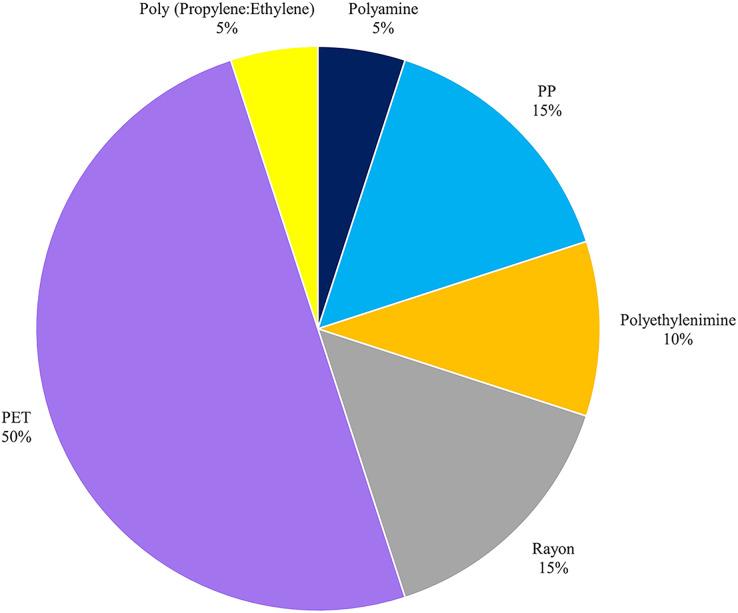
The MPs found were as follows: 4.76 particles/individual were found in upstream, 5.20 particles/individual were found in downstream, 7.28 particles/individual were found in upstream, and 4.00 particles/individual were found in downstream. It was found in the two-way ANOVA that the accumulation of MPs in gastropods was affected by species and study sites (upstream and downstream). There was a significant difference in the amount of MPs in between upstream and downstream sites ( = 0.003). Fibers were the most common MPs in both species. Moreover, upstream had the most significant amount of MPs. The smallest amount of MPs was recorded for downstream, but there was great diversity in shape, size, and polymer type. MPs sized 500 μm mm were the most common in both species. Fourier transform infrared spectroscopy revealed six polymers: poly (ethylene terephthalate), polypropylene, rayon, polyethyleneimine, polyamine, and poly propylene: ethylene). The occurrence of MPs in gastropods is alarming for food security in Thailand. The results of this study can be used to support baseline data on MP accumulation among freshwater gastropods.
背景
微塑料(MPs)是河流和海洋环境中的污染物。河流可以是进入生物群的 MPs 的源和汇。以前的研究主要集中在淡水物种上,非常有限,特别是对于腹足类动物。淡水腹足类动物对水生生态系统至关重要,因为它们是其他水生动物(如鱼类、虾类和蟹类)的食物。它们是水资源和人类食物之间食物链的关键环节。因此,本研究旨在调查流入浅沿海泻湖的河流中常见的淡水贝类( 和 )中 MPs 的积累情况。
方法
在本研究中,用 30%的过氧化氢消化贝类组织样本。将混合物在 60°C 下加热 24 小时。通过立体显微镜下的目视识别,对 MP 颗粒进行识别、计数和特征(形状、大小和颜色)描述。此外,还使用傅里叶变换红外光谱(FTIR)进行聚合物类型鉴定。采用方差分析(ANOVA)进行统计分析。
结果
发现的 MPs 如下:上游的个体中发现了 4.76 个 MPs/个体,下游的个体中发现了 5.20 个 MPs/个体,上游的个体中发现了 7.28 个 MPs/个体,下游的个体中发现了 4.00 个 MPs/个体。双向方差分析发现,贝类中 MPs 的积累受到物种和研究地点(上游和下游)的影响。上游和下游站点之间 MPs 的含量存在显著差异( = 0.003)。纤维是两种物种中最常见的 MPs。此外,上游的 MPs 含量最高。下游记录的 MPs 数量最少,但形状、大小和聚合物类型的多样性很大。两种物种中最常见的 MPs 大小为 500 μm mm。傅里叶变换红外光谱揭示了六种聚合物:聚对苯二甲酸乙二醇酯、聚丙烯、人造丝、聚乙烯亚胺、聚胺和聚丙烯:乙烯。 MPs 在腹足类动物中的存在令人担忧,这对泰国的食品安全构成了威胁。本研究的结果可用于支持淡水腹足类动物中 MPs 积累的基线数据。



 Zotero 插件