
H 是铁腐蚀的主要中间产物。
H Is a Major Intermediate in Corrosion of Iron.
机构信息
Department of Microbiology, University of Massachusetts-Amherst, Amherst, Massachusetts, USA.
Institute for Applied Life Sciences, University of Massachusetts-Amherst, Amherst, Massachusetts, USA.
出版信息
mBio. 2023 Apr 25;14(2):e0007623. doi: 10.1128/mbio.00076-23. Epub 2023 Feb 14.
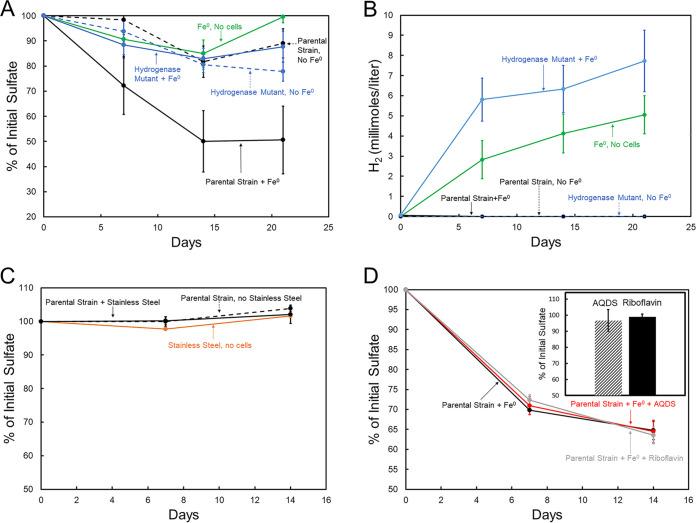
Desulfovibrio vulgaris has been a primary pure culture sulfate reducer for developing microbial corrosion concepts. Multiple mechanisms for how it accepts electrons from Fe have been proposed. We investigated Fe oxidation with a mutant of in which hydrogenase genes were deleted. The hydrogenase mutant grew as well as the parental strain with lactate as the electron donor, but unlike the parental strain, it was not able to grow on H. The parental strain reduced sulfate with Fe as the sole electron donor, but the hydrogenase mutant did not. H accumulated over time in Fe cultures of the hydrogenase mutant and sterile controls but not in parental strain cultures. Sulfide stimulated H production in uninoculated controls apparently by both reacting with Fe to generate H and facilitating electron transfer from Fe to H. Parental strain supernatants did not accelerate H production from Fe, ruling out a role for extracellular hydrogenases. Previously proposed electron transfer between Fe and via soluble electron shuttles was not evident. The hydrogenase mutant did not reduce sulfate in the presence of Fe and either riboflavin or anthraquinone-2,6-disulfonate, and these potential electron shuttles did not stimulate parental strain sulfate reduction with Fe as the electron donor. The results demonstrate that primarily accepts electrons from Fe via H as an intermediary electron carrier. These findings clarify the interpretation of previous corrosion studies and suggest that H-mediated electron transfer is an important mechanism for iron corrosion under sulfate-reducing conditions. Microbial corrosion of iron in the presence of sulfate-reducing microorganisms is economically significant. There is substantial debate over how microbes accelerate iron corrosion. Tools for genetic manipulation have only been developed for a few Fe(III)-reducing and methanogenic microorganisms known to corrode iron and in each case those microbes were found to accept electrons from Fe via direct electron transfer. However, iron corrosion is often most intense in the presence of sulfate-reducing microbes. The finding that Desulfovibrio vulgaris relies on H to shuttle electrons between Fe and cells revives the concept, developed in some of the earliest studies on microbial corrosion, that sulfate reducers consumption of H is a major microbial corrosion mechanism. The results further emphasize that direct Fe-to-microbe electron transfer has yet to be rigorously demonstrated in sulfate-reducing microbes.
脱硫弧菌一直是研究微生物腐蚀概念的主要纯培养硫酸盐还原菌。人们提出了多种它从 Fe 中接受电子的机制。我们研究了一种突变体的 Fe 氧化,该突变体缺失了氢化酶基因。与亲本菌株相比,该突变体在以乳酸盐作为电子供体时的生长情况与亲本菌株一样好,但不能在 H 上生长。亲本菌株可以用 Fe 作为唯一电子供体还原硫酸盐,但氢酶突变体不能。在氢酶突变体和无菌对照的 Fe 培养物中,H 随时间积累,但在亲本菌株的培养物中没有。未接种的对照物中的硫酸盐刺激 H 的产生,显然是通过与 Fe 反应生成 H 并促进 Fe 向 H 的电子转移。亲本菌株上清液不能加速 Fe 产生的 H,排除了细胞外氢化酶的作用。先前提出的 Fe 和 之间通过可溶性电子穿梭体进行电子转移的情况并不明显。在 Fe 和核黄素或蒽醌-2,6-二磺酸盐存在的情况下,氢酶突变体不能还原硫酸盐,这些潜在的电子穿梭体也不能刺激亲本菌株用 Fe 作为电子供体还原硫酸盐。结果表明,脱硫弧菌主要通过 H 作为中间电子载体从 Fe 中接受电子。这些发现澄清了先前关于 腐蚀研究的解释,并表明在硫酸盐还原条件下,H 介导的电子转移是铁腐蚀的重要机制。在硫酸盐还原微生物存在的情况下,铁的微生物腐蚀具有重要的经济意义。对于微生物如何加速铁腐蚀存在大量争论。遗传操作工具仅针对少数已知腐蚀铁的 Fe(III)还原和产甲烷微生物开发,在每种情况下,这些微生物都被发现通过直接电子转移从 Fe 中接受电子。然而,铁腐蚀在硫酸盐还原微生物存在的情况下通常最为强烈。发现脱硫弧菌依赖 H 将电子在 Fe 和细胞之间穿梭,这重新唤起了一个概念,即在一些关于微生物腐蚀的最早研究中提出的,硫酸盐还原菌消耗 H 是一种主要的微生物腐蚀机制。结果进一步强调,在硫酸盐还原菌中,直接的 Fe 到微生物的电子转移尚未得到严格证明。

 Zotero 插件