
作为研究硫酸盐还原条件下腐蚀的模型微生物。
as a model microbe for the study of corrosion under sulfate-reducing conditions.
作者信息
Ueki Toshiyuki, Lovley Derek R
机构信息
Key Laboratory for Anisotropy and Texture of Materials, Ministry of Education, Electrobiomaterials Institute Northeastern University Shenyang China.
Department of Microbiology University of Massachusetts Amherst MA USA.
出版信息
mLife. 2022 Mar 24;1(1):13-20. doi: 10.1002/mlf2.12018. eCollection 2022 Mar.
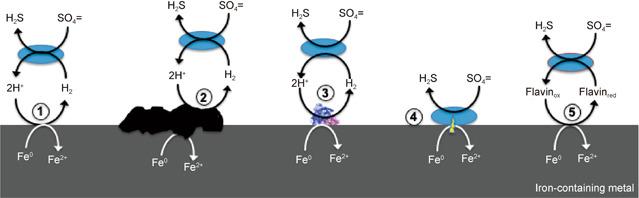
Corrosion of iron-containing metals under sulfate-reducing conditions is an economically important problem. Microbial strains now known as served as the model microbes in many of the foundational studies that developed existing models for the corrosion of iron-containing metals under sulfate-reducing conditions. Proposed mechanisms for corrosion by include: (1) H consumption to accelerate the oxidation of Fe coupled to the reduction of protons to H; (2) production of sulfide that combines with ferrous iron to form iron sulfide coatings that promote H production; (3) moribund cells release hydrogenases that catalyze Fe oxidation with the production of H; (4) direct electron transfer from Fe to cells; and (5) flavins serving as an electron shuttle for electron transfer between Fe and cells. The demonstrated possibility of conducting transcriptomic and proteomic analysis of cells growing on metal surfaces suggests that similar studies on corrosion biofilms can aid in identifying proteins that play an important role in corrosion. Tools for making targeted gene deletions in are available for functional genetic studies. These approaches, coupled with instrumentation for the detection of low concentrations of H, and proven techniques for evaluating putative electron shuttle function, are expected to make it possible to determine which of the proposed mechanisms for corrosion are most important.
在硫酸盐还原条件下含铁金属的腐蚀是一个具有重要经济意义的问题。目前已知的微生物菌株在许多基础研究中作为模型微生物,这些研究建立了现有含铁金属在硫酸盐还原条件下腐蚀的模型。提出的由[微生物名称未给出]引起腐蚀的机制包括:(1)消耗氢气以加速铁的氧化,同时质子还原为氢气;(2)产生的硫化物与亚铁结合形成促进氢气产生的硫化铁涂层;(3)濒死细胞释放氢化酶,催化铁氧化并产生氢气;(4)铁向细胞的直接电子转移;以及(5)黄素作为铁与细胞之间电子转移的电子穿梭体。对在金属表面生长的细胞进行转录组学和蛋白质组学分析已被证明是可行的,这表明对[微生物名称未给出]腐蚀生物膜进行类似研究有助于识别在腐蚀中起重要作用的蛋白质。在[微生物名称未给出]中进行靶向基因缺失的工具可用于功能基因研究。这些方法,再加上用于检测低浓度氢气的仪器,以及用于评估假定电子穿梭体功能的成熟技术,有望确定所提出的[微生物名称未给出]腐蚀机制中哪些最为重要。
 Zotero 插件