
细胞色素介导的从金属铁中直接摄取电子 由……进行 (原句不完整,翻译可能不太准确,需结合完整内容理解)
Cytochrome-mediated direct electron uptake from metallic iron by .
作者信息
Holmes Dawn E, Tang Haiyan, Woodard Trevor, Liang Dandan, Zhou Jinjie, Liu Xinying, Lovley Derek R
机构信息
Department of Microbiology University of Massachusetts-Amherst Amherst Massachusetts USA.
Department of Physical and Biological Science Western New England University Springfield Massachusetts USA.
出版信息
mLife. 2022 Nov 17;1(4):443-447. doi: 10.1002/mlf2.12044. eCollection 2022 Dec.
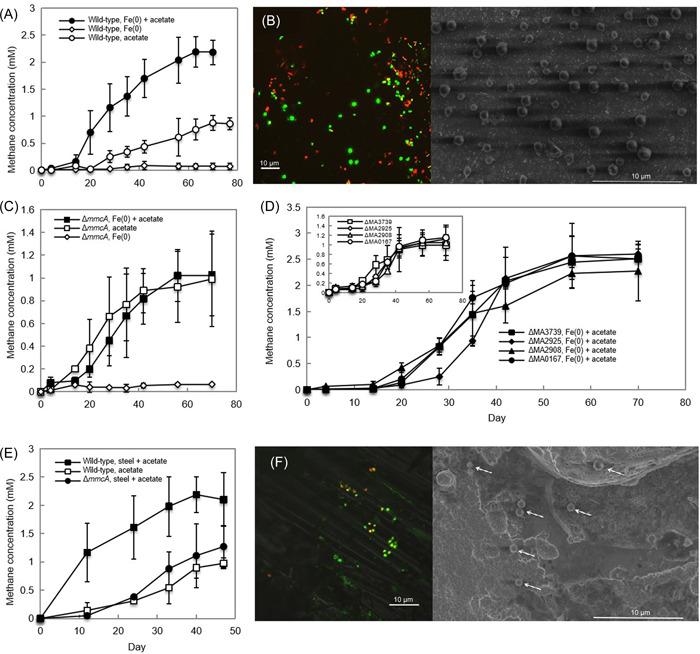
Methane-producing microorganisms accelerate the corrosion of iron-containing metals. Previous studies have inferred that some methanogens might directly accept electrons from Fe(0), but when this possibility was more intensively investigated, H was shown to be an intermediary electron carrier between Fe(0) and methanogens. Here, we report that catalyzes direct metal-to-microbe electron transfer to support methane production. Deletion of the gene for the multiheme, outer-surface -type cytochrome MmcA eliminated methane production from Fe(0), consistent with the key role of MmcA in other forms of extracellular electron exchange. These findings, coupled with the previous demonstration that outer-surface -type cytochromes are also electrical contacts for electron uptake from Fe(0) by and species, suggest that the presence of multiheme -type cytochromes on corrosion surfaces might be diagnostic for direct metal-to-microbe electron transfer and that interfering with cytochrome function might be a strategy to mitigate corrosion.
产甲烷微生物会加速含铁金属的腐蚀。先前的研究推断,一些产甲烷菌可能直接从Fe(0)接受电子,但当对这种可能性进行更深入研究时,发现H是Fe(0)与产甲烷菌之间的中间电子载体。在此,我们报告 催化直接的金属到微生物的电子转移以支持甲烷生成。多血红素、外表面型细胞色素MmcA的基因缺失消除了Fe(0)产生的甲烷,这与MmcA在其他形式的细胞外电子交换中的关键作用一致。这些发现,再加上先前证明外表面型细胞色素也是 和 物种从Fe(0)摄取电子的电接触点,表明腐蚀表面上多血红素型细胞色素的存在可能是直接金属到微生物电子转移的诊断指标,并且干扰细胞色素功能可能是减轻腐蚀的一种策略。
 Zotero 插件