
恩考芬尼联合西妥昔单抗与化疗双重阻断在人 BRAFV600E 突变结直肠癌中的抗肿瘤疗效。
Antitumor Efficacy of Dual Blockade with Encorafenib + Cetuximab in Combination with Chemotherapy in Human BRAFV600E-Mutant Colorectal Cancer.
机构信息
Department of Precision Medicine, Università degli Studi della Campania "Luigi Vanvitelli", Napoli, Italy.
Division of Cancer Medicine, Department of Gastrointestinal Medical Oncology, The University of Texas MD Anderson Cancer Center, Houston, Texas.
出版信息
Clin Cancer Res. 2023 Jun 13;29(12):2299-2309. doi: 10.1158/1078-0432.CCR-22-3894.
PURPOSE
Encorafenib + cetuximab (E+C) is an effective therapeutic option in chemorefractory BRAFV600E metastatic colorectal cancer (mCRC). However, there is a need to improve the efficacy of this molecular-targeted therapy and evaluate regimens suitable for untreated BRAFV600E in patients with mCRC.
EXPERIMENTAL DESIGN
We performed a series of in vivo studies using BRAFV600E mCRC tumor xenografts. Mice were randomized to receive 5-fluoruracil (5-FU), irinotecan, or oxaliplatin regimens (FOLFIRI or FOLFOX), (E+C) or the combination. Patients received long-term treatment until disease progression, with deescalation strategies used to mimic maintenance therapy. Transcriptomic changes after progression on cytotoxic chemotherapy or targeted therapy were assessed.
RESULTS
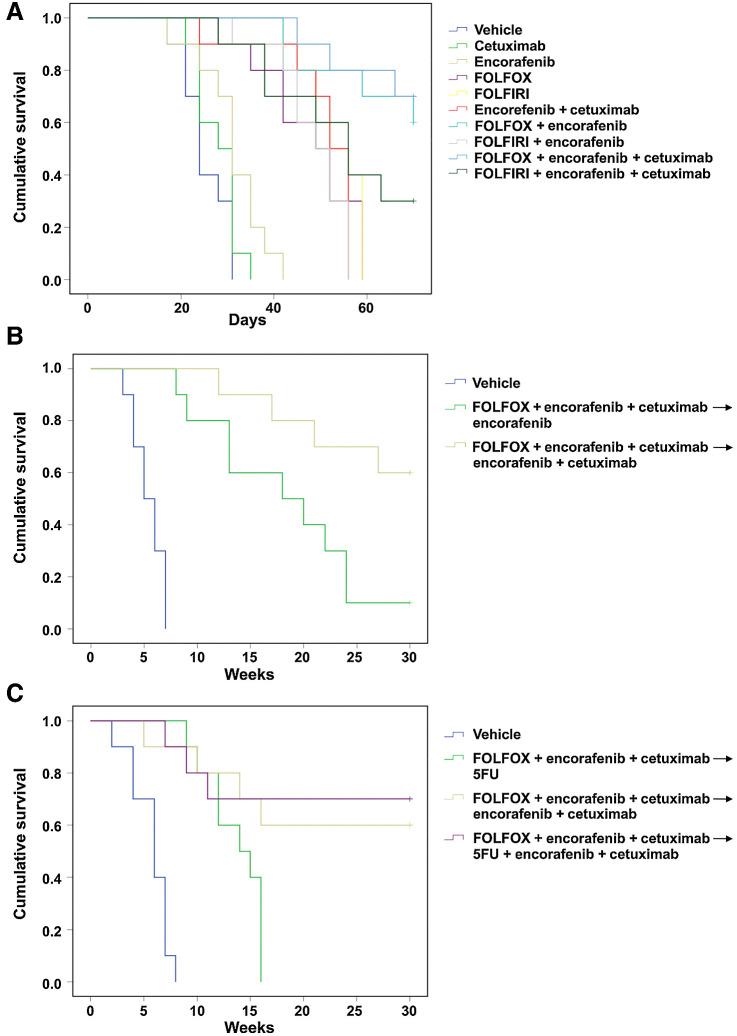
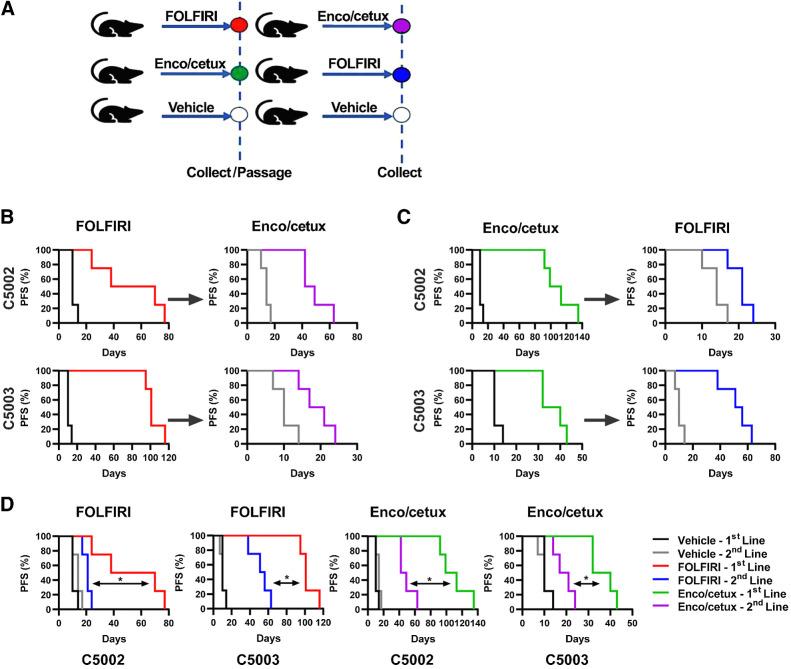
Antitumor activity of either FOLFIRI or E+C was better as first-line treatment as compared with second-line, with partial cross-resistance seen between a cytotoxic regimen and targeted therapy with an average 62% loss of efficacy for FOLFIRI after E+C and a 45% loss of efficacy of E+C after FOLFIRI (P < 0.001 for both). FOLFIRI-treated models had upregulation of epithelial-mesenchymal transition (EMT) and MAPK pathway activation, where E+C treated models had suppressed MAPK signaling. In contrast, with chemotherapy with E+C, EMT and MAPK signaling remained suppressed. FOLFOX or FOLFIRI, each in combination with E+C, were the most active first-line treatments as compared with E+C or to chemotherapy alone. Furthermore, FOLFOX in combination with E+C as first-line induction therapy, followed by E+C ± 5-FU as maintenance therapy, was the most effective strategy for long-term disease control.
CONCLUSIONS
These results support the combination of cytotoxic chemotherapy and molecular-targeted therapy as a promising therapeutic approach in the first-line treatment of BRAFV600E mCRC.
目的
依维莫司联合西妥昔单抗(E+C)是治疗化疗耐药 BRAFV600E 转移性结直肠癌(mCRC)的有效治疗选择。然而,需要提高这种分子靶向治疗的疗效,并评估适合未经治疗的 BRAFV600E mCRC 患者的方案。
实验设计
我们使用 BRAFV600E mCRC 肿瘤异种移植进行了一系列体内研究。将小鼠随机分为接受氟尿嘧啶(5-FU)、伊立替康或奥沙利铂方案(FOLFIRI 或 FOLFOX)、(E+C)或联合治疗组。患者接受长期治疗直至疾病进展,并采用逐步降级策略模拟维持治疗。评估细胞毒性化疗或靶向治疗后进展时的转录组变化。
结果
与二线治疗相比,FOLFIRI 或 E+C 的抗肿瘤活性作为一线治疗更好,细胞毒性方案与靶向治疗之间存在部分交叉耐药,E+C 后 FOLFIRI 的疗效平均降低 62%,FOLFIRI 后 E+C 的疗效降低 45%(均<0.001)。接受 FOLFIRI 治疗的模型中上皮间质转化(EMT)和 MAPK 通路激活上调,而接受 E+C 治疗的模型中 MAPK 信号受到抑制。相比之下,化疗联合 E+C 治疗后,EMT 和 MAPK 信号仍受到抑制。FOLFOX 或 FOLFIRI 联合 E+C 作为一线治疗比单独使用 E+C 或化疗更有效。此外,FOLFOX 联合 E+C 作为一线诱导治疗,随后 E+C±5-FU 作为维持治疗,是长期疾病控制的最有效策略。
结论
这些结果支持细胞毒性化疗和分子靶向治疗的联合作为治疗 BRAFV600E mCRC 的一线治疗有希望的治疗方法。


 Zotero 插件