
血清脂质组学揭示了胆酸腹泻的诊断潜力。
Serum lipidome unravels a diagnostic potential in bile acid diarrhoea.
机构信息
Health and Medical Sciences, University of Copenhagen Biotech Research and Innovation Centre, Copenhagen, Denmark.
Center for Clinical Metabolic Research, Copenhagen University Hospital - Herlev and Gentofte, Hellerup, Denmark.
出版信息
Gut. 2023 Sep;72(9):1698-1708. doi: 10.1136/gutjnl-2022-329213. Epub 2023 Apr 18.
OBJECTIVE
Bile acid diarrhoea (BAD) is debilitating yet treatable, but it remains underdiagnosed due to challenging diagnostics. We developed a blood test-based method to guide BAD diagnosis.
DESIGN
We included serum from 50 treatment-naive patients with BAD diagnosed by gold standard selenium homotaurocholic acid test, 56 feature-matched controls and 37 patients with non-alcoholic fatty liver disease (NAFLD). Metabolomes were generated using mass spectrometry covering 1295 metabolites and compared between groups. Machine learning was used to develop a BAD Diagnostic Score (BDS).
RESULTS
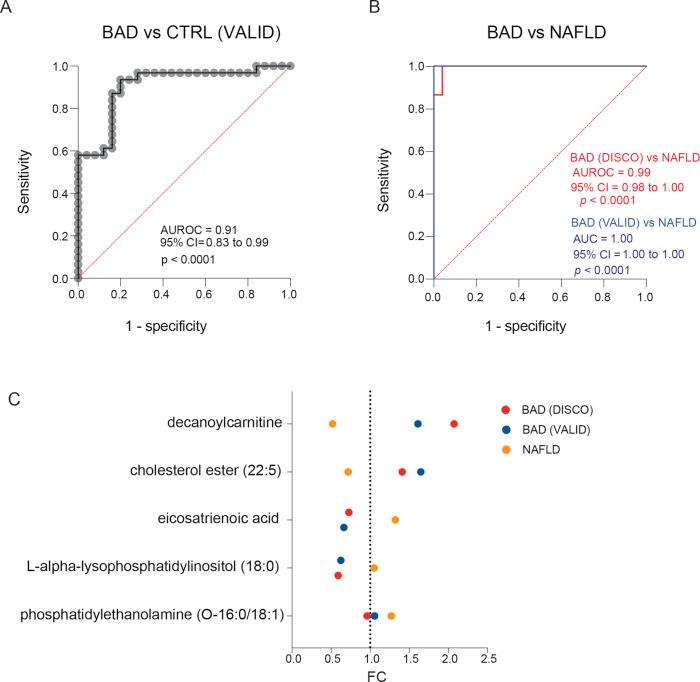
Metabolomes of patients with BAD significantly differed from controls and NAFLD. We detected 70 metabolites with a discriminatory performance in the discovery set with an area under receiver-operating curve metric above 0.80. Logistic regression modelling using concentrations of decanoylcarnitine, cholesterol ester (22:5), eicosatrienoic acid, L-alpha-lysophosphatidylinositol (18:0) and phosphatidylethanolamine (O-16:0/18:1) distinguished BAD from controls with a sensitivity of 0.78 (95% CI 0.64 to 0.89) and a specificity of 0.93 (95% CI 0.83 to 0.98). The model was independent of covariates (age, sex, body mass index) and distinguished BAD from NAFLD irrespective of fibrosis stage. BDS outperformed other blood test-based tests (7-alpha-hydroxy-4-cholesten-3-one and fibroblast growth factor 19) currently under development.
CONCLUSIONS
BDS derived from serum metabolites in a single-blood sample showed robust identification of patients with BAD with superior specificity and sensitivity compared with current blood test-based diagnostics.
目的
胆酸腹泻(BAD)虽然可以治疗,但由于诊断困难,仍未得到充分诊断。我们开发了一种基于血液检测的方法来指导 BAD 的诊断。
设计
我们纳入了 50 名未经治疗的 BAD 患者的血清,这些患者的诊断均采用金标准硒同牛磺胆酸检测,纳入了 56 名特征匹配的对照者和 37 名非酒精性脂肪性肝病(NAFLD)患者。采用质谱法生成涵盖 1295 种代谢物的代谢组学,并在各组之间进行比较。使用机器学习开发 BAD 诊断评分(BDS)。
结果
BAD 患者的代谢组学与对照组和 NAFLD 患者明显不同。我们在发现组中检测到 70 种具有鉴别性能的代谢物,其接受者操作特征曲线下面积(AUC)指标大于 0.80。使用癸酰肉碱、胆固醇酯(22:5)、二十碳三烯酸、α-溶血磷脂酰肌醇(18:0)和磷脂酰乙醇胺(O-16:0/18:1)的浓度进行逻辑回归建模,可以将 BAD 与对照组区分开来,其敏感性为 0.78(95%CI 0.64 至 0.89),特异性为 0.93(95%CI 0.83 至 0.98)。该模型独立于协变量(年龄、性别、体重指数),并且无论纤维化阶段如何,都可以将 BAD 与 NAFLD 区分开来。BDS 优于其他目前正在开发的基于血液检测的测试(7-α-羟基-4-胆甾烯-3-酮和成纤维细胞生长因子 19)。
结论
在单个血样中从血清代谢物中得出的 BDS 显示出对 BAD 患者的强大识别能力,与目前基于血液检测的诊断相比,具有更高的特异性和敏感性。




 Zotero 插件