
纳米塑料研究中的关键差距及其与风险评估的联系。
Critical gaps in nanoplastics research and their connection to risk assessment.
作者信息
Cunningham Brittany E, Sharpe Emma E, Brander Susanne M, Landis Wayne G, Harper Stacey L
机构信息
Department of Environmental and Molecular Toxicology, Oregon State University, Corvallis, OR, United States.
Institute of Environmental Toxicology and Chemistry, Western Washington University, Bellingham, WA, United States.
出版信息
Front Toxicol. 2023 Apr 24;5:1154538. doi: 10.3389/ftox.2023.1154538. eCollection 2023.
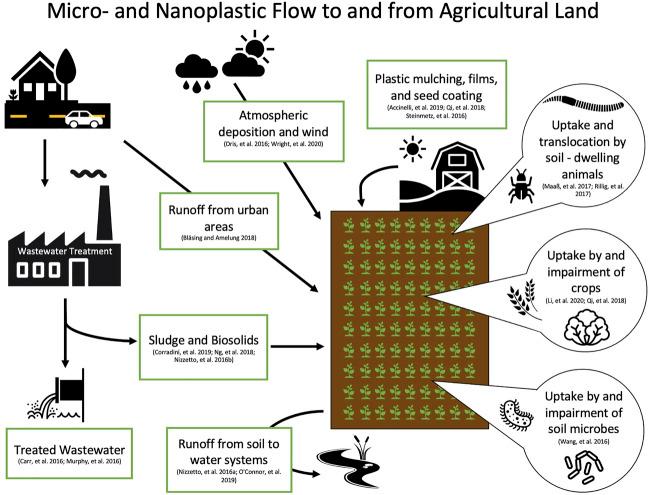
Reports of plastics, at higher levels than previously thought, in the water that we drink and the air that we breathe, are generating considerable interest and concern. Plastics have been recorded in almost every environment in the world with estimates on the order of trillions of microplastic pieces. Yet, this may very well be an underestimate of plastic pollution as a whole. Once microplastics (<5 mm) break down in the environment, they nominally enter the nanoscale (<1,000 nm), where they cannot be seen by the naked eye or even with the use of a typical laboratory microscope. Thus far, research has focused on plastics in the macro- (>25 mm) and micro-size ranges, which are easier to detect and identify, leaving large knowledge gaps in our understanding of nanoplastic debris. Our ability to ask and answer questions relating to the transport, fate, and potential toxicity of these particles is disadvantaged by the detection and identification limits of current technology. Furthermore, laboratory exposures have been substantially constrained to the study of commercially available nanoplastics; i.e., polystyrene spheres, which do not adequately reflect the composition of environmental plastic debris. While a great deal of plastic-focused research has been published in recent years, the pattern of the work does not answer a number of key factors vital to calculating risk that takes into account the smallest plastic particles; namely, sources, fate and transport, exposure measures, toxicity and effects. These data are critical to inform regulatory decision making and to implement adaptive management strategies that mitigate risk to human health and the environment. This paper reviews the current state-of-the-science on nanoplastic research, highlighting areas where data are needed to establish robust risk assessments that take into account plastics pollution. Where nanoplastic-specific data are not available, suggested substitutions are indicated.
在我们饮用的水和呼吸的空气中,塑料的含量比之前认为的要高,这引发了人们极大的兴趣和关注。塑料几乎在世界上的每一个环境中都有记录,据估计有数万亿个微塑料碎片。然而,这很可能是对整个塑料污染的低估。一旦微塑料(<5毫米)在环境中分解,它们名义上就进入了纳米级(<1000纳米),在这个尺度下,肉眼甚至使用典型的实验室显微镜都无法看到它们。到目前为止,研究主要集中在宏观(>25毫米)和微尺寸范围内的塑料,这些塑料更容易检测和识别,这使得我们在理解纳米塑料碎片方面存在很大的知识空白。当前技术的检测和识别限制不利于我们提出和回答与这些颗粒的运输、归宿和潜在毒性相关的问题。此外,实验室暴露基本上局限于对市售纳米塑料的研究;即聚苯乙烯微球,它不能充分反映环境塑料碎片的组成。虽然近年来发表了大量以塑料为重点的研究,但这些研究模式并未回答一些对于计算考虑最小塑料颗粒的风险至关重要的关键因素;即来源、归宿和运输、暴露措施、毒性和影响。这些数据对于为监管决策提供信息以及实施减轻对人类健康和环境风险的适应性管理策略至关重要。本文回顾了纳米塑料研究的当前科学现状,强调了在建立考虑塑料污染的稳健风险评估时需要数据的领域。在没有纳米塑料特定数据的情况下,指出了建议的替代数据。


 Zotero 插件