
双特异性抗体将合成的激动型受体修饰的 T 细胞重定向用于治疗黑色素瘤。
Bispecific antibodies redirect synthetic agonistic receptor modified T cells against melanoma.
机构信息
Department of Medicine IV, Division of Clinical Pharmacology, Klinikum der Universität München, Munich, Germany.
Roche Innovation Center Zurich, Roche Pharma Research & Early Development, Schlieren, Switzerland.
出版信息
J Immunother Cancer. 2023 May;11(5). doi: 10.1136/jitc-2022-006436.
BACKGROUND
Melanoma is an immune sensitive disease, as demonstrated by the activity of immune check point blockade (ICB), but many patients will either not respond or relapse. More recently, tumor infiltrating lymphocyte (TIL) therapy has shown promising efficacy in melanoma treatment after ICB failure, indicating the potential of cellular therapies. However, TIL treatment comes with manufacturing limitations, product heterogeneity, as well as toxicity problems, due to the transfer of a large number of phenotypically diverse T cells. To overcome said limitations, we propose a controlled adoptive cell therapy approach, where T cells are armed with synthetic agonistic receptors (SAR) that are selectively activated by bispecific antibodies (BiAb) targeting SAR and melanoma-associated antigens.
METHODS
Human as well as murine SAR constructs were generated and transduced into primary T cells. The approach was validated in murine, human and patient-derived cancer models expressing the melanoma-associated target antigens tyrosinase-related protein 1 (TYRP1) and melanoma-associated chondroitin sulfate proteoglycan (MCSP) (CSPG4). SAR T cells were functionally characterized by assessing their specific stimulation and proliferation, as well as their tumor-directed cytotoxicity, in vitro and in vivo.
RESULTS
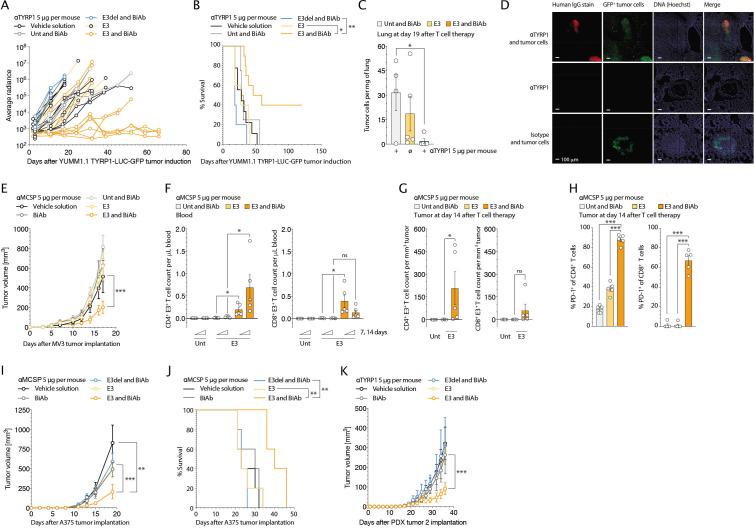
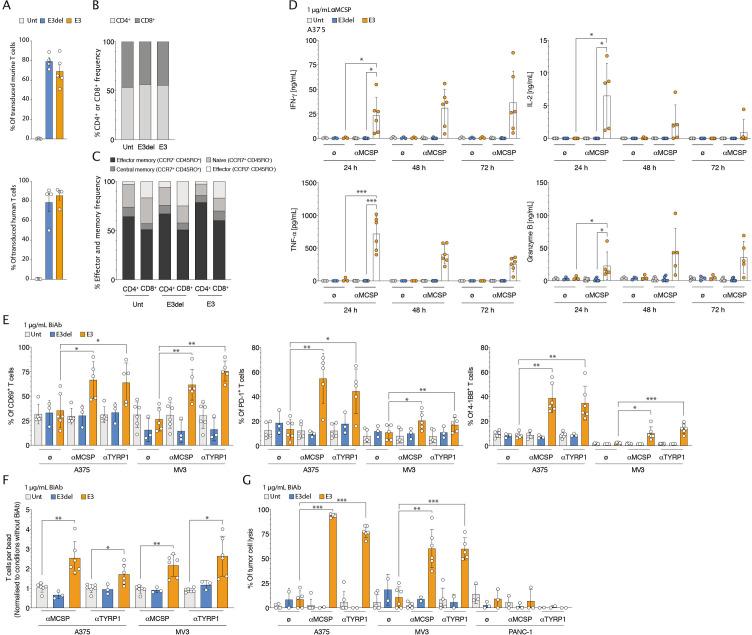
MCSP and TYRP1 expression was conserved in samples of patients with treated as well as untreated melanoma, supporting their use as melanoma-target antigens. The presence of target cells and anti-TYRP1 × anti-SAR or anti-MCSP × anti-SAR BiAb induced conditional antigen-dependent activation, proliferation of SAR T cells and targeted tumor cell lysis in all tested models. In vivo, antitumoral activity and long-term survival was mediated by the co-administration of SAR T cells and BiAb in a syngeneic tumor model and was further validated in several xenograft models, including a patient-derived xenograft model.
CONCLUSION
The SAR T cell-BiAb approach delivers specific and conditional T cell activation as well as targeted tumor cell lysis in melanoma models. Modularity is a key feature for targeting melanoma and is fundamental towards personalized immunotherapies encompassing cancer heterogeneity. Because antigen expression may vary in primary melanoma tissues, we propose that a dual approach targeting two tumor-associated antigens, either simultaneously or sequentially, could avoid issues of antigen heterogeneity and deliver therapeutic benefit to patients.
背景
黑色素瘤是一种免疫敏感疾病,免疫检查点阻断(ICB)的活性证明了这一点,但许多患者要么没有反应,要么复发。最近,肿瘤浸润淋巴细胞(TIL)治疗在 ICB 失败后显示出对黑色素瘤治疗的有希望的疗效,表明细胞治疗的潜力。然而,TIL 治疗由于需要转移大量表型多样化的 T 细胞,因此存在制造限制、产品异质性以及毒性问题。为了克服这些限制,我们提出了一种受控的过继细胞治疗方法,其中 T 细胞被武装有合成激动型受体(SAR),这些受体被针对 SAR 和黑色素瘤相关抗原的双特异性抗体(BiAb)选择性激活。
方法
生成了人源和鼠源 SAR 构建体,并将其转导到原代 T 细胞中。该方法在表达黑色素瘤相关靶抗原酪氨酸酶相关蛋白 1(TYRP1)和黑色素瘤相关软骨素硫酸蛋白聚糖(MCSP)(CSPG4)的小鼠、人类和患者来源的癌症模型中得到了验证。通过评估 SAR T 细胞的特异性刺激和增殖以及它们在体外和体内的肿瘤定向细胞毒性,对 SAR T 细胞进行了功能表征。
结果
在治疗和未经治疗的黑色素瘤患者的样本中均保留了 MCSP 和 TYRP1 的表达,支持将其用作黑色素瘤靶抗原。靶细胞的存在以及抗-TYRP1×抗-SAR 或抗-MCSP×抗-SAR BiAb 诱导了条件性抗原依赖性激活、SAR T 细胞的增殖以及所有测试模型中的靶向肿瘤细胞裂解。在体内,SAR T 细胞和 BiAb 的联合给药介导了抗肿瘤活性和长期生存,这在同种异体肿瘤模型中得到了验证,并在包括患者来源的异种移植模型在内的几个异种移植模型中得到了进一步验证。
结论
SAR T 细胞-BiAb 方法在黑色素瘤模型中提供了特异性和条件性 T 细胞激活以及靶向肿瘤细胞裂解。模块化是靶向黑色素瘤的关键特征,也是包含癌症异质性的个性化免疫疗法的基础。由于主要黑色素瘤组织中的抗原表达可能存在差异,因此我们提出同时或顺序靶向两个肿瘤相关抗原的双重方法可以避免抗原异质性问题,并为患者提供治疗益处。



 Zotero 插件