
抗伤害感受过程中白细胞介素-10/β-内啡肽介导的对小胶质细胞的神经免疫调节
IL-10/β-Endorphin-Mediated Neuroimmune Modulation on Microglia during Antinociception.
作者信息
Belo Thiago Caetano Andrade, Santos Gabriela Xavier, da Silva Bruno Eduardo Gabriel, Rocha Bruno Lopes Gonçalves, Abdala Dennis William, Freire Larissa Alves Moreira, Rocha Fernanda Santos, Galdino Giovane
机构信息
Laboratory of Molecular Biology of Microorganisms, Federal University of Alfenas, Alfenas 37130-001, Brazil.
Laboratory of Neuroimmunobiology of Pain, Federal University of Alfenas, Alfenas 37130-001, Brazil.
出版信息
Brain Sci. 2023 May 12;13(5):789. doi: 10.3390/brainsci13050789.
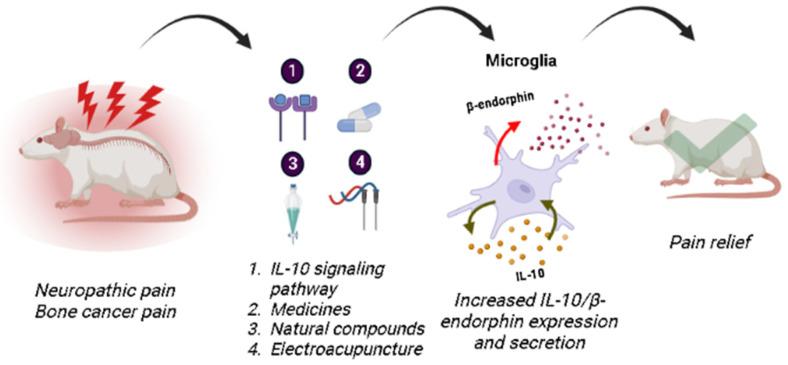
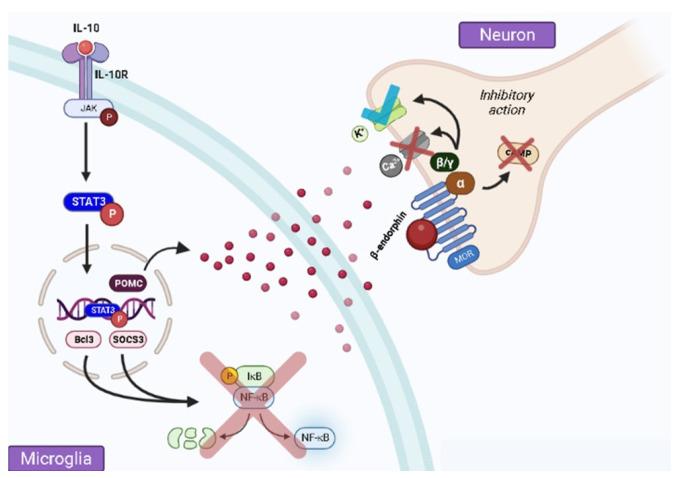
Microglia are glial cells centrally related to pathophysiology and neuroimmunological regulation of pain through microglia-neuron crosstalk mechanisms. In contrast, anti-inflammatory mechanisms guided by immunological effectors such as IL-10 trigger the secretion of analgesic substances, culminating in the differential expression of genes encoding endogenous opioid peptides, especially β-endorphin. Thus, when β-endorphin binds to the µ-opioid receptor, it generates neuronal hyperpolarization, inhibiting nociceptive stimuli. This review aimed to summarize the recent advances in understanding the mechanism by which IL-10/β-endorphin can reduce pain. For this, databases were searched for articles from their inception up until November 2022. Two independent reviewers extracted the data and assessed the methodological quality of the included studies, and seventeen studies were considered eligible for this review. Several studies have demonstrated the impact of IL-10/β-endorphin in reducing pain, where IL-10 can stimulate GLP-1R, GRP40, and α7nAChR receptors, as well as intracellular signaling pathways, such as STAT3, resulting in increased β-endorphin expression and secretion. In addition, molecules such as gabapentinoids, thalidomide, cynandione A, morroniside, lemairamin, and cinobufagin, as well as non-pharmacological treatments such as electroacupuncture, reduce pain through IL-10 mediated mechanisms, reflecting a microglia-dependent β-endorphin differential increase. This process represents a cornerstone in pain neuroimmunology knowledge, and the results obtained by different studies about the theme are presented in this review.
小胶质细胞是通过小胶质细胞 - 神经元相互作用机制与疼痛的病理生理学和神经免疫调节密切相关的神经胶质细胞。相比之下,由白细胞介素 - 10等免疫效应因子引导的抗炎机制会触发镇痛物质的分泌,最终导致编码内源性阿片肽的基因差异表达,尤其是β - 内啡肽。因此,当β - 内啡肽与μ - 阿片受体结合时,会产生神经元超极化,抑制伤害性刺激。本综述旨在总结在理解白细胞介素 - 10/β - 内啡肽减轻疼痛机制方面的最新进展。为此,检索了数据库中从其创建到2022年11月的文章。两名独立评审员提取数据并评估纳入研究的方法学质量,有17项研究被认为符合本综述的要求。多项研究证明了白细胞介素 - 10/β - 内啡肽在减轻疼痛方面的作用,其中白细胞介素 - 10可刺激胰高血糖素样肽 - 1受体、G蛋白偶联受体40和α7烟碱型乙酰胆碱受体,以及细胞内信号通路,如信号转导和转录激活因子3,从而导致β - 内啡肽表达和分泌增加。此外,加巴喷丁类药物、沙利度胺、氰定酮A、莫诺苷、莱马胺和华蟾毒精等分子,以及电针等非药物治疗,通过白细胞介素 - 10介导的机制减轻疼痛,反映了小胶质细胞依赖性β - 内啡肽的差异增加。这一过程代表了疼痛神经免疫学知识的基石,本综述展示了关于该主题的不同研究所获得的结果。
 Zotero 插件