
MAGOH 和 MAGOHB 这两个同源基因是高级别神经胶质瘤的致癌因子,能够调控细胞分裂和细胞周期基因的剪接。
The paralogues MAGOH and MAGOHB are oncogenic factors in high-grade gliomas and safeguard the splicing of cell division and cell cycle genes.
机构信息
Molecular Oncology Center, Hospital Sirio-Libanes, São Paulo, Brazil.
Departamento de Bioquimica, Instituto de Química - Universidade de São Paulo, São Paulo, Brazil.
出版信息
RNA Biol. 2023 Jan;20(1):311-322. doi: 10.1080/15476286.2023.2221511.
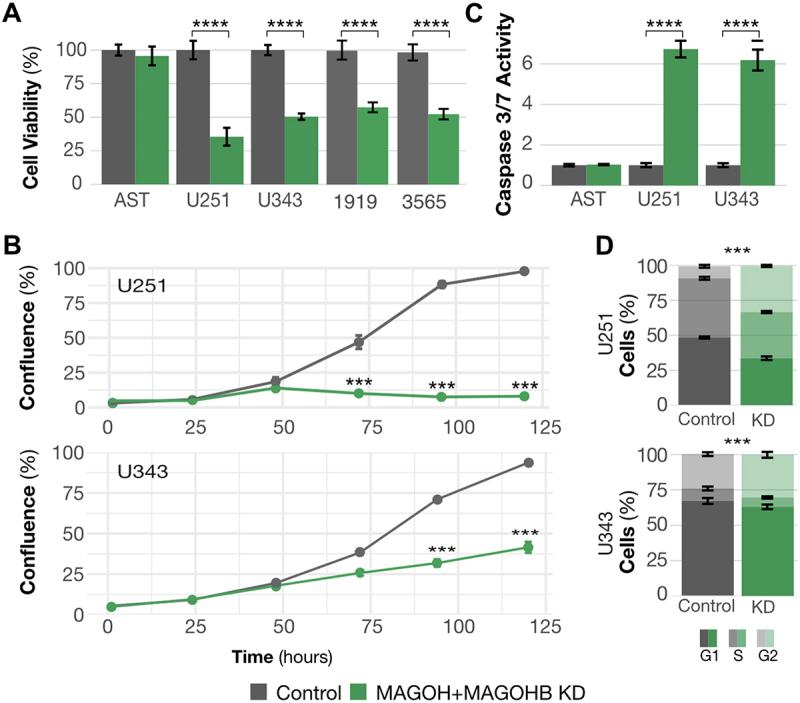
The exon junction complex (EJC) plays key roles throughout the lifespan of RNA and is particularly relevant in the nervous system. We investigated the roles of two EJC members, the paralogs MAGOH and MAGOHB, with respect to brain tumour development. High MAGOH/MAGOHB expression was observed in 14 tumour types; glioblastoma (GBM) showed the greatest difference compared to normal tissue. Increased MAGOH/MAGOHB expression was associated with poor prognosis in glioma patients, while knockdown of MAGOH/MAGOHB affected different cancer phenotypes. Reduced MAGOH/MAGOHB expression in GBM cells caused alterations in the splicing profile, including re-splicing and skipping of multiple exons. The binding profiles of EJC proteins indicated that exons affected by MAGOH/MAGOHB knockdown accumulated fewer complexes on average, providing a possible explanation for their sensitivity to MAGOH/MAGOHB knockdown. Transcripts (genes) showing alterations in the splicing profile are mainly implicated in cell division, cell cycle, splicing, and translation. We propose that high MAGOH/MAGOHB levels are required to safeguard the splicing of genes in high demand in scenarios requiring increased cell proliferation (brain development and GBM growth), ensuring efficient cell division, cell cycle regulation, and gene expression (splicing and translation). Since differentiated neuronal cells do not require increased MAGOH/MAGOHB expression, targeting these paralogs is a potential option for treating GBM.
外显子结合复合体(EJC)在 RNA 的整个生命周期中发挥着关键作用,在神经系统中尤为重要。我们研究了 EJC 成员 MAGOH 和 MAGOHB 这两个蛋白在脑肿瘤发展中的作用。在 14 种肿瘤类型中观察到 MAGOH/MAGOHB 高表达;与正常组织相比,胶质母细胞瘤(GBM)的差异最大。在神经胶质瘤患者中,MAGOH/MAGOHB 表达增加与预后不良相关,而 MAGOH/MAGOHB 的敲低会影响不同的癌症表型。GBM 细胞中 MAGOH/MAGOHB 表达的降低导致剪接谱的改变,包括多个外显子的重新剪接和跳过。EJC 蛋白的结合谱表明,受 MAGOH/MAGOHB 敲低影响的外显子平均积累的复合物较少,这为它们对外显子结合复合体的敏感性提供了可能的解释。剪接谱改变的转录本(基因)主要涉及细胞分裂、细胞周期、剪接和翻译。我们提出,在需要增加细胞增殖的情况下(大脑发育和 GBM 生长),高水平的 MAGOH/MAGOHB 是维持对高需求基因剪接所必需的,以确保有效的细胞分裂、细胞周期调节和基因表达(剪接和翻译)。由于分化的神经元细胞不需要增加 MAGOH/MAGOHB 的表达,因此靶向这些同源蛋白可能是治疗 GBM 的一种潜在选择。




 Zotero 插件