
多发性骨髓瘤中双特异性抗体相关感染:系统评价和荟萃分析。
Infections following bispecific antibodies in myeloma: a systematic review and meta-analysis.
机构信息
National Centre for Infections in Cancer, Peter MacCallum Cancer Centre, Melbourne, VIC, Australia.
Department of Infectious Diseases, Austin Health, Heidelberg, VIC, Australia.
出版信息
Blood Adv. 2023 Oct 10;7(19):5898-5903. doi: 10.1182/bloodadvances.2023010539.
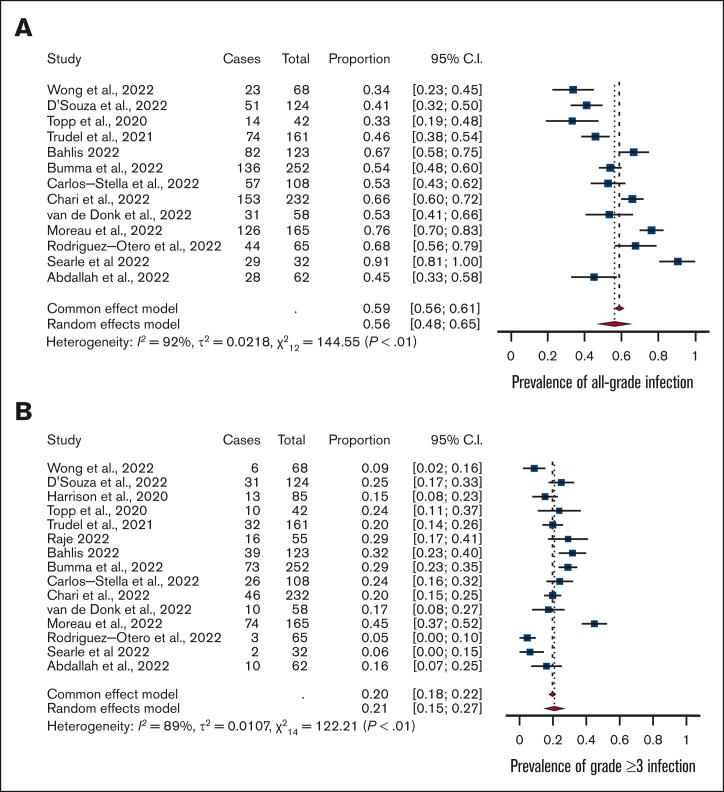
Bispecific antibodies, a novel immunotherapy with promising efficacy against multiple myeloma, form immune synapses between T-cell surface marker CD3 and malignant cell markers, including B-cell maturation antigen (BCMA), FcRH5, and G protein-coupled receptor GPRC5D. These bispecific antibodies so effectively deplete plasma cells (and to some extent T-cells) that patients are at increased risk of developing infections. A systematic review and meta-analysis of infections in published studies of patients with myeloma treated with bispecific antibodies was conducted to better characterize the infection risks. A literature search used MEDLINE, EMBASE, and Cochrane to identify relevant studies between inception and February 10, 2023, including major conference presentations. Phase 1b-3 clinical trials and observational studies were included. Sixteen clinical trials comprising 1666 patients were included. Median follow-up was 7.6 months and 38% of the cohort had penta-drug refractory disease. Pooled prevalence of all-grade infections was 56%, whereas the prevalence of grade ≥3 infections was 24%. Patients who were treated with BCMA-targeted bispecifics had significantly higher rates of grade ≥3 infections than non-BCMA bispecifics (25% vs 20%). Similarly, patients treated with bispecifics in combination with other agents had significantly higher rate of all-grade infection than those receiving monotherapy (71% vs 52%). In observational studies (n = 293), excluded from the primary analysis to ensure no overlap with patients in clinical trials, several infections classically associated with T-cell depletion were identified. This systematic review identifies BCMA-targeted bispecifics and bispecific combination therapy as having higher infection risk, requiring vigilant infection screening and prophylaxis strategies.
双特异性抗体是一种新型免疫疗法,对多发性骨髓瘤具有显著疗效,它在 T 细胞表面标志物 CD3 和恶性细胞标志物(包括 B 细胞成熟抗原 (BCMA)、FcRH5 和 G 蛋白偶联受体 GPRC5D)之间形成免疫突触。这些双特异性抗体非常有效地耗尽浆细胞(在某种程度上也耗尽 T 细胞),以至于患者发生感染的风险增加。本系统评价和荟萃分析旨在更好地描述双特异性抗体治疗多发性骨髓瘤患者的感染风险,对已发表的研究进行了系统性回顾和荟萃分析。通过 MEDLINE、EMBASE 和 Cochrane 进行文献检索,以确定从研究开始到 2023 年 2 月 10 日之间的相关研究,包括主要会议报告。纳入了 1b-3 期临床试验和观察性研究。纳入了 16 项包含 1666 例患者的临床试验。中位随访时间为 7.6 个月,38%的队列患者患有五药难治性疾病。所有级别感染的 pooled 患病率为 56%,而≥3 级感染的患病率为 24%。与非 BCMA 双特异性抗体相比,接受 BCMA 靶向双特异性抗体治疗的患者的≥3 级感染率显著更高(25%比 20%)。同样,与接受单药治疗的患者相比,接受双特异性联合其他药物治疗的患者的所有级别感染率显著更高(71%比 52%)。在观察性研究(n=293)中,为了确保与临床试验患者没有重叠,将其从主要分析中排除,确定了几种与 T 细胞耗竭相关的感染。本系统评价确定了 BCMA 靶向双特异性抗体和双特异性联合治疗具有更高的感染风险,需要进行警惕性感染筛查和预防策略。

 Zotero 插件