
吡咯啉-5-羧酸还原酶 2 通过调节微管相关丝氨酸/苏氨酸激酶样/Wnt/β-连环蛋白信号通路促进结直肠癌发生。
Pyrroline-5-Carboxylate Reductase-2 Promotes Colorectal Carcinogenesis by Modulating Microtubule-Associated Serine/Threonine Kinase-like/Wnt/β-Catenin Signaling.
机构信息
Department of Biochemistry and Molecular Biology, University of Nebraska Medical Center, 985870 Nebraska Medical Center, Omaha, NE 68198-6125, USA.
Department of Biochemistry and Redox Biology Center, University of Nebraska-Lincoln, Lincoln, NE 68588, USA.
出版信息
Cells. 2023 Jul 18;12(14):1883. doi: 10.3390/cells12141883.
BACKGROUND
Despite significant progress in clinical management, colorectal cancer (CRC) remains the third most common cause of cancer-related deaths. A positive association between PYCR2 (pyrroline-5-carboxylate reductase-2), a terminal enzyme of proline metabolism, and CRC aggressiveness was recently reported. However, how PYCR2 promotes colon carcinogenesis remains ill understood.
METHODS
A comprehensive analysis was performed using publicly available cancer databases and CRC patient cohorts. Proteomics and biochemical evaluations were performed along with genetic manipulations and in vivo tumor growth assays to gain a mechanistic understanding.
RESULTS
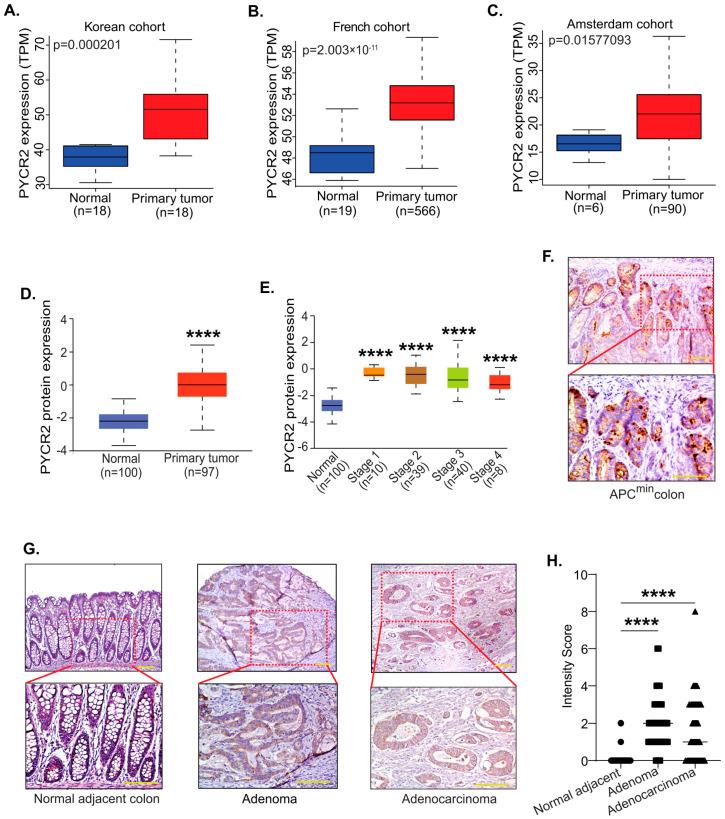
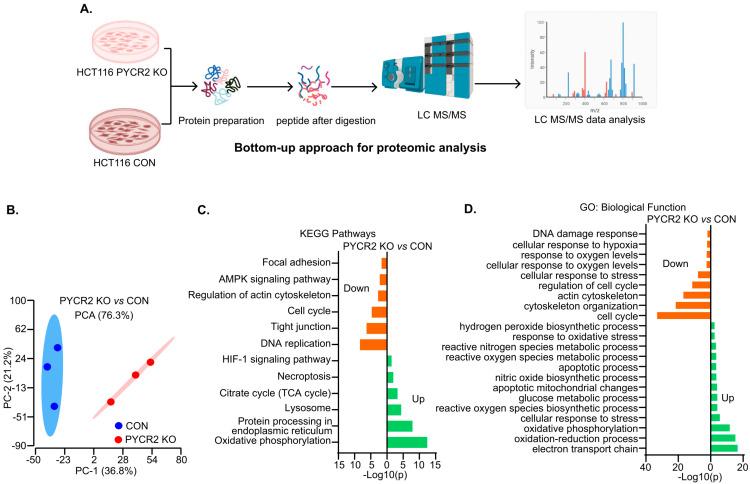
PYCR2 expression was significantly upregulated in CRC and associated with poor patient survival, specifically among PYCR isoforms (PYCR1, 2, and 3). The genetic inhibition of PYCR2 inhibited the tumorigenic abilities of CRC cells and in vivo tumor growth. Coinciding with these observations was a significant decrease in cellular proline content. PYCR2 overexpression promoted the tumorigenic abilities of CRC cells. Proteomics (LC-MS/MS) analysis further demonstrated that PYCR2 loss of expression in CRC cells inhibits survival and cell cycle pathways. A subsequent biochemical analysis supported the causal role of PYCR2 in regulating CRC cell survival and the cell cycle, potentially by regulating the expression of MASTL, a cell-cycle-regulating protein upregulated in CRC. Further studies revealed that PYCR2 regulates Wnt/β-catenin-signaling in manners dependent on the expression of MASTL and the cancer stem cell niche.
CONCLUSIONS
PYCR2 promotes MASTL/Wnt/β-catenin signaling that, in turn, promotes cancer stem cell populations and, thus, colon carcinogenesis. Taken together, our data highlight the significance of PYCR2 as a novel therapeutic target for effectively treating aggressive colon cancer.
背景
尽管在临床管理方面取得了重大进展,但结直肠癌(CRC)仍然是癌症相关死亡的第三大常见原因。最近有报道称,脯氨酸代谢的终末酶 PYCR2(吡咯啉-5-羧酸还原酶-2)与 CRC 的侵袭性之间存在正相关。然而,PYCR2 如何促进结肠癌的发生仍知之甚少。
方法
使用公共癌症数据库和 CRC 患者队列进行了全面分析。进行了蛋白质组学和生化评估以及遗传操作和体内肿瘤生长测定,以获得机制上的理解。
结果
PYCR2 在 CRC 中表达显著上调,并与患者生存不良相关,特别是在 PYCR 同工型(PYCR1、2 和 3)中。PYCR2 的遗传抑制抑制了 CRC 细胞的致瘤能力和体内肿瘤生长。与这些观察结果一致的是细胞脯氨酸含量的显著下降。PYCR2 的过表达促进了 CRC 细胞的致瘤能力。蛋白质组学(LC-MS/MS)分析进一步表明,CRC 细胞中 PYCR2 表达的丧失抑制了生存和细胞周期途径。随后的生化分析支持了 PYCR2 通过调节 CRC 细胞生存和细胞周期来调节 MASTL(一种在 CRC 中上调的细胞周期调节蛋白)的表达来发挥因果作用。进一步的研究表明,PYCR2 以依赖 MASTL 表达和癌症干细胞生态位的方式调节 Wnt/β-catenin 信号传导。
结论
PYCR2 促进 MASTL/Wnt/β-catenin 信号传导,进而促进癌症干细胞群体,从而促进结肠癌变。总之,我们的数据强调了 PYCR2 作为有效治疗侵袭性结肠癌的新型治疗靶标的重要性。





 Zotero 插件