
肿瘤内 NKp46 自然杀伤细胞与 T 细胞和 MHC-I 细胞在空间上分离,这与软组织肉瘤的预后有关。
Intratumoral NKp46 natural killer cells are spatially distanced from T and MHC-I cells with prognostic implications in soft tissue sarcoma.
机构信息
Division of Surgical Oncology, Department of Surgery, University of California, Davis, Sacramento, CA, United States.
Department of Surgery, Memorial Sloan Kettering Cancer Center, New York, NY, United States.
出版信息
Front Immunol. 2023 Jul 21;14:1230534. doi: 10.3389/fimmu.2023.1230534. eCollection 2023.
INTRODUCTION
Soft tissue sarcomas (STS) are rare, heterogenous malignancies with an unmet need for novel immunotherapies. Tumor infiltrating lymphocytes (TILs) have been linked with favorable outcomes in STS patients, though the contribution of natural killer (NK) cells and spatial relationships of TILs with MHC-I expressing cells lacks detailed characterization.
EXPERIMENTAL DESIGN
Using archived and prospectively collected specimens, we evaluated intratumoral NK cells by immunohistochemistry (IHC), flow cytometry, and immunofluorescence (IF). We assessed spatial localization of NK and T cells by multiplex IF, analyzing the effects of MHC-I expression status on NK and T cell clustering.
RESULTS
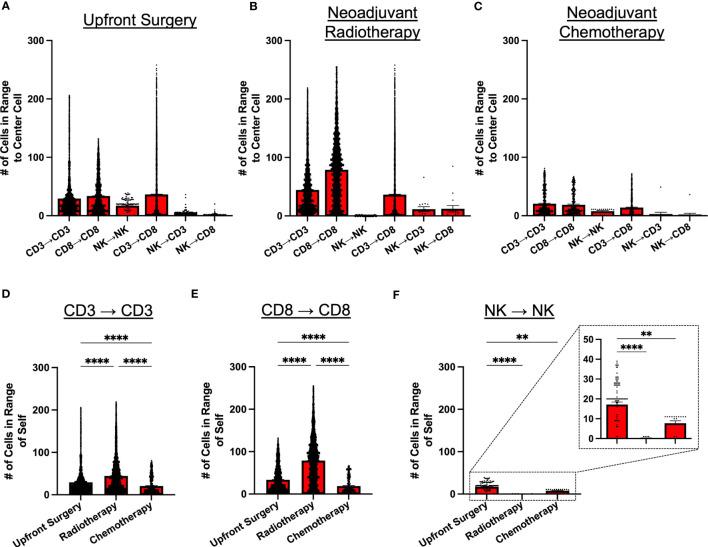
Both intratumoral NKp46 and CD56 expression were associated with significantly improved overall survival (P=0.05), while higher infiltrates of CD56bright NK cells predicted a worse prognosis (P=0.05). The presence of intratumoral NK cells was inversely proportional to CD3 T cells. Spatial analyses showed NK cells preferentially clustering close to other NK cells with sparse CD3 T and CD8 T cells in range (P<0.0001). Additionally, CD3 T and CD8 T cells showed significantly greater co-localization with MHC-I cells, compared to NK cells (P<0.0001). After neoadjuvant radiotherapy, there was greater CD8 clustering, while after neoadjuvant chemotherapy, there was overall lower TIL clustering.
CONCLUSION
Intratumoral NK cells are prognostic in STS and localize closer to MHC-I- cells than T cells. Although both NK and T cells are associated with improved survival in STS, their differential distribution in the TME based on MHC-I expression status may serve as a biomarker for improved immunotherapy treatment selection.
简介
软组织肉瘤(STS)是一种罕见的、异质性的恶性肿瘤,需要新型免疫疗法。肿瘤浸润淋巴细胞(TIL)与 STS 患者的良好预后相关,尽管自然杀伤(NK)细胞的贡献和 TIL 与 MHC-I 表达细胞的空间关系缺乏详细的特征描述。
实验设计
使用存档和前瞻性收集的标本,我们通过免疫组织化学(IHC)、流式细胞术和免疫荧光(IF)评估肿瘤内 NK 细胞。我们通过多重 IF 评估 NK 和 T 细胞的空间定位,分析 MHC-I 表达状态对 NK 和 T 细胞聚类的影响。
结果
肿瘤内 NKp46 和 CD56 的表达均与总生存率显著相关(P=0.05),而 CD56bright NK 细胞的浸润程度较高则预示着预后较差(P=0.05)。肿瘤内 NK 细胞的存在与 CD3 T 细胞呈反比。空间分析显示 NK 细胞优先与其他 NK 细胞聚类,而 CD3 T 和 CD8 T 细胞则稀疏分布在其范围内(P<0.0001)。此外,与 NK 细胞相比,CD3 T 和 CD8 T 细胞与 MHC-I 细胞的共定位明显更多(P<0.0001)。新辅助放疗后 CD8 细胞聚类增加,而新辅助化疗后 TIL 整体聚类减少。
结论
肿瘤内 NK 细胞在 STS 中具有预后价值,并且与 MHC-I 细胞比 T 细胞更接近。尽管 NK 和 T 细胞都与 STS 的生存改善相关,但基于 MHC-I 表达状态的 TME 中的不同分布可能作为改善免疫治疗选择的生物标志物。


 Zotero 插件