
用于神经退行性疾病建模的源自诱导多能干细胞的脑类器官技术的发展:概览
Development of brain organoid technology derived from iPSC for the neurodegenerative disease modelling: a glance through.
作者信息
Jusop Amirah Syamimi, Thanaskody Kalaiselvaan, Tye Gee Jun, Dass Sylvia Annabel, Wan Kamarul Zaman Wan Safwani, Nordin Fazlina
机构信息
Centre for Tissue Engineering and Regenerative Medicine (CTERM), Faculty of Medicine, Universiti Kebangsaan Malaysia, Kuala Lumpur, Malaysia.
Institute for Research in Molecular Medicine (INFORMM), Universiti Sains Malaysia, Minden, Penang, Malaysia.
出版信息
Front Mol Neurosci. 2023 Aug 3;16:1173433. doi: 10.3389/fnmol.2023.1173433. eCollection 2023.
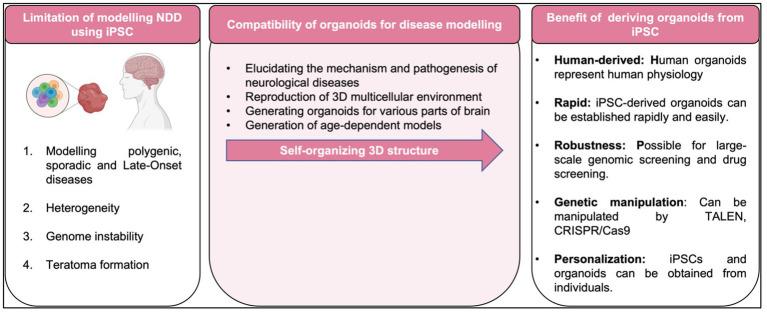
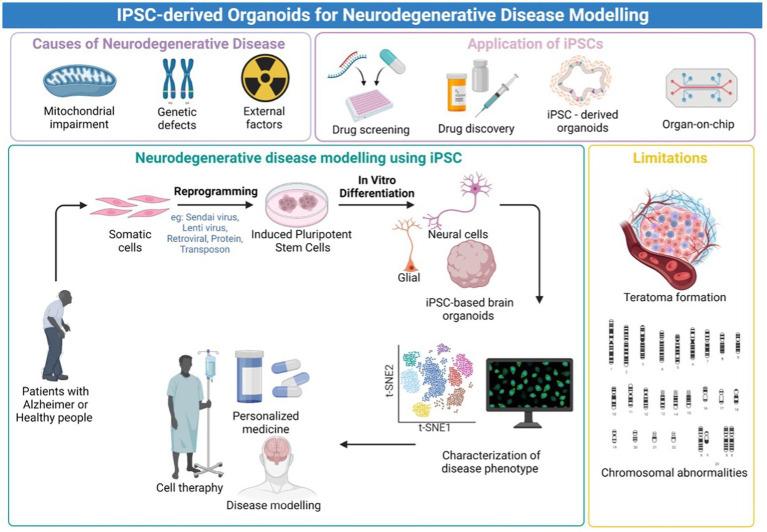
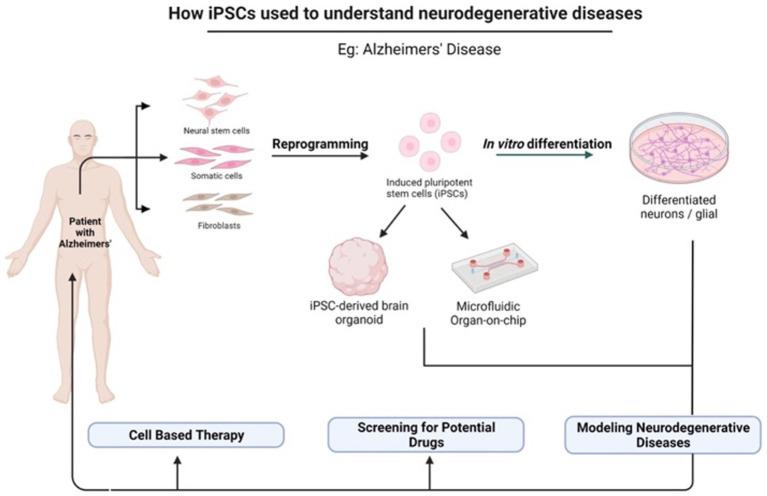
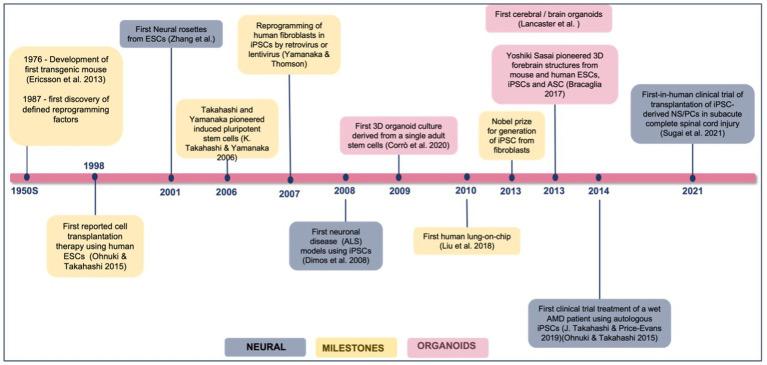
Neurodegenerative diseases are adult-onset neurological conditions that are notoriously difficult to model for drug discovery and development because most models are unable to accurately recapitulate pathology in disease-relevant cells, making it extremely difficult to explore the potential mechanisms underlying neurodegenerative diseases. Therefore, alternative models of human or animal cells have been developed to bridge the gap and allow the impact of new therapeutic strategies to be anticipated more accurately by trying to mimic neuronal and glial cell interactions and many more mechanisms. In tandem with the emergence of human-induced pluripotent stem cells which were first generated in 2007, the accessibility to human-induced pluripotent stem cells (hiPSC) derived from patients can be differentiated into disease-relevant neurons, providing an unrivaled platform for modeling, drug testing, and therapeutic strategy development. The recent development of three-dimensional (3D) brain organoids derived from iPSCs as the best alternative models for the study of the pathological features of neurodegenerative diseases. This review highlights the overview of current iPSC-based disease modeling and recent advances in the development of iPSC models that incorporate neurodegenerative diseases. In addition, a summary of the existing brain organoid-based disease modeling of Alzheimer's disease was presented. We have also discussed the current methodologies of regional specific brain organoids modeled, its potential applications, emphasizing brain organoids as a promising platform for the modeling of patient-specific diseases, the development of personalized therapies, and contributing to the design of ongoing or future clinical trials on organoid technologies.
神经退行性疾病是成年期发病的神经疾病,因其大多数模型无法在与疾病相关的细胞中准确重现病理情况,故而在药物研发中极难建模,这使得探索神经退行性疾病潜在机制极为困难。因此,人们开发了人源或动物细胞的替代模型来弥合差距,并通过尝试模拟神经元和神经胶质细胞的相互作用以及更多机制,更准确地预测新治疗策略的影响。随着2007年首次生成的人诱导多能干细胞的出现,从患者身上获取的人诱导多能干细胞(hiPSC)可分化为与疾病相关的神经元,为疾病建模、药物测试和治疗策略开发提供了无与伦比的平台。最近,源自诱导多能干细胞的三维(3D)脑类器官的发展成为研究神经退行性疾病病理特征的最佳替代模型。本综述重点介绍了当前基于诱导多能干细胞的疾病建模概况以及纳入神经退行性疾病的诱导多能干细胞模型开发的最新进展。此外,还介绍了现有的基于脑类器官的阿尔茨海默病疾病建模总结。我们还讨论了区域特异性脑类器官建模的当前方法、其潜在应用,强调脑类器官作为患者特异性疾病建模、个性化治疗开发的有前景平台,并为正在进行或未来的类器官技术临床试验设计做出贡献。

 Zotero 插件