
我们感觉越糟糕,就越需要紧密团结在一起:一项关于夫妻对多种疾病挑战的情绪共同调节的定性研究。
The worse we feel, the more intensively we need to stick together: a qualitative study of couples' emotional co-regulation of the challenge of multimorbidity.
作者信息
Horn Andrea B, Zimmerli Lukas, Maercker Andreas, Holzer Barbara M
机构信息
CoupleSense: Health and Interpersonal Emotion Regulation Lab, University Research Priority Program "Dynamics of Healthy Aging," University of Zurich, Zurich, Switzerland.
Center of Gerontology, Healthy Longevity Center, University of Zurich, Zurich, Switzerland.
出版信息
Front Psychol. 2023 Aug 11;14:1213927. doi: 10.3389/fpsyg.2023.1213927. eCollection 2023.
INTRODUCTION
Being faced with multimorbidity (i.e., being diagnosed with at least two chronic conditions), is not only demanding in terms of following complicated medical regimes and changing health behaviors. The changes and threats involved also provoke emotional responses in the patients but also in their romantic partners. This study aims at exploring the ways of emotional co-regulation that couples facing multimorbidity express when interviewed together.
METHOD
= 15 opposite sex couples with one multimorbid patient after an acute health crisis that led to hospitalization were asked in a semi-structured interview about how they found ways to deal with the health situation, what they would recommend to other couples in a similar situation, and how they regulated their emotional responses. Interviews were analyzed qualitatively following open, axial, and selective coding, as in the grounded theory framework.
RESULTS
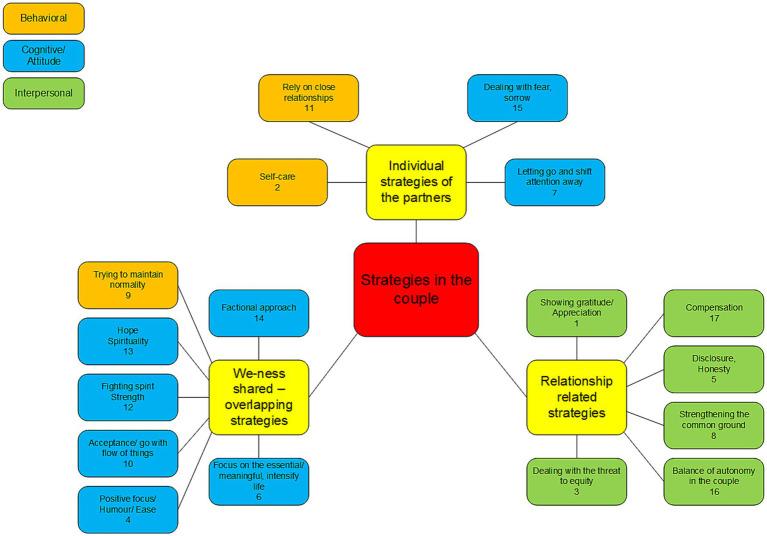
Emerging categories from the romantic partners' and the patients' utterances revealed three main categories: First, (from fighting spirit to fatalism) (construing the couple self as a unit) emerged as higher order factor from the utterances. Second, including strategies aimed at maintaining high relationship quality in spite of the asymmetric situation like strengthening the common ground and balancing autonomy and equity in the couple were often mentioned. Third, some couples mentioned how they benefit from that involve fostering individual resources of the partners outside the couple relationship (such as cultivating relationships with grandchildren or going outdoors to nature).
DISCUSSION
Results underline the importance of a dyadic perspective not only on coping with disease but also on regulating the emotional responses to this shared challenging situation. The utterances of the couples were in line with earlier conceptualizations of interpersonal emotion regulation and dyadic perspectives on we-disease. They broaden the view by integrating the interplay between individual and interpersonal regulation strategies and underline the importance of balancing individual and relational resources when supporting couples faced with chronic diseases.
引言
面对多种疾病(即被诊断患有至少两种慢性病),不仅在遵循复杂的医疗方案和改变健康行为方面要求很高。所涉及的变化和威胁还会引发患者及其浪漫伴侣的情绪反应。本研究旨在探索共同接受访谈时,患有多种疾病的夫妻表达情感共同调节的方式。
方法
对15对异性夫妻进行研究,其中一方患有多种疾病,且经历了导致住院的急性健康危机。通过半结构化访谈询问他们如何找到应对健康状况的方法、他们会向处于类似情况的其他夫妻推荐什么,以及他们如何调节自己的情绪反应。按照扎根理论框架,通过开放编码、轴心编码和选择性编码对访谈进行定性分析。
结果
从浪漫伴侣和患者的话语中浮现出的类别揭示了三个主要类别:第一,(从斗志到宿命论)(将夫妻视为一个整体)从话语中浮现为高阶因素。第二,经常提到一些策略,包括尽管情况不对称,但仍旨在维持高关系质量,如加强共同点以及在夫妻关系中平衡自主性和公平性。第三,一些夫妻提到了他们如何从 中受益,这包括培养夫妻关系之外伴侣的个人资源(例如与孙辈培养关系或到户外亲近自然)。
讨论
结果强调了二元视角不仅在应对疾病方面,而且在调节对这种共同挑战情况的情绪反应方面的重要性。夫妻的话语与人际情绪调节和“我们的疾病”的二元视角的早期概念一致。它们通过整合个体和人际调节策略之间的相互作用拓宽了视野,并强调了在支持患有慢性病的夫妻时平衡个人和关系资源的重要性。
 Zotero 插件