
贝叶斯判别分析定量评估脑卒后手的大鱼际功能
Quantitative assessment of thenar to evaluate hand function after stroke by Bayes discriminant.
机构信息
Department of Ultrasound, Beijing Tiantan Hospital, Capital Medical University, No. 119, South Fourth Ring Road West, Fengtai District, Beijing, 100070, China.
Department of Ultrasound, Baoji City Hospital of Traditional Chinese Medicine, Baoji, China.
出版信息
BMC Musculoskelet Disord. 2023 Aug 29;24(1):682. doi: 10.1186/s12891-023-06789-w.
BACKGROUND
The incidence rate of stroke or cerebrovascular accidents ranks first in China. More than 85% of stroke patients have residual upper limb motor dysfunction, especially hand dysfunction. Normalizing the rehabilitation evaluation process and standard quantitative evaluation method is a complex and key point in rehabilitation therapy. The study aimed to establish a function model based on the Bayes discriminant by measuring the thenar stiffness with shear wave elastography (SWE) to quantitatively evaluate the hand motor function of hemiplegic patients after stroke.
METHODS
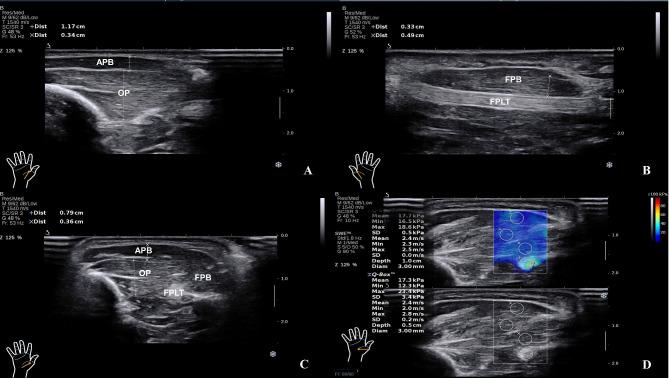
This study collected 60 patients diagnosed with hemiplegia after stroke from October 2021 to October 2022. Therapists used the Brunnstrom assessment (BA)scale to divide the patients into the stage. All the patients underwent the measurement of SWE examination of abductor pollicis brevis (APB), opponens pollicis (OP), flexor pollicis long tendon (FPLT), and flexor pollicis brevis (FPB) by two sonographers. The SWE change rate of four parts of the thenar area was calculated prospectively with the non-hemiplegic side as the reference, the function equation was established by the Bayes discriminant method, and the evaluation model was fitted according to the acquired training set data. Lastly, the model was verified by self-validation, cross-validation, and external data validation methods. The classification performance was evaluated regarding the area under the ROC curve (AUC), sensitivity, and specificity.
RESULTS
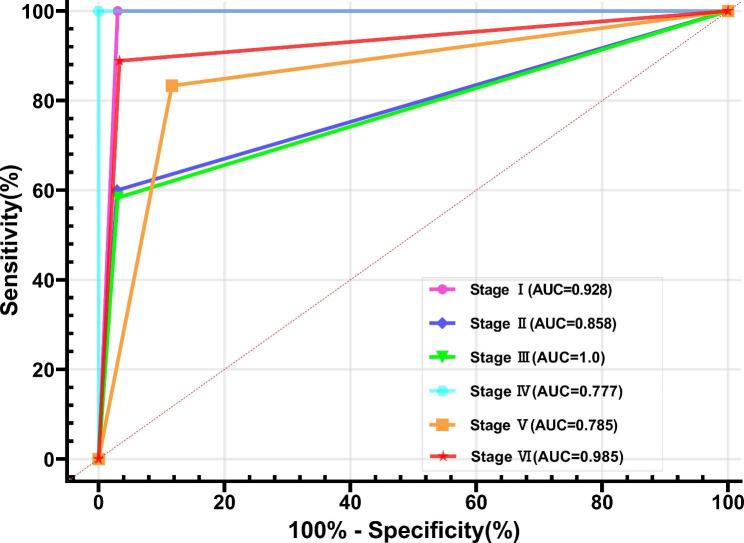
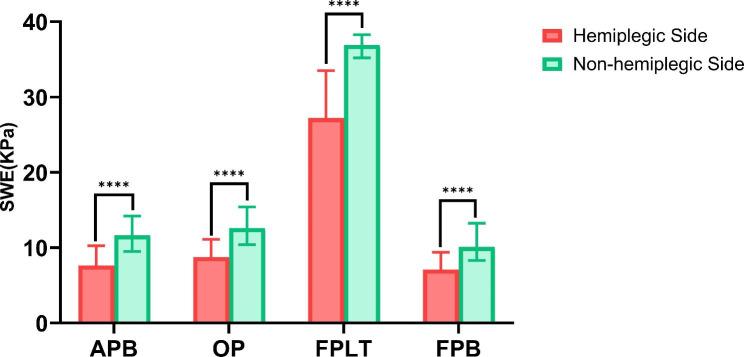
The median SWE values of the hemiplegic side of patients were lower than those of the non-hemiplegic side. According to the BA stage and SWE of APB, OP, FPLT, and FPB, our study established the Bayes discriminative model and validated it via self-validation and cross-validation methods. Then, the discriminant equation was used to validate 18 patients prospectively, the diagnostic coincidence rate was about 78.8%, and the misjudgment rate was approximately 21.2%. The AUC of the discriminant model for diagnosing BA stage I-VI was 0.928(95% CI: 0.839-1.0),0.858(95% CI: 0.748-0.969),1.0(95% CI: 1.0-1.0), 0.777(95% CI: 0.599-0.954),0.785(95% CI: 0.593-0.977) and 0.985(95% CI: 0.959-1.0), respectively.
CONCLUSION
This Bayes discriminant model built by measuring thenar stiffness was of diagnostic value and can provide an objective basis for evaluating clinical rehabilitation.
背景
脑卒中或脑血管意外的发病率在中国位居首位。超过 85%的脑卒中患者存在上肢运动功能障碍,尤其是手部功能障碍。规范康复评估过程和标准的定量评估方法是康复治疗中的一个复杂而关键的问题。本研究旨在通过测量大鱼际的剪切波弹性(SWE)来建立基于贝叶斯判别分析的功能模型,定量评估脑卒中后偏瘫患者手部运动功能。
方法
本研究于 2021 年 10 月至 2022 年 10 月间共收集了 60 例脑卒中后偏瘫患者。治疗师使用 Brunnstrom 评估(BA)量表对患者进行分期。所有患者均由两位超声医师进行 SWE 检查,测量拇短展肌(APB)、对掌肌(OP)、拇长屈肌腱(FPLT)和蚓状肌(FPB)的 SWE 值。前瞻性地计算大鱼际区 4 个部位的 SWE 变化率,以健侧为参考,采用贝叶斯判别法建立功能方程,根据获取的训练集数据拟合评价模型。最后,采用自我验证、交叉验证和外部数据验证方法对模型进行验证。采用受试者工作特征曲线(ROC)下面积(AUC)、灵敏度和特异度评估分类性能。
结果
患者偏瘫侧的 SWE 值中位数低于健侧。根据 BA 分期和 APB、OP、FPLT、FPB 的 SWE 值,本研究建立了贝叶斯判别模型,并通过自我验证和交叉验证方法进行了验证。然后,使用判别方程对 18 例患者进行前瞻性验证,诊断符合率约为 78.8%,误判率约为 21.2%。诊断 BA Ⅰ-Ⅵ期的判别模型 AUC 分别为 0.928(95%CI:0.839-1.0)、0.858(95%CI:0.748-0.969)、1.0(95%CI:1.0-1.0)、0.777(95%CI:0.599-0.954)、0.785(95%CI:0.593-0.977)和 0.985(95%CI:0.959-1.0)。
结论
本研究通过测量大鱼际硬度建立的贝叶斯判别模型具有诊断价值,可为临床康复评估提供客观依据。


 Zotero 插件