
人隐孢子虫(IdA15G1)和小隐孢子虫(Iowa-IIaA17G2R1 和 IIaA18G3R1)体外生长特性的比较。
Comparison of in vitro growth characteristics of Cryptosporidium hominis (IdA15G1) and Cryptosporidium parvum (Iowa-IIaA17G2R1 and IIaA18G3R1).
机构信息
Harry Butler Institute, College of Environmental and Life Sciences, Murdoch University, Murdoch, Western Australia, 6150, Australia.
Centre for Microscopy, Characterisation, and Analysis and School of Biological Sciences, The University of Western Australia, Crawley, Western Australia, 6009, Australia.
出版信息
Parasitol Res. 2023 Dec;122(12):2891-2905. doi: 10.1007/s00436-023-07979-0. Epub 2023 Sep 30.
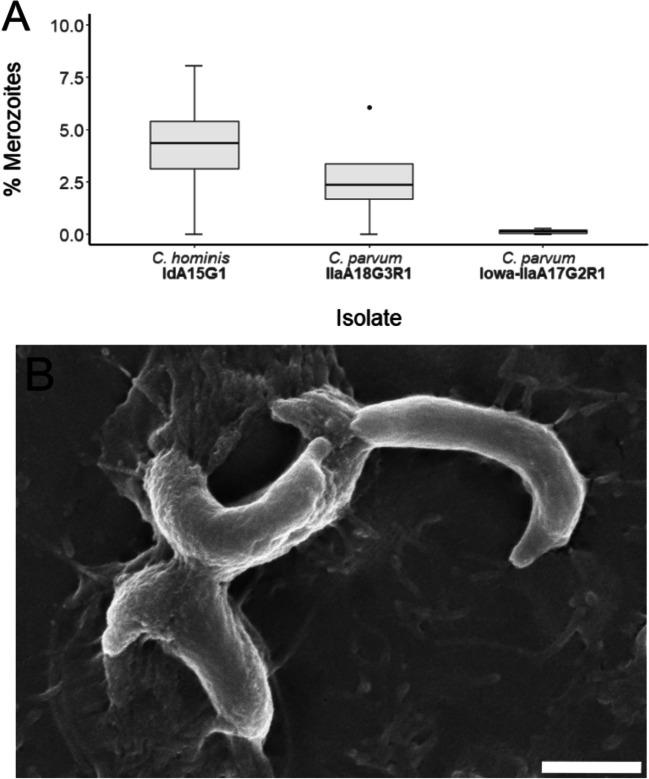
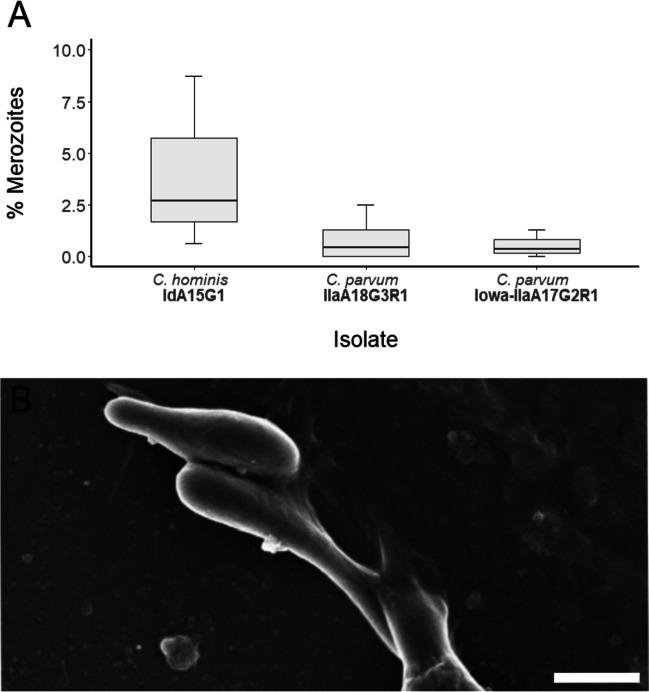
Cryptosporidium is a major cause of diarrhoeal disease and mortality in young children in resource-poor countries, for which no vaccines or adequate therapeutic options are available. Infection in humans is primarily caused by two species: C. hominis and C. parvum. Despite C. hominis being the dominant species infecting humans in most countries, very little is known about its growth characteristics and life cycle in vitro, given that the majority of our knowledge of the in vitro development of Cryptosporidium has been based on C. parvum. In the present study, the growth and development of two C. parvum isolates (subtypes Iowa-IIaA17G2R1 and IIaA18G3R1) and one C. hominis isolate (subtype IdA15G1) in HCT-8 cells were examined and compared at 24 h and 48 h using morphological data acquired with scanning electron microscopy. Our data indicated no significant differences in the proportion of meronts or merozoites between species or subtypes at either time-point. Sexual development was observed at the 48-h time-point across both species through observations of both microgamonts and macrogamonts, with a higher frequency of macrogamont observations in C. hominis (IdA15G1) cultures at 48-h post-infection compared to both C. parvum subtypes. This corresponded to differences in the proportion of trophozoites observed at the same time point. No differences in proportion of microgamonts were observed between the three subtypes, which were rarely observed across all cultures. In summary, our data indicate that asexual development of C. hominis is similar to that of C. parvum, while sexual development is accelerated in C. hominis. This study provides new insights into differences in the in vitro growth characteristics of C. hominis when compared to C. parvum, which will facilitate our understanding of the sexual development of both species.
隐孢子虫是资源匮乏国家幼儿腹泻病和死亡的主要原因,但目前尚无疫苗或足够的治疗方法。人类感染主要由两个种引起:人隐孢子虫和微小隐孢子虫。尽管在大多数国家,人隐孢子虫是人感染的主要种,但由于我们对隐孢子虫体外发育的大部分了解都是基于微小隐孢子虫,因此对其在体外的生长特征和生命周期知之甚少。在本研究中,使用扫描电子显微镜获得的形态学数据,在 24 小时和 48 小时检查和比较了两种微小隐孢子虫分离株(亚型爱荷华-IIaA17G2R1 和 IIaA18G3R1)和一种人隐孢子虫分离株(亚型 IdA15G1)在 HCT-8 细胞中的生长和发育情况。我们的数据表明,在两个时间点,种间或亚型间的裂殖体或裂殖子的比例没有显著差异。在两个种中均观察到了 48 小时时的有性发育,观察到了小配子体和大配子体,在感染后 48 小时的人隐孢子虫(IdA15G1)培养物中观察到大配子体的频率更高,而与两种微小隐孢子虫亚型相比。这与同一时间点观察到的滋养体比例的差异相对应。在三个亚型之间没有观察到小配子体比例的差异,而在所有培养物中很少观察到小配子体。总之,我们的数据表明,人隐孢子虫的无性发育与人隐孢子虫相似,而有性发育在人隐孢子虫中加速。这项研究为人隐孢子虫与人隐孢子虫相比在体外生长特征方面的差异提供了新的见解,这将有助于我们理解两种物种的有性发育。



 Zotero 插件