
CD44v6、STn和O-神经节苷脂GD2:为新型靶向癌症治疗开辟道路的有前景的肿瘤相关抗原。
CD44v6, STn & O-GD2: promising tumor associated antigens paving the way for new targeted cancer therapies.
作者信息
Lodewijk Iris, Dueñas Marta, Paramio Jesus M, Rubio Carolina
机构信息
Biomedical Research Institute I+12, University Hospital "12 de Octubre", Madrid, Spain.
Molecular Oncology Unit, CIEMAT (Centro de Investigaciones Energéticas, Medioambientales y Tecnológicas), Madrid, Spain.
出版信息
Front Immunol. 2023 Oct 3;14:1272681. doi: 10.3389/fimmu.2023.1272681. eCollection 2023.
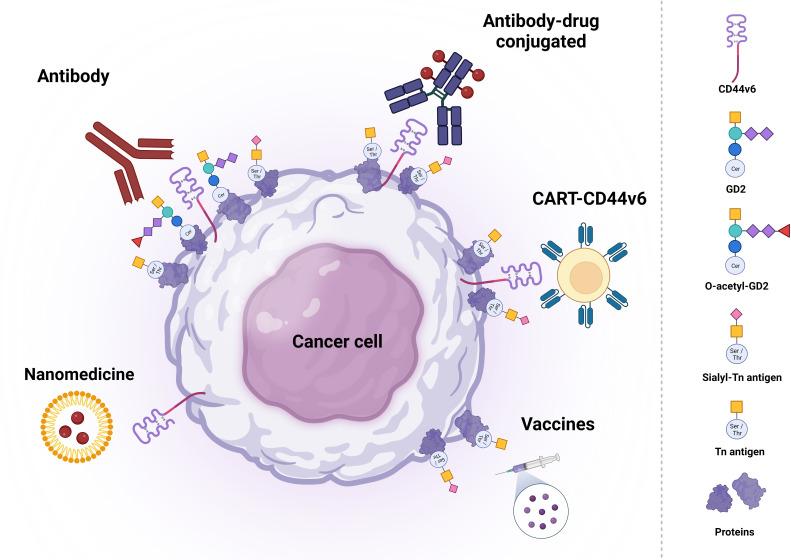
Targeted therapies are the state of the art in oncology today, and every year new Tumor-associated antigens (TAAs) are developed for preclinical research and clinical trials, but few of them really change the therapeutic scenario. Difficulties, either to find antigens that are solely expressed in tumors or the generation of good binders to these antigens, represent a major bottleneck. Specialized cellular mechanisms, such as differential splicing and glycosylation processes, are a good source of neo-antigen expression. Changes in these processes generate surface proteins that, instead of showing decreased or increased antigen expression driven by enhanced mRNA processing, are aberrant in nature and therefore more specific targets to elicit a precise anti-tumor therapy. Here, we present promising TAAs demonstrated to be potential targets for cancer monitoring, targeted therapy and the generation of new immunotherapy tools, such as recombinant antibodies and chimeric antigen receptor (CAR) T cell (CAR-T) or Chimeric Antigen Receptor-Engineered Natural Killer (CAR-NK) for specific tumor killing, in a wide variety of tumor types. Specifically, this review is a detailed update on TAAs CD44v6, STn and O-GD2, describing their origin as well as their current and potential use as disease biomarker and therapeutic target in a diversity of tumor types.
靶向治疗是当今肿瘤学的先进技术,每年都有新的肿瘤相关抗原(TAA)被开发用于临床前研究和临床试验,但其中很少能真正改变治疗局面。无论是寻找仅在肿瘤中表达的抗原,还是生成针对这些抗原的优质结合物,都存在困难,这是一个主要瓶颈。特殊的细胞机制,如差异剪接和糖基化过程,是新抗原表达的良好来源。这些过程的变化产生的表面蛋白,并非由增强的mRNA加工驱动而呈现抗原表达减少或增加,而是本质上异常,因此是引发精确抗肿瘤治疗的更特异性靶点。在此,我们展示了有前景的TAA,它们被证明是癌症监测、靶向治疗以及生成新免疫治疗工具(如重组抗体和嵌合抗原受体(CAR)T细胞(CAR-T)或嵌合抗原受体工程化自然杀伤细胞(CAR-NK)用于特异性肿瘤杀伤)的潜在靶点,适用于多种肿瘤类型。具体而言,本综述是关于TAA CD44v6、STn和O-GD2的详细更新,描述了它们的起源以及在多种肿瘤类型中作为疾病生物标志物和治疗靶点的当前及潜在用途。

 Zotero 插件