
非编码 RNA 在肝细胞癌肿瘤微环境中的作用。
The role of noncoding RNAs in the tumor microenvironment of hepatocellular carcinoma.
机构信息
Laboratory for Noncoding RNA and Cancer, School of Life Sciences, Shanghai University, Shanghai 200444, China.
Department of Geriatrics, Zhongshan Hospital, Fudan University, Shanghai 200032, China.
出版信息
Acta Biochim Biophys Sin (Shanghai). 2023 Nov 25;55(11):1697-1706. doi: 10.3724/abbs.2023231.
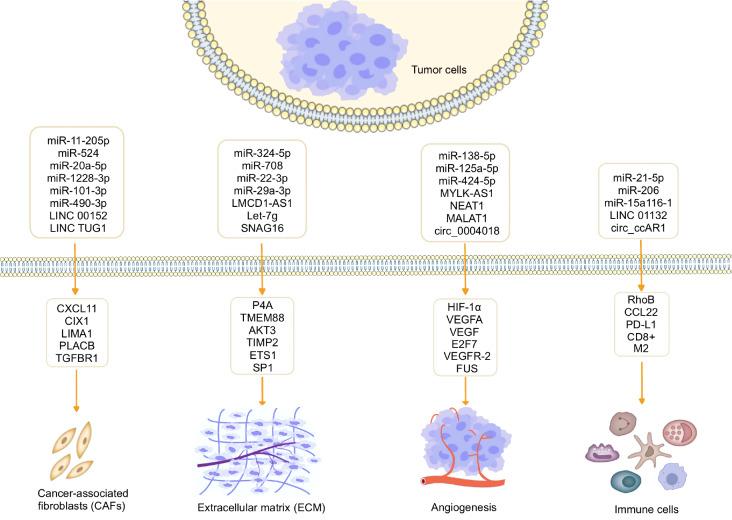
Hepatocellular carcinoma (HCC) is the leading fatal malignancy worldwide. The tumor microenvironment (TME) can affect the survival, proliferation, migration, and even dormancy of cancer cells. Hypoxia is an important component of the TME, and hypoxia-inducible factor-1α (HIF-1α) is the most important transcriptional regulator. Noncoding RNAs (ncRNAs), including microRNAs (miRNAs), long noncoding RNAs (lncRNAs), and circular RNAs (circRNAs), comprise a large part of the human transcriptome and play an important role in regulating the tumorigenesis of HCC. This review discusses the role of ncRNAs in hepatocarcinogenesis, epithelial-mesenchymal transition (EMT), and angiogenesis in a hypoxic microenvironment, as well as the interactions between ncRNAs and key components of the TME. It further discusses their use as biomarkers and the potential clinical value of drugs, as well as the challenges faced in the future.
肝细胞癌(HCC)是全球导致死亡的主要恶性肿瘤。肿瘤微环境(TME)可以影响癌细胞的存活、增殖、迁移,甚至休眠。缺氧是 TME 的重要组成部分,缺氧诱导因子-1α(HIF-1α)是最重要的转录调节因子。非编码 RNA(ncRNA),包括 microRNAs(miRNAs)、长链非编码 RNA(lncRNA)和 circular RNA(circRNA),构成了人类转录组的很大一部分,在调控 HCC 的肿瘤发生中发挥着重要作用。本综述讨论了 ncRNA 在缺氧微环境中促进肝癌发生、上皮-间充质转化(EMT)和血管生成中的作用,以及 ncRNA 与 TME 关键成分之间的相互作用。它还进一步讨论了它们作为生物标志物的潜在临床价值和药物的应用,以及未来面临的挑战。

 Zotero 插件