
脯氨酸脱氢酶氢化物和质子转移机制的计算研究。
Computational insights on the hydride and proton transfer mechanisms of L-proline dehydrogenase.
机构信息
Chemistry Department and Applied Material Chemistry Center (AMCC), Khalifa University, Abu Dhabi, UAE.
出版信息
PLoS One. 2023 Nov 15;18(11):e0290901. doi: 10.1371/journal.pone.0290901. eCollection 2023.
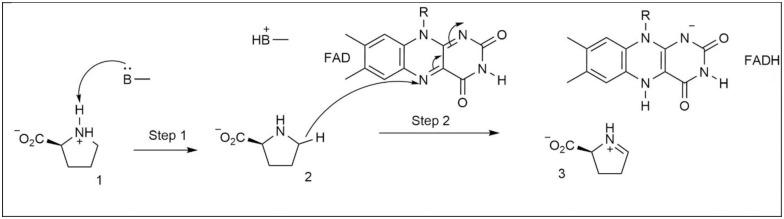
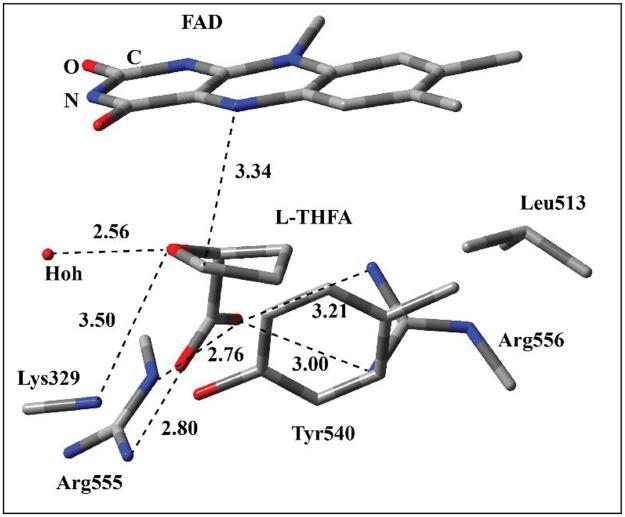
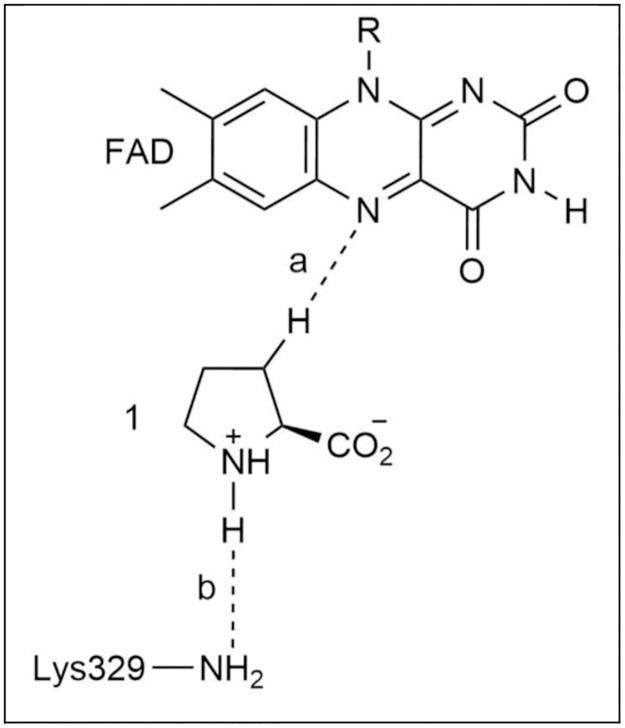
L-Proline dehydrogenase (ProDH) is a flavin-dependent oxidoreductase, which catalyzes the oxidation of L-proline to (S)-1-pyrroline-5-carboxylate. Based on the experimental studies, a stepwise proton and hydride transfer mechanism is supported. According to this mechanism, the amino group of L-proline is deprotonated by a nearby Lys residue, which is followed by the hydride transfer process from C5 position of L-proline to N5 position of isoalloxazine ring of FAD. It was concluded that the hydride transfer step is rate limiting in the reductive half-reaction, however, in the overall reaction, the oxidation of FAD is the rate limiting step. In this study, we performed a computational mechanistic investigation based on ONIOM method to elucidate the mechanism of the reductive half-reaction corresponding to the oxidation of L-proline into iminoproline. Our calculations support the stepwise mechanism in which the deprotonation occurs initially as a fast step as result of a proton transfer from L-proline to the Lys residue. Subsequently, a hydride ion transfers from L-proline to FAD with a higher activation barrier. The enzyme-product complex showed a strong interaction between reduced FAD and iminoproline, which might help to explain why a step in the oxidative half-reaction is rate-limiting.
L-脯氨酸脱氢酶(ProDH)是一种黄素依赖性氧化还原酶,它催化 L-脯氨酸氧化为(S)-1-吡咯啉-5-羧酸。基于实验研究,支持逐步质子和氢转移机制。根据该机制,L-脯氨酸的氨基被附近的赖氨酸残基去质子化,随后发生 L-脯氨酸 C5 位置到 FAD 异咯嗪环 N5 位置的氢转移过程。结论是氢转移步骤是还原半反应中的限速步骤,然而,在整个反应中,FAD 的氧化是限速步骤。在这项研究中,我们基于 ONIOM 方法进行了计算机制研究,以阐明对应于 L-脯氨酸氧化成亚氨基脯氨酸的还原半反应的机制。我们的计算支持逐步机制,其中去质子化最初作为快速步骤发生,是由于质子从 L-脯氨酸转移到赖氨酸残基。随后,氢离子从 L-脯氨酸向 FAD 转移,需要更高的活化能垒。酶-产物复合物显示还原 FAD 和亚氨基脯氨酸之间的强相互作用,这可能有助于解释为什么氧化半反应中的一个步骤是限速的。



 Zotero 插件