
酶对氨基酸的识别驱动了原始遗传密码的进化。
Enzymic recognition of amino acids drove the evolution of primordial genetic codes.
机构信息
Department of Physics, The University of Auckland, New Zealand.
Centre for Computational Evolution, The University of Auckland, New Zealand.
出版信息
Nucleic Acids Res. 2024 Jan 25;52(2):558-571. doi: 10.1093/nar/gkad1160.
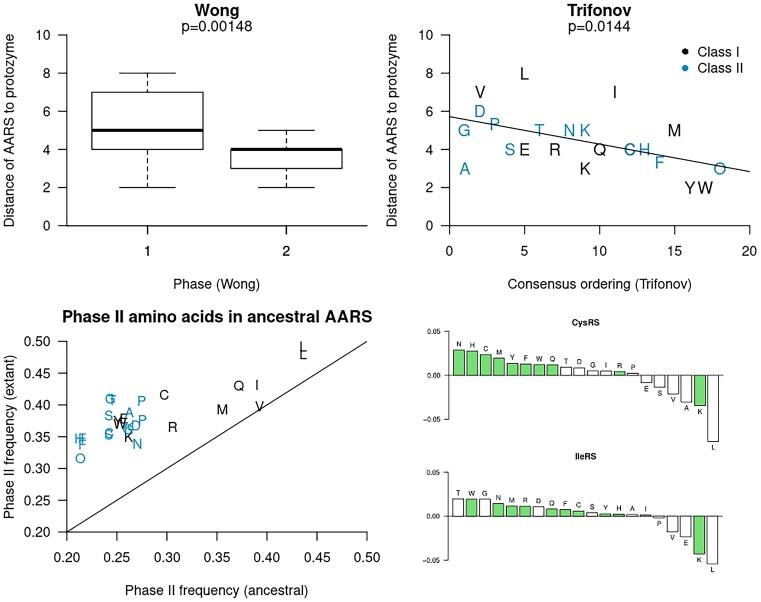
How genetic information gained its exquisite control over chemical processes needed to build living cells remains an enigma. Today, the aminoacyl-tRNA synthetases (AARS) execute the genetic codes in all living systems. But how did the AARS that emerged over three billion years ago as low-specificity, protozymic forms then spawn the full range of highly-specific enzymes that distinguish between 22 diverse amino acids? A phylogenetic reconstruction of extant AARS genes, enhanced by analysing modular acquisitions, reveals six AARS with distinct bacterial, archaeal, eukaryotic, or organellar clades, resulting in a total of 36 families of AARS catalytic domains. Small structural modules that differentiate one AARS family from another played pivotal roles in discriminating between amino acid side chains, thereby expanding the genetic code and refining its precision. The resulting model shows a tendency for less elaborate enzymes, with simpler catalytic domains, to activate amino acids that were not synthesised until later in the evolution of the code. The most probable evolutionary route for an emergent amino acid type to establish a place in the code was by recruiting older, less specific AARS, rather than adapting contemporary lineages. This process, retrofunctionalisation, differs from previously described mechanisms through which amino acids would enter the code.
遗传信息如何对构建活细胞所需的化学过程进行精细控制,仍然是一个谜。如今,氨酰-tRNA 合成酶(AARS)在所有生命系统中执行遗传密码。但是,在 30 多亿年前,AARS 是如何从低特异性、原始酶形式演变成能够区分 22 种不同氨基酸的高度特异性酶的呢?通过分析模块获取,对现存 AARS 基因进行系统发育重建,揭示了 6 种具有独特细菌、古菌、真核生物或细胞器进化枝的 AARS,从而产生了总共 36 种 AARS 催化结构域家族。区分不同 AARS 家族的小结构模块在区分氨基酸侧链方面发挥了关键作用,从而扩展了遗传密码并提高了其精度。由此产生的模型表明,与激活后来在遗传密码进化过程中合成的氨基酸的更复杂的酶相比,不太复杂的酶具有更简单的催化结构域。新兴氨基酸类型在密码子中确立位置的最可能的进化途径是招募更古老、特异性更低的 AARS,而不是适应当代谱系。这个过程,称为 retrofunctionalisation,与以前描述的氨基酸进入密码子的机制不同。


 Zotero 插件