
等待时间和延迟治疗对肝细胞癌患者预后的影响:一项系统评价和荟萃分析。
The impact of waiting time and delayed treatment on the outcomes of patients with hepatocellular carcinoma: A systematic review and meta-analysis.
作者信息
Cheo Feng Yi, Lim Celeste Hong Fei, Chan Kai Siang, Shelat Vishal Girishchandra
机构信息
Yong Loo Lin School of Medicine, National University of Singapore, Singapore.
Department of General Surgery, Tan Tock Seng Hospital, Singapore.
出版信息
Ann Hepatobiliary Pancreat Surg. 2024 Feb 29;28(1):1-13. doi: 10.14701/ahbps.23-090. Epub 2023 Dec 14.
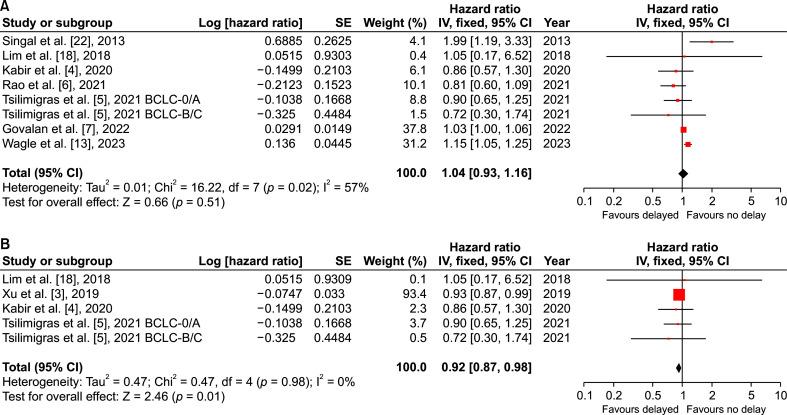
Hepatocellular carcinoma (HCC) is the sixth most diagnosed cancer worldwide. Healthcare resource constraints may predispose treatment delays. We aim to review existing literature on whether delayed treatment results in worse outcomes in HCC. PubMed, Embase, The Cochrane Library, and Scopus were systematically searched from inception till December 2022. Primary outcomes were overall survival (OS) and disease-free survival (DFS). Secondary outcomes included post-treatment mortality, readmission rates, and complications. Fourteen studies with a total of 135,389 patients (delayed n = 25,516, no delay n = 109,873) were included. Age, incidence of male patients, Child-Pugh B cirrhosis, and Barcelona Clinic Liver Cancer Stage 0/A HCC were comparable between delayed and no delay groups. Tumor size was significantly smaller in delayed versus no delay group (mean difference, -0.70 cm; 95% confidence interval [CI]: -1.14, 0.26; = 0.002). More patients received radiofrequency ablation in delayed versus no delay group (OR, 1.22; 95% CI: 1.16, 1.27; < 0.0001). OS was comparable between delayed and no delay in HCC treatment (hazard ratio [HR], 1.13; 95% CI: 0.99, 1.29; = 0.07). Comparable DFS between delayed and no delay groups (HR, 0.99; 95% CI: 0.75, 1.30; = 0.95) was observed. Subgroup analysis of studies that defined treatment delay as > 90 days showed comparable OS in the delayed group (HR, 1.04; 95% CI: 0.93, 1.16; = 0.51). OS and DFS for delayed treatment were non-inferior compared to no delay, but might be due to better tumor biology/smaller tumor size in the delayed group.
肝细胞癌(HCC)是全球第六大最常被诊断出的癌症。医疗资源限制可能导致治疗延迟。我们旨在回顾现有文献,探讨延迟治疗是否会导致HCC患者出现更差的预后。从数据库建立至2022年12月,我们对PubMed、Embase、Cochrane图书馆和Scopus进行了系统检索。主要结局指标为总生存期(OS)和无病生存期(DFS)。次要结局指标包括治疗后死亡率、再入院率和并发症。纳入了14项研究,共135,389例患者(延迟治疗组n = 25,516,未延迟治疗组n = 109,873)。延迟治疗组和未延迟治疗组在年龄、男性患者发病率、Child-Pugh B级肝硬化以及巴塞罗那临床肝癌分期0/A期HCC方面具有可比性。延迟治疗组的肿瘤大小显著小于未延迟治疗组(平均差值,-0.70 cm;95%置信区间[CI]:-1.14,0.26;P = 0.002)。与未延迟治疗组相比,延迟治疗组接受射频消融治疗的患者更多(比值比[OR],1.22;95% CI:1.16,1.27;P < 0.0001)。HCC治疗中延迟治疗组和未延迟治疗组的OS具有可比性(风险比[HR],1.13;95% CI:0.99,1.29;P = 0.07)。观察到延迟治疗组和未延迟治疗组的DFS具有可比性(HR,0.99;95% CI:0.75,1.30;P = 0.95)。将治疗延迟定义为> 90天的研究的亚组分析显示,延迟治疗组中的OS具有可比性(HR,1.04;95% CI:0.93,1.16;P = 0.51)。延迟治疗的OS和DFS与未延迟治疗相比并非劣效,但这可能是由于延迟治疗组中肿瘤生物学特性更好/肿瘤尺寸更小。


 Zotero 插件