
系统综述室内外空气中的微塑料和纳米塑料:确定量化人体吸入暴露的框架和数据需求。
Systematic review of microplastics and nanoplastics in indoor and outdoor air: identifying a framework and data needs for quantifying human inhalation exposures.
机构信息
Gangarosa Department of Environmental Health, Rollins School of Public Health of Emory University, Atlanta, GA, USA.
Agency of Toxic Substances and Disease Registry, Office of Innovation and Analytics, Atlanta, GA, USA.
出版信息
J Expo Sci Environ Epidemiol. 2024 Mar;34(2):185-196. doi: 10.1038/s41370-023-00634-x. Epub 2024 Jan 6.
BACKGROUND
Humans are likely exposed to microplastics (MPs) in a variety of places including indoor and outdoor air. Research to better understand how exposure to MPs correlates to health is growing. To fully understand the possible impacts of MPs on human health, it is necessary to quantify MP exposure and identify what critical data gaps exist.
OBJECTIVES
The current paper provides a human exposure assessment of microplastics in the air using systematically reviewed literature that provided concentration of MPs in air as well as doses used in toxicology studies to calculate inhalation exposure dose.
METHODS
All published peer-reviewed journal articles, non-published papers, and grey literature that focused on micro- or nano-plastics in indoor and outdoor air were systematically searched using PRISMA guidelines. Literature that defined specific concentrations and size of MPs in air or exposed to human lung cells, animals, or humans with measurable health impacts were included in data extraction. Inhalational exposures were calculated for different age groups using published MP concentrations from the included literature using exposure dose equations and values from U.S. ATSDR and EPA.
RESULTS
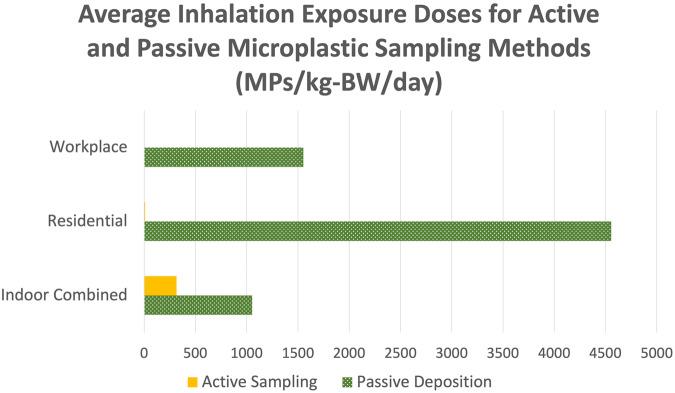
Calculated mean indoor inhalational exposures from passive sampling methods were higher than those calculated from active sampling methods. When comparing indoor and outdoor sampling, calculated inhalation exposures from indoor samples were greater than those from outdoor samples. Inhalation exposures of MPs differed between age groups with infants having the highest calculated dose values for all locations followed by preschool age children, middle-school aged children, pregnant women, adolescents, and non-pregnant adults. MP doses used in toxicology studies produced higher calculated mean inhalational exposures than those from environmental samples.
IMPACT
This study is the first known systematic review of inhalational MP exposure from indoor and outdoor air. It also provides inhalational exposures calculated from previously published environmental samples of MPs as well as from toxicology studies.
背景
人类可能会在各种场所接触到微塑料(MPs),包括室内和室外空气。为了更好地了解接触 MPs 与健康之间的关联,相关研究正在不断增加。为了全面了解 MPs 对人类健康的潜在影响,有必要量化 MP 暴露量并确定存在哪些关键数据缺口。
目的
本研究通过系统综述文献,评估空气中微塑料的人体暴露量,这些文献提供了空气中 MPs 的浓度以及毒理学研究中使用的剂量,以计算吸入暴露剂量。
方法
本研究采用 PRISMA 指南,系统检索了所有已发表的同行评议期刊文章、未发表的论文和灰色文献,这些文献都集中探讨了室内和室外空气中的微塑料或纳米塑料。纳入文献中必须明确界定了空气中 MPs 的具体浓度和粒径,或暴露于人类肺细胞、动物或具有可衡量健康影响的人类,且这些研究必须有相关数据可用于提取。本研究使用纳入文献中的 MP 浓度,通过暴露剂量方程和美国 ATSDR 和 EPA 的数值,为不同年龄组计算了不同的吸入暴露量。
结果
采用被动采样方法计算得出的室内平均吸入暴露量高于采用主动采样方法计算出的暴露量。在比较室内和室外采样时,室内样本的吸入暴露量大于室外样本的暴露量。不同年龄组的 MPs 吸入暴露量存在差异,所有地点的婴儿计算出的剂量值最高,其次是学龄前儿童、中学生、孕妇、青少年和非孕妇成年人。毒理学研究中使用的 MPs 剂量比环境样本计算出的平均吸入暴露量更高。
结论
这是第一项针对室内和室外空气微塑料吸入暴露的系统综述,它还提供了从先前发表的环境 MPs 样本和毒理学研究中计算出的吸入暴露量。


 Zotero 插件