
MRE11 在肿瘤发生过程中使 cGAS 从核小体隔离中释放出来。
MRE11 liberates cGAS from nucleosome sequestration during tumorigenesis.
机构信息
Lineberger Comprehensive Cancer Center, University of North Carolina at Chapel Hill, Chapel Hill, NC, USA.
UNC MD-PhD Program, University of North Carolina at Chapel Hill School of Medicine, Chapel Hill, NC, USA.
出版信息
Nature. 2024 Jan;625(7995):585-592. doi: 10.1038/s41586-023-06889-6. Epub 2024 Jan 10.
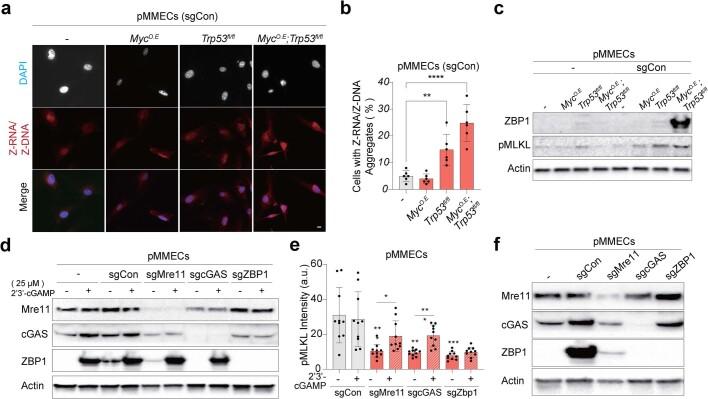
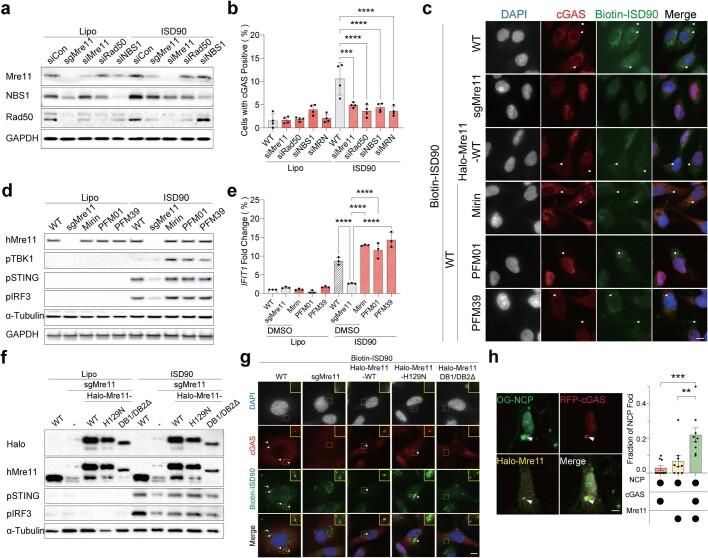
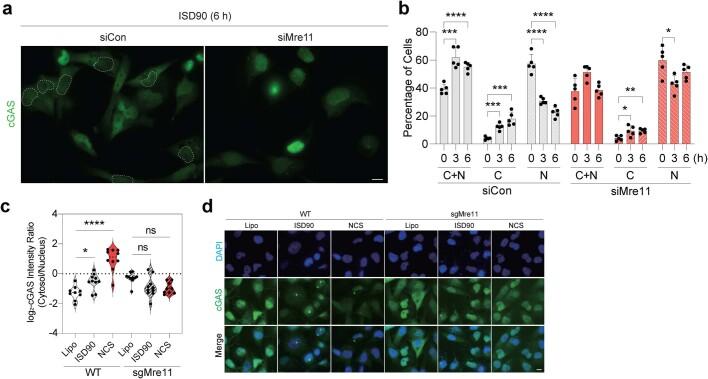
Oncogene-induced replication stress generates endogenous DNA damage that activates cGAS-STING-mediated signalling and tumour suppression. However, the precise mechanism of cGAS activation by endogenous DNA damage remains enigmatic, particularly given that high-affinity histone acidic patch (AP) binding constitutively inhibits cGAS by sterically hindering its activation by double-stranded DNA (dsDNA). Here we report that the DNA double-strand break sensor MRE11 suppresses mammary tumorigenesis through a pivotal role in regulating cGAS activation. We demonstrate that binding of the MRE11-RAD50-NBN complex to nucleosome fragments is necessary to displace cGAS from acidic-patch-mediated sequestration, which enables its mobilization and activation by dsDNA. MRE11 is therefore essential for cGAS activation in response to oncogenic stress, cytosolic dsDNA and ionizing radiation. Furthermore, MRE11-dependent cGAS activation promotes ZBP1-RIPK3-MLKL-mediated necroptosis, which is essential to suppress oncogenic proliferation and breast tumorigenesis. Notably, downregulation of ZBP1 in human triple-negative breast cancer is associated with increased genome instability, immune suppression and poor patient prognosis. These findings establish MRE11 as a crucial mediator that links DNA damage and cGAS activation, resulting in tumour suppression through ZBP1-dependent necroptosis.
癌基因诱导的复制应激产生内源性 DNA 损伤,激活 cGAS-STING 介导的信号转导和肿瘤抑制。然而,内源性 DNA 损伤激活 cGAS 的精确机制仍然是个谜,特别是考虑到高亲和力组蛋白酸性斑(AP)结合通过空间位阻抑制 cGAS 被双链 DNA(dsDNA)激活。在这里,我们报告 DNA 双链断裂传感器 MRE11 通过在调节 cGAS 激活方面的关键作用抑制乳腺肿瘤发生。我们证明,MRE11-RAD50-NBN 复合物与核小体片段的结合对于将 cGAS 从酸性斑介导的隔离中置换出来是必需的,这使其能够被 dsDNA 动员和激活。因此,MRE11 对于 cGAS 对致癌应激、细胞质 dsDNA 和电离辐射的激活是必不可少的。此外,MRE11 依赖性 cGAS 激活促进 ZBP1-RIPK3-MLKL 介导的坏死,这对于抑制致癌增殖和乳腺肿瘤发生至关重要。值得注意的是,人三阴性乳腺癌中 ZBP1 的下调与基因组不稳定性增加、免疫抑制和患者预后不良有关。这些发现确立了 MRE11 作为一种关键的调节剂,它将 DNA 损伤和 cGAS 激活联系起来,通过 ZBP1 依赖性坏死导致肿瘤抑制。




 Zotero 插件