
鼠疫耶尔森菌可有效抑制3型分泌系统诱导白细胞合成白三烯B4的过程,从而逃避早期免疫识别。
Type 3 secretion system induced leukotriene B4 synthesis by leukocytes is actively inhibited by Yersinia pestis to evade early immune recognition.
作者信息
Brady Amanda, Sheneman Katelyn R, Pulsifer Amanda R, Price Sarah L, Garrison Taylor M, Maddipati Krishna Rao, Bodduluri Sobha R, Pan Jianmin, Boyd Nolan L, Zheng Jing-Juan, Rai Shesh N, Hellmann Jason, Haribabu Bodduluri, Uriarte Silvia M, Lawrenz Matthew B
机构信息
Department of Microbiology and Immunology, University of Louisville School of Medicine, Louisville, Kentucky, United States of America.
Department of Pathology, Lipidomics Core Facility, Wayne State University, Detroit, Michigan, United States of America.
出版信息
PLoS Pathog. 2024 Jan 25;20(1):e1011280. doi: 10.1371/journal.ppat.1011280. eCollection 2024 Jan.
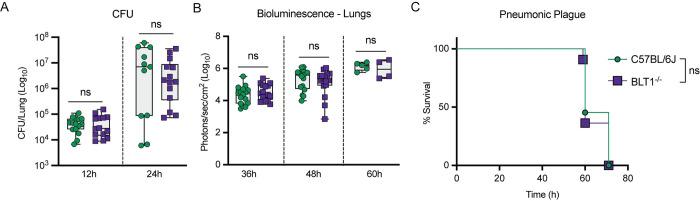
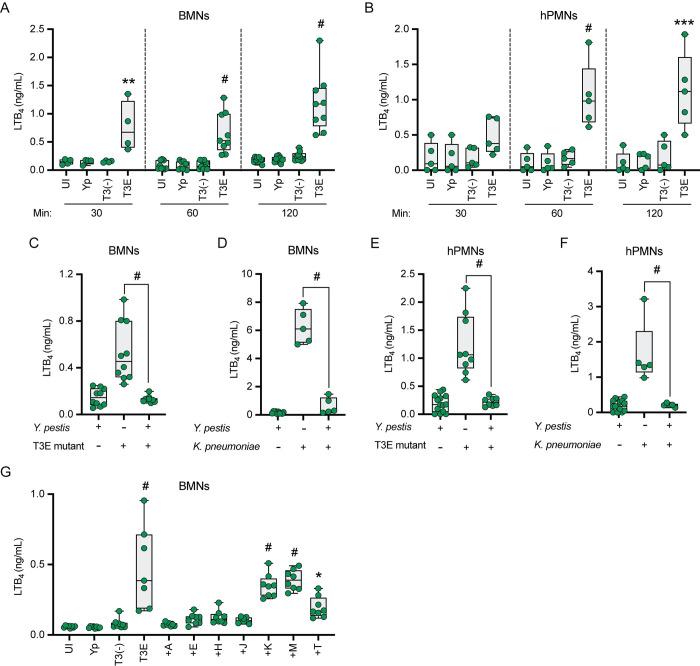
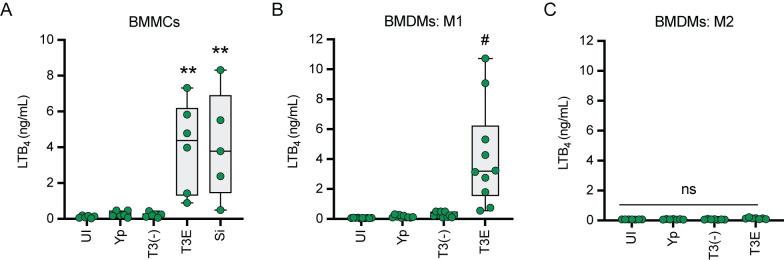
Subverting the host immune response to inhibit inflammation is a key virulence strategy of Yersinia pestis. The inflammatory cascade is tightly controlled via the sequential action of lipid and protein mediators of inflammation. Because delayed inflammation is essential for Y. pestis to cause lethal infection, defining the Y. pestis mechanisms to manipulate the inflammatory cascade is necessary to understand this pathogen's virulence. While previous studies have established that Y. pestis actively inhibits the expression of host proteins that mediate inflammation, there is currently a gap in our understanding of the inflammatory lipid mediator response during plague. Here we used the murine model to define the kinetics of the synthesis of leukotriene B4 (LTB4), a pro-inflammatory lipid chemoattractant and immune cell activator, within the lungs during pneumonic plague. Furthermore, we demonstrated that exogenous administration of LTB4 prior to infection limited bacterial proliferation, suggesting that the absence of LTB4 synthesis during plague contributes to Y. pestis immune evasion. Using primary leukocytes from mice and humans further revealed that Y. pestis actively inhibits the synthesis of LTB4. Finally, using Y. pestis mutants in the Ysc type 3 secretion system (T3SS) and Yersinia outer protein (Yop) effectors, we demonstrate that leukocytes recognize the T3SS to initiate the rapid synthesis of LTB4. However, several Yop effectors secreted through the T3SS effectively inhibit this host response. Together, these data demonstrate that Y. pestis actively inhibits the synthesis of the inflammatory lipid LTB4 contributing to the delay in the inflammatory cascade required for rapid recruitment of leukocytes to sites of infection.
颠覆宿主免疫反应以抑制炎症是鼠疫耶尔森菌的关键毒力策略。炎症级联反应通过脂质和蛋白质炎症介质的顺序作用受到严格控制。由于延迟炎症对于鼠疫耶尔森菌引起致命感染至关重要,因此确定鼠疫耶尔森菌操纵炎症级联反应的机制对于理解该病原体的毒力是必要的。虽然先前的研究已经证实鼠疫耶尔森菌会积极抑制介导炎症的宿主蛋白的表达,但目前我们对鼠疫期间炎症脂质介质反应的理解仍存在空白。在这里,我们使用小鼠模型来确定在肺鼠疫期间肺内促炎脂质趋化因子和免疫细胞激活剂白三烯B4(LTB4)合成的动力学。此外,我们证明在感染前外源性给予LTB4可限制细菌增殖,这表明鼠疫期间LTB4合成的缺失有助于鼠疫耶尔森菌的免疫逃避。使用来自小鼠和人类的原代白细胞进一步揭示,鼠疫耶尔森菌会积极抑制LTB4的合成。最后,使用Ⅲ型分泌系统(T3SS)和耶尔森菌外膜蛋白(Yop)效应蛋白中的鼠疫耶尔森菌突变体,我们证明白细胞识别T3SS以启动LTB4的快速合成。然而,通过T3SS分泌的几种Yop效应蛋白有效地抑制了这种宿主反应。总之,这些数据表明鼠疫耶尔森菌会积极抑制炎症脂质LTB4的合成,这导致炎症级联反应延迟,而炎症级联反应是白细胞快速募集到感染部位所必需的。





 Zotero 插件