
3级脑膜瘤的分子预后评估及用于预测状态的p16/MTAP免疫组化分析
Molecular prognostication in grade 3 meningiomas and p16/MTAP immunohistochemistry for predicting status.
作者信息
Tosefsky Kira, Martin Karina Chornenka, Rebchuk Alexander D, Wang Justin Z, Nassiri Farshad, Lum Amy, Zadeh Gelareh, Makarenko Serge, Yip Stephen
机构信息
MD Undergraduate Program, Faculty of Medicine, University of British Columbia, Vancouver, British Columbia, Canada.
Department of Pathology and Laboratory Medicine, Faculty of Medicine, University of British Columbia, Vancouver, British Columbia, Canada.
出版信息
Neurooncol Adv. 2024 Jan 8;6(1):vdae002. doi: 10.1093/noajnl/vdae002. eCollection 2024 Jan-Dec.
BACKGROUND
The World Health Organization 2021 classification introduces molecular grading criteria for anaplastic meningiomas, including promoter () mutations and homozygous deletion. Additional adverse prognostic factors include H3K27me3 and BAP1 loss. The aim of this study was to explore whether these molecular alterations stratified clinical outcomes in a single-center cohort of grade 3 meningiomas. Additionally, we examined whether p16 and MTAP immunohistochemistry can predict status.
METHODS
Clinical and histopathological information was obtained from the electronic medical records of grade 3 meningiomas resected at a tertiary center between 2007 and 2020. Molecular testing for mutations and copy-number status, methylation profiling, and immunohistochemistry for H3K27me3, BAP1, p16, and methylthioadenosine phosphorylase (MTAP) were performed. Predictors of survival were identified by Cox regression.
RESULTS
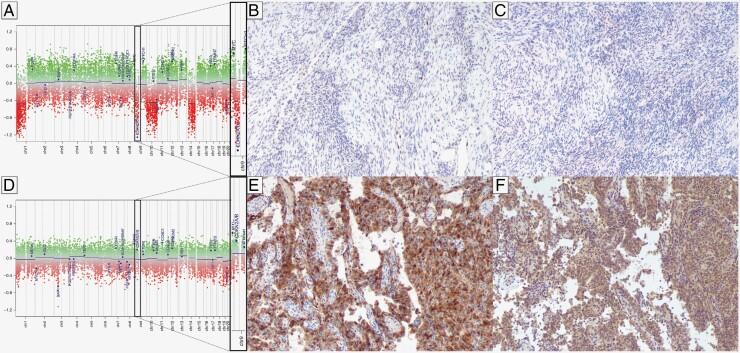
Eight of 15 cases demonstrated elevated mitotic index (≥20 mitoses per 10 consecutive high-power fields), 1 tumor exhibited BAP1 loss, 4 harbored mutations, and 3 demonstrated homozygous deletion. Meningiomas with mutations and/or homozygous deletion showed significantly reduced survival compared to anaplastic meningiomas with elevated mitotic index alone. Immunohistochemical loss of p16 and MTAP demonstrated high sensitivity (67% and 100%, respectively) and specificity (100% and 100%, respectively) for predicting status.
CONCLUSIONS
Molecular alterations of grade 3 meningiomas stratify clinical outcomes more so than histologic features alone. Immunohistochemical loss of p16 and MTAP show promise in predicting status.
背景
世界卫生组织2021年分类引入了间变性脑膜瘤的分子分级标准,包括启动子()突变和纯合缺失。其他不良预后因素包括H3K27me3和BAP1缺失。本研究的目的是探讨这些分子改变是否能在三级中心的3级脑膜瘤单中心队列中对临床结局进行分层。此外,我们还研究了p16和MTAP免疫组化是否能预测状态。
方法
从2007年至2020年在一家三级中心切除的3级脑膜瘤的电子病历中获取临床和组织病理学信息。进行了突变和拷贝数状态的分子检测、甲基化分析以及H3K27me3、BAP1、p16和甲硫腺苷磷酸化酶(MTAP)的免疫组化检测。通过Cox回归确定生存预测因素。
结果
15例中有8例显示有丝分裂指数升高(每10个连续高倍视野中≥20个有丝分裂),1例肿瘤显示BAP1缺失,4例有突变,3例显示纯合缺失。与仅伴有有丝分裂指数升高的间变性脑膜瘤相比,伴有突变和/或纯合缺失的脑膜瘤生存率显著降低。p16和MTAP的免疫组化缺失对预测状态显示出高敏感性(分别为67%和100%)和特异性(分别为100%和100%)。
结论
3级脑膜瘤的分子改变比单独的组织学特征更能对临床结局进行分层。p16和MTAP的免疫组化缺失在预测状态方面显示出前景。



 Zotero 插件